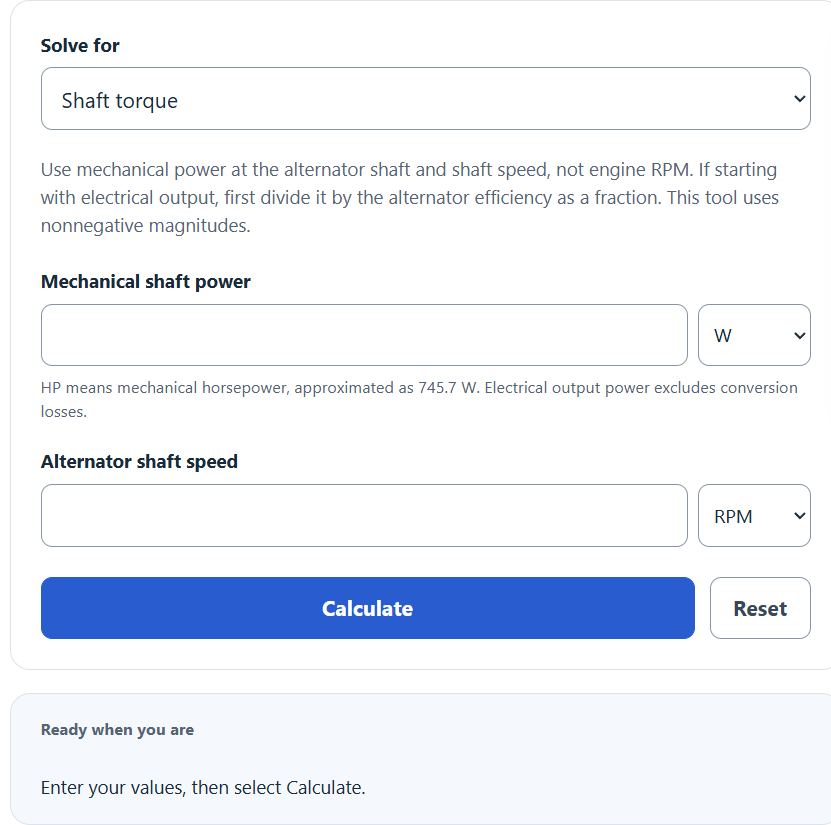
Select mechanical shaft power, shaft speed, or shaft torque to solve for, then enter the other two values in W, kW, HP, RPM, rad/s, N-m, or lb-ft with step-by-step results.
- All Automotive Calculators
- Alternator Pulley Ratio Calculator
- Electric Motor Torque Calculator
- Nm to Ft-Lbs Torque Conversion Calculator
- Power to Torque Calculator
- RPM to Torque Calculator
- Torque to Power Calculator
Alternator Torque Formula
The alternator torque calculation is based on the relationship between mechanical power, rotational speed, and torque. The calculator converts all inputs to base units first: watts for power, RPM for speed, and newton-meters for torque.
- T = alternator torque in newton-meters, N-m
- P = mechanical shaft power in watts, W
- RPM = alternator speed in revolutions per minute
- pi = 3.14159265
To calculate power instead of torque, the calculator rearranges the same relationship:
To calculate speed instead of torque, the calculator uses:
- Torque mode: enter power and speed to find the shaft torque required to drive the alternator.
- Power mode: enter torque and speed to find the mechanical power being transferred.
- Speed mode: enter power and torque to find the alternator speed needed for that power level.
The calculator also supports unit conversions. Power can be entered in W, kW, or HP. Speed can be entered in RPM or rad/s. Torque can be entered in N-m or lb-ft.
Common Alternator Unit Conversions
These conversions are useful when checking the result or comparing it with equipment ratings.
| Quantity | Conversion | Used by calculator |
|---|---|---|
| Power | 1 kW = 1000 W | Yes |
| Power | 1 HP = 745.7 W | Yes |
| Speed | 1 rad/s ≈ 9.5493 RPM | Yes |
| Torque | 1 lbf-ft ≈ 1.355817948 N-m | Yes |
| Torque | 1 N-m ≈ 0.737562 lbf-ft | Yes |
Torque Examples at Selected Mechanical Power and Speed Values
| Power | Speed | Approx. Torque |
|---|---|---|
| 1 kW | 1500 RPM | 6.37 N-m |
| 2 kW | 1800 RPM | 10.61 N-m |
| 5 kW | 3000 RPM | 15.92 N-m |
| 10 kW | 3600 RPM | 26.53 N-m |
Example Calculations
Example 1: Calculate alternator torque
The mechanical input at the alternator shaft is 5 kW at 3000 RPM. Find the shaft torque.
The required alternator torque is about 15.92 N-m.
Example 2: Calculate alternator power
You have 20 N-m of torque at 1800 RPM. Find the power.
The mechanical shaft power is about 3769.91 W, or 3.77 kW.
FAQ
Does this calculate electrical output torque or shaft torque?
This calculation gives the mechanical shaft torque associated with the entered power and speed. If you enter electrical output power, the result does not include alternator losses unless you adjust the power for efficiency. For example, if an alternator is 80% efficient and delivers 4 kW electrically, the required mechanical input power is 4 kW / 0.80 = 5 kW.
Why does torque decrease when RPM increases for the same power?
Power depends on both torque and rotational speed. For a fixed power value, a higher RPM means the same work is being delivered over more revolutions per minute, so less torque is needed per revolution. A lower RPM requires more torque to produce the same power.
Can I use horsepower instead of watts?
Yes. Select HP in the power unit dropdown. The calculator converts horsepower to watts using 1 HP = 745.7 W, performs the calculation, and displays solved power in watts with kW and HP equivalents.