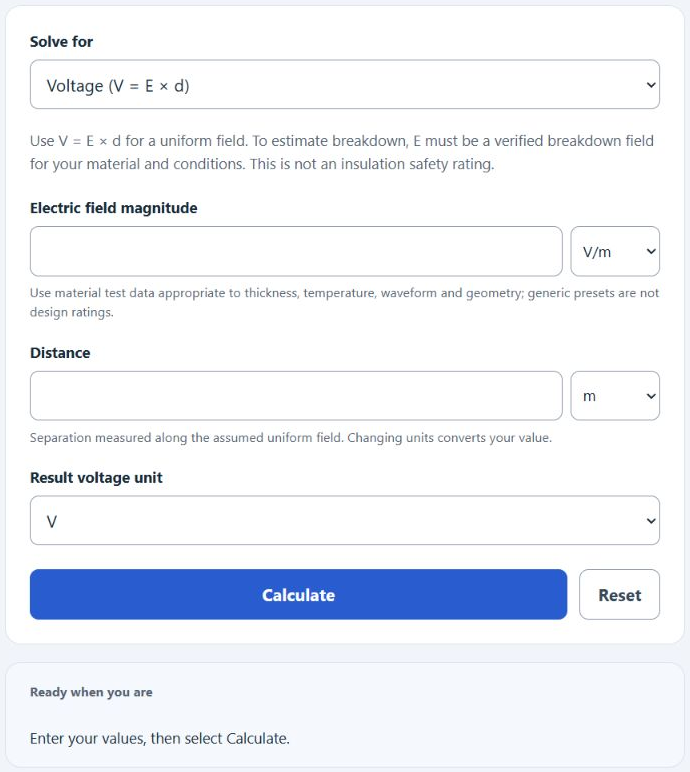
Choose voltage, field or distance for the uniform-field relationship, or choose Paschen’s Law for a gas estimate using verified coefficients, absolute pressure, gap and gamma.
Breakdown Voltage Formula
The following formula gives voltage across a uniform electric field. It estimates breakdown voltage only when E is the applicable breakdown field for the material and conditions.
Variables:
- V is the breakdown voltage
- E is the uniform electric field magnitude in volts per meter (V/m), using a verified breakdown field when estimating breakdown
- d is the distance in meters (m)
To estimate breakdown voltage in a uniform field, multiply the applicable breakdown field by the distance. This is not an insulation safety rating or a clearance/creepage design rule.
What is Breakdown Voltage?
Breakdown voltage is the minimum voltage that causes a portion of an insulator to become electrically conductive. This phenomenon occurs when the electric field in the insulator becomes strong enough to cause a significant number of charge carriers to be generated, leading to a sudden increase in current. Breakdown voltage is a critical parameter in the design of electrical and electronic systems, as exceeding this voltage can lead to equipment failure or damage.
How to Calculate Breakdown Voltage?
The following steps outline how to calculate the Breakdown Voltage.
- First, determine a verified breakdown field (E) in volts per meter (V/m) for the material and relevant conditions.
- Next, determine the distance (d) in meters (m).
- Finally, calculate the breakdown voltage using the formula V = E * d.
- After inserting the values and calculating the result, check your answer with the calculator above.
Example Problem :
Use the following variables as an example problem to test your knowledge.
For an arithmetic example, electric field (E) = 1000 V/m. This is not a claimed material breakdown strength.
Distance (d) = 0.01 m, so V = 1000 × 0.01 = 10 V.
For Paschen’s Law, V = Bpd / {ln(Apd) − ln[ln(1 + 1/γ)]}, with natural logarithms and positive coefficients. Use absolute pressure and a uniform-field gas gap. Select the coefficient unit convention and enter matching A, B and γ; the calculator converts pressure and distance accordingly. Previous unverified gas and material presets have been removed because their units and test conditions were not consistently established. A positive denominator does not by itself validate the physical model.