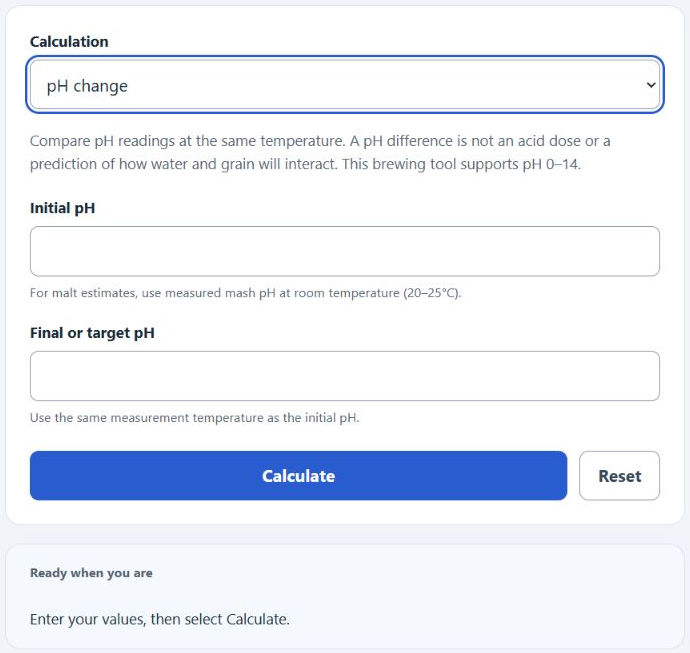
Calculate brewing water pH change from initial and final pH, and estimate sparge acid for reducing alkalinity or an approximate acidulated malt share for recipe planning. These estimates do not guarantee a target pH.
Related Calculators
- Alcohol Per Volume Calculator
- Bitterness Ratio Calculator
- Brix To Grams Of Sugar Calculator
- Sugar To Alcohol Calculator
- All Food and Cooking Calculators
Brewing Water pH Change Formula
The following formula relates the initial pH, the final pH, and the pH change (ΔpH). Note that pH itself is logarithmic, so predicting pH from a volume of acid/base requires additional information (water volume, alkalinity/buffering, and acid/base strength). Choose “Sparge acid estimate” for an approximate alkalinity-neutralization calculation. Match the product’s weight concentration and enter its verified density. The four acid choices use one effective equivalent per mole; the model does not predict final pH.
Variables:
- pH_f is the final pH
- pH_i is the initial pH
- ΔpH is the pH change (pH_f − pH_i), unitless
To calculate the final pH, add the initial pH to ΔpH.
What is Brewing Water pH?
Brewing water pH refers to the acidity or alkalinity of the source water used in brewing. In practice, the pH of the water by itself is usually less important than its alkalinity (buffering capacity) and mineral content, because the mash largely determines the pH that affects enzymes, wort composition, and flavor. Typically, brewers aim for a mash pH of about 5.2 to 5.6 when measured at room temperature (~20–25°C) (hot readings differ; compare samples measured at the same temperature rather than applying a fixed correction). Adjustments are often made by neutralizing alkalinity with food-grade acids, adding brewing salts, or using acidulated malt, depending on the starting water and the desired result.
How to Calculate Brewing Water pH?
The following steps outline how to calculate the Brewing Water pH.
- First, choose pH change, final pH or initial pH in the calculator.
- Next, enter the two known values. Compare pH readings at the same temperature.
- Next, calculate the pH change: ΔpH = pH_f − pH_i.
- Finally, select Calculate to solve for the chosen value using pH_f = pH_i + ΔpH or its rearrangement.
- After inserting the values and calculating the result, check your answer with the calculator above.
Example Problem :
Use the following variables as an example problem to test your knowledge.
Initial pH (pH_i) = 5.5
Final pH (pH_f) = 5.2
pH Change (ΔpH) = −0.3
The acidulated malt estimate retains the rough rule of 1% of the total grain bill per 0.1 pH decrease. It is not a guaranteed correction: water alkalinity, malt acidity and buffering vary. An optional grain weight gives grams within the planned total grain bill, not an extra addition on top. Measure a cooled mash sample and verify adjustments. The sparge calculation uses approximately 50 mg CaCO₃ per mEq; it cannot raise alkalinity, and acid quantities must be checked against the actual product and a small measured trial.