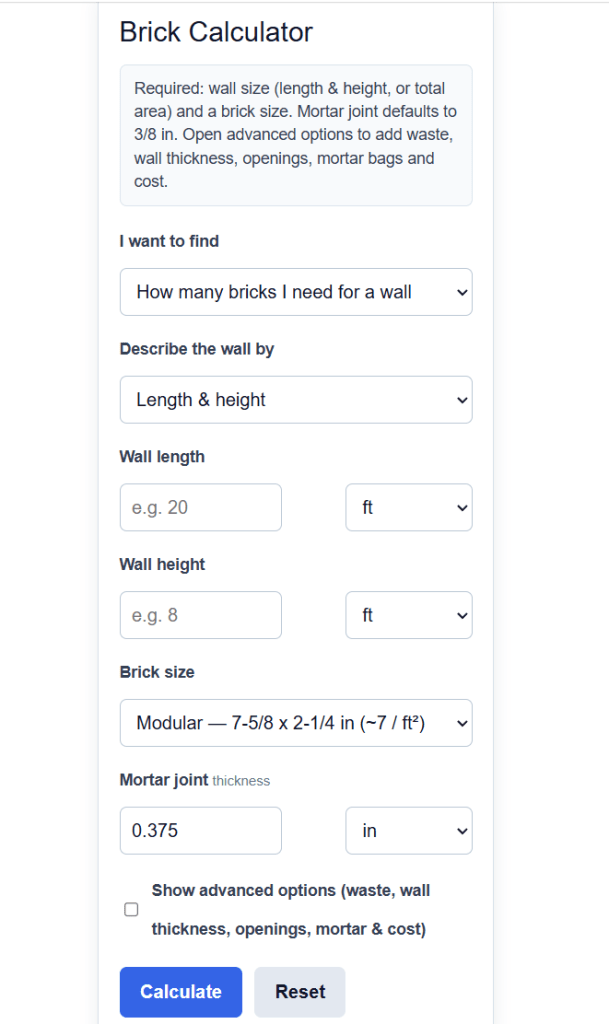
Calculate how many bricks you need for a wall from the wall area, brick size, and mortar joint thickness, including waste and openings.
Brick Formula
The calculator works in two modes. In both, it first finds how many bricks cover one square foot of wall face from the brick size and mortar joint:
BPSF = 144 / ((L + J) * (H + J))
To find the number of bricks needed for a wall, it multiplies the net wall area by that coverage, the wall thickness in bricks, and a waste factor:
B = A * BPSF * W * (1 + waste)
To find the wall area a stack of bricks will cover, it divides the brick count by the coverage and the wall thickness:
A = N / (BPSF * W)
- BPSF = bricks per square foot of wall face
- B = total bricks needed
- N = number of bricks you have
- A = net wall area in square feet (gross area minus door and window openings)
- L = brick face length in inches
- H = brick face height in inches
- J = mortar joint thickness in inches
- W = wall thickness in bricks (1 for a single-brick veneer, 2 for a double-wythe wall)
- waste = breakage allowance written as a decimal (10% = 0.10)
The brick size selector sets L and H for you from standard brick dimensions, or you can enter a custom face size. The mortar joint adds to both the length and height of each brick because a course of brick plus mortar is what actually repeats across the wall. Larger joints mean fewer bricks per square foot. The waste factor pads the result so breakage and cuts do not leave you short, and the wall thickness setting multiplies the count when a wall is more than one brick deep. Openings you enter are subtracted from the gross wall area before the brick count is figured.
Bricks Per Square Foot by Brick Size
These are typical coverage values for common North American and UK brick faces laid with a 3/8 inch mortar joint. Your exact count depends on the joint you use.
| Brick type | Face size (L x H, in) | Bricks per ft² |
|---|---|---|
| Modular | 7-5/8 x 2-1/4 | ~7.0 |
| Standard | 8 x 2-1/4 | ~6.5 |
| Queen | 7-5/8 x 2-3/4 | ~5.75 |
| Closure | 7-5/8 x 3-5/8 | ~4.5 |
| Roman | 11-5/8 x 1-5/8 | ~6.0 |
| Norman | 11-5/8 x 2-1/4 | ~4.5 |
| Utility | 11-5/8 x 3-5/8 | ~3.0 |
| UK metric | 215 x 65 mm | ~5.5 |
How the Mortar Joint Changes the Count
The joint thickness you choose shifts the count noticeably. The table below shows the rough effect relative to the standard 3/8 inch joint.
| Mortar joint | Effect on bricks per ft² |
|---|---|
| 1/4 in | About 8% more bricks |
| 3/8 in (standard) | Baseline |
| 1/2 in | About 7% fewer bricks |
Example Problems
Example 1. You are building a single-brick wall 20 ft long and 8 ft high using modular brick with a 3/8 inch joint, and you want a 10% waste allowance. The gross area is 20 x 8 = 160 ft². Modular brick covers about 7 bricks per ft², so the base count is 160 x 7 = 1,120 bricks. Adding 10% waste gives 1,120 x 1.10 = 1,232 bricks.
Example 2. You have 1,000 standard bricks and want to know the wall area they will cover at one brick deep. Standard brick covers about 6.5 bricks per ft², so the area is 1,000 / 6.5 = about 154 ft².
FAQ
How many bricks do I need per square foot?
For most modular face brick laid with a 3/8 inch mortar joint, plan on about 7 bricks per square foot of wall. Standard brick is closer to 6.5, and larger formats like Norman or Utility need fewer. The exact figure comes from the brick face size and joint, which the calculator handles for you.
Should I order extra bricks?
Yes. A waste allowance of about 10% is standard to cover breakage, cuts at corners and openings, and color matching for future repairs. Use the waste field in the advanced options to add this padding to your order.
Does the calculator account for doors and windows?
Yes. Enter the total area of any openings in the advanced options and that area is subtracted from the wall before the brick count is figured, so you do not pay for bricks you will not lay.