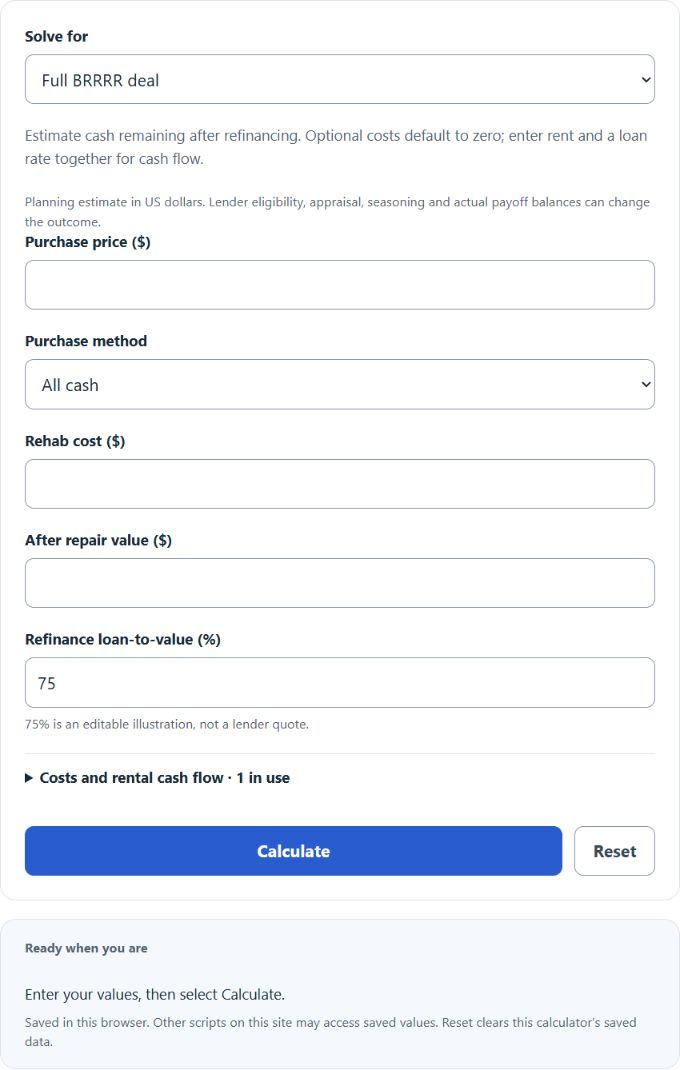
Calculate a BRRRR deal: cash left in the deal after refinancing, capital recovered, cash flow, cash-on-cash return, and the 70% max purchase price.
BRRRR Formula
A BRRRR deal comes down to how much of your own money you get back when you refinance. The core figure is the cash left in the deal:
Cash Left = Cash Invested - (New Loan - Loan Payoff - Refi Costs)
The new loan is set by the after repair value and the lender loan to value limit:
New Loan = ARV * (LTV / 100)
This calculator reports cash-on-cash on positive cash remaining after refinancing. This differs from a return measured against initial cash invested. It is not reported when remaining cash is zero or negative:
Cash on Cash = Annual Cash Flow / Cash Left * 100
The maximum purchase price mode uses the 70 percent rule:
Max Price = ARV * (Rule / 100) - Rehab
The capital recovery mode rearranges the first formula to solve for the appraised value you need to pull all of your cash back out:
ARV Needed = (Cash Invested + Loan Payoff + Refi Costs) / (LTV / 100)
Variables:
- Cash Invested is your own money in the deal, meaning the down payment or full price plus purchase closing, rehab and holding costs
- New Loan is the refinance loan amount
- Loan Payoff is any short-term or purchase loan the refinance clears, which is zero for a cash purchase
- Refi Costs are the refinance closing costs
- ARV is the after repair value, the appraised value once the rehab is finished
- LTV is the selected loan-to-value percentage; actual cash-out eligibility varies by lender and program
- Annual Cash Flow is yearly rent minus operating expenses and the new mortgage payment
- Rule is the percent of ARV used as a buying ceiling, classically 70
Pick what you want to solve for at the top of the calculator. The full deal mode takes your buy, rehab and refinance numbers and returns the cash left in the deal, the capital recovered, the equity after refinancing and, if you enter rent, the monthly cash flow and cash-on-cash return. The maximum purchase price mode applies an adjustable rule to ARV and rehab; it does not determine a safe offer or guaranteed margin. The capital recovery mode tells you the appraised value the property must reach for the refinance to return every dollar you put in.
BRRRR Refinance Benchmarks
Use the first table to read your result. The cash left in the deal and the share of capital you recover tell you how repeatable the deal is.
| Cash left in deal | Capital recovered | What it means |
|---|---|---|
| Below zero | Over 100% | You pull out more than you put in. Cash returned exceeds modeled cash invested. This does not establish profitability or an infinite return. |
| Zero | 100% | Full modeled capital recovery. Cash flow must be evaluated separately. |
| 5% to 20% of cash in | 80% to 95% | Most modeled capital is recovered; the percentage alone does not judge investment quality. |
| Over 20% of cash in | Under 80% | More modeled cash remains invested; evaluate costs, debt and cash flow separately. |
The refinance itself is limited by how long you have owned the property, called the seasoning period, and by the lender loan to value cap. These vary by lender type and directly change how much cash you can pull out.
| Lender type | Typical seasoning before cash-out | Common max LTV |
|---|---|---|
| Fannie Mae eligible investment cash-out | Generally 12 months on the existing first mortgage, note-to-note, and 6 months on title; exceptions apply | Maximum 75% for 1 unit; 70% for 2 to 4 units, subject to eligibility |
| Portfolio or local bank | Program-specific; confirm with the lender | Program-specific |
| DSCR or private | Program-specific; confirm any exception | Program-specific |
Seasoning can refer to time on title or the age of the mortgage being paid off. Valuation, payoff, occupancy and other eligibility rules also apply. See the Fannie Mae cash-out guide and eligibility matrix; private programs have their own terms.
Example Problems
Example 1: A full cash deal.
You buy a distressed house for $120,000 in cash, spend $3,000 on purchase closing, $35,000 on rehab and $4,000 on holding costs. Your total cash invested is $162,000. After the work it appraises at an ARV of $230,000, and your lender refinances at 75 percent for a new loan of $172,500. After $4,000 in refinance closing costs you pull out $168,500.
Cash Left = 162,000 - (172,500 - 0 - 4,000) = -$6,500. You recover about 104 percent of your cash, so you have nothing left in the deal and a small amount back in hand.
Example 2: A maximum offer using the 70 percent rule.
You expect the same $230,000 ARV and a $35,000 rehab and want to follow the 70 percent rule.
Max Price = 230,000 * 0.70 - 35,000 = $126,000. The rule subtracts rehab from 70 percent of ARV. The remaining 30 percent of ARV must accommodate other costs and uncertainty; it is not a guaranteed profit margin.
Frequently Asked Questions
What is a good cash-on-cash return for a BRRRR deal?
A suitable return depends on financing, costs, risk and investment objectives. This calculator divides annual modeled cash flow by positive cash remaining after refinancing. At zero remaining cash the ratio is undefined; for negative remaining cash this calculator reports it as not applicable. Neither means an infinite investment return.
How much of my cash should I expect to get back?
Use the modeled cash recovery and the lender’s actual terms together. Purchase, rehab, holding and closing costs affect whether the refinance returns your invested cash. A recovery percentage alone does not establish a good investment or predict approval.
Why does the refinance use the ARV instead of what I paid?
The entered ARV represents an assumed appraised value after repairs. Actual lenders apply their own valuation and seasoning rules and may limit proceeds. An appraisal increase alone does not guarantee that all invested cash can be recovered.