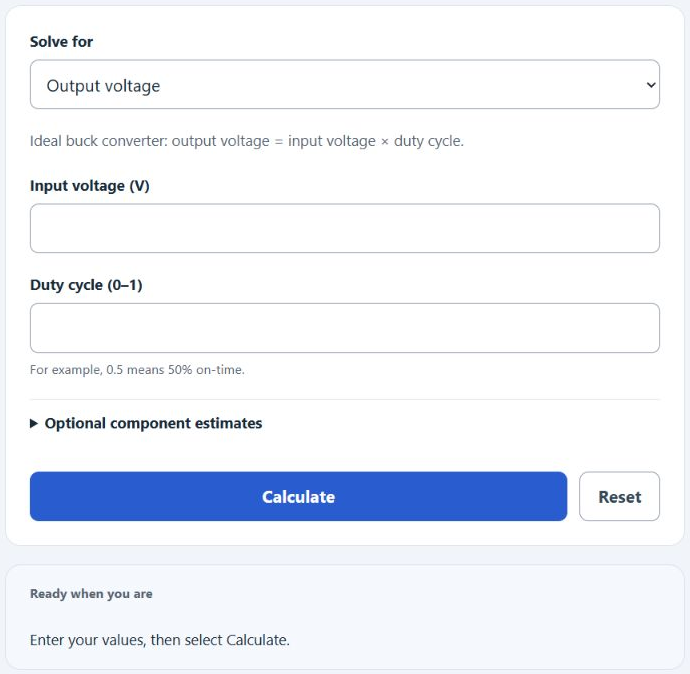
Calculate buck converter Vin, duty cycle or Vout, and find inductance, capacitance and current ripple from load current, frequency and voltage ripple.
Buck Converter Formula
The following equation estimates the output voltage of an ideal buck converter operating in continuous conduction.
- Where Vout is the output voltage (V)
- Vin is the input voltage (V)
- D is the duty cycle (0 to 1)
To calculate the output voltage, multiply the input voltage by the duty cycle.
What is a Buck Converter?
Definition:
A buck converter is a type of DC-DC power converter that steps down voltage from a higher input level to a lower output level using a switching element, an inductor, and a capacitor for filtering. It is widely used in power supplies for efficiently converting voltages.
How to Calculate Buck Converter Parameters?
Example Problem:
The following example outlines the steps and information needed to calculate the key parameters of a buck converter.
First, select Output voltage and enter an input voltage of 12 V and a duty cycle of 0.5. Select Calculate to obtain 6 V.
For component estimates, open Optional component estimates and enter all three inputs: load current 2 A, switching frequency 100 kHz (100000 Hz), and peak-to-peak output voltage ripple 1%. Leave all three blank for voltage or duty calculations alone.
Select Calculate. With the assumed 30% peak-to-peak inductor ripple, the estimates are 50 µH inductance, 12.5 µF minimum capacitance, and 0.6 A current ripple. These ideal continuous-conduction estimates exclude capacitor ESR, losses, transients, tolerances, and control-loop requirements; check the controller datasheet before choosing parts.
FAQ
What is the role of the duty cycle in a buck converter?
The duty cycle determines the fraction of the input voltage that is applied to the load, directly influencing the output voltage. Adjusting the duty cycle allows for regulation of the output voltage.
How are the inductor and capacitor values determined?
The calculator assumes peak-to-peak inductor current ripple ΔIL = 0.30 × load current, then uses L = (Vin − Vout) × D / (ΔIL × switching frequency) and Cmin = ΔIL / (8 × switching frequency × peak-to-peak voltage ripple). Component estimates require 0 < D < 1 and positive load current, frequency, and ripple.
Can modifying the switching frequency improve converter performance?
Yes, a higher switching frequency can reduce the size of passive components and improve transient response, though it may increase switching losses. The optimal frequency balances these trade-offs.