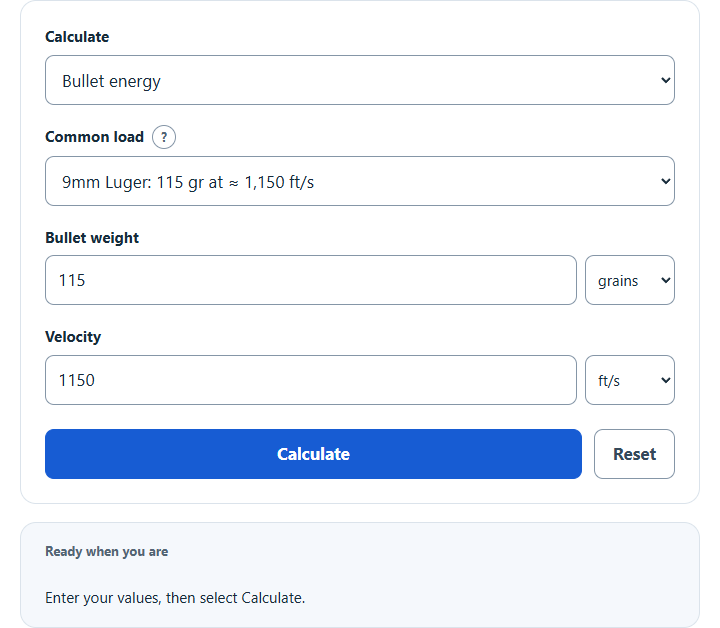
Calculate bullet energy in ft-lbs and joules from bullet weight and velocity or a common caliber load, or find velocity, power factor or momentum.
Calculator Functions
| Function | What it does | What it requires |
|---|---|---|
| Bullet energy | Finds the kinetic energy of a bullet in ft·lb and joules | Requires the bullet weight and the velocity, typed in or filled from a common load |
| Velocity from energy and weight | Finds the velocity a bullet needs to carry a given energy | Requires the bullet energy and the bullet weight |
| Bullet weight from energy and velocity | Finds the bullet weight that carries a given energy at a given velocity | Requires the bullet energy and the velocity |
| Power factor (USPSA) | Finds the power factor of a load and whether it reaches Minor or Major | Requires the bullet weight and the velocity |
| Momentum | Finds the momentum of a bullet in N·s and slug·ft/s | Requires the bullet weight and the velocity |
Bullet weight is entered in grains, grams, kilograms, ounces or pounds, velocity in ft/s, m/s, mph or km/h, and energy in ft·lb, J or kJ. The Common load menu fills the weight and muzzle velocity of eleven factory loads, and both numbers can be edited afterward. Energy is shown in ft·lb with joules beside it, or in joules first when the weight or velocity is entered in metric units.
Bullet Energy Formulas
| E | Bullet energy (J) |
| m | Bullet mass (kg). One grain is 0.00006479891 kg [2] |
| v | Bullet velocity (m/s). One ft/s is 0.3048 m/s [2] |
Bullet energy
This is the same formula with the bullet weight w in grains, the velocity v in ft/s and the energy in ft·lb. The divisor comes from the grain, the foot and 1 ft·lb = 1.355818 J [2]. A 115 gr bullet at 1,150 ft/s carries 115 × 1,150² ÷ 450,437 = 337.6 ft·lb, which is 457.8 J. Energy rises with the square of velocity, so doubling the velocity gives four times the energy, while doubling the weight only doubles it.
| Common load | Weight | Velocity | Energy (ft·lb) | Energy (J) |
|---|---|---|---|---|
| .22 LR | 40 gr | 1,070 ft/s | 101.7 | 137.8 |
| 9mm Luger | 115 gr | 1,150 ft/s | 337.6 | 457.8 |
| 9mm Luger | 124 gr | 1,150 ft/s | 364.1 | 493.6 |
| .357 Magnum | 158 gr | 1,250 ft/s | 548.1 | 743.1 |
| 10mm Auto | 180 gr | 1,200 ft/s | 575.4 | 780.2 |
| .45 ACP | 230 gr | 850 ft/s | 368.9 | 500.2 |
| .223 Rem | 55 gr | 3,200 ft/s | 1,250.3 | 1,695.2 |
| 6.5 Creedmoor | 140 gr | 2,700 ft/s | 2,265.8 | 3,072.0 |
| .308 Win | 150 gr | 2,820 ft/s | 2,648.2 | 3,590.5 |
| .300 Win Mag | 180 gr | 2,960 ft/s | 3,501.2 | 4,747.0 |
| 12 gauge slug, 1 oz | 437.5 gr | 1,200 ft/s | 1,398.6 | 1,896.3 |
Velocity from energy and weight
The energy formula is solved for velocity. The answer is given in ft/s, m/s and mph.
Bullet weight from energy and velocity
The energy formula is solved for mass. The answer is given in grains, grams and kilograms.
Power factor (USPSA)
w is the bullet weight in grains and v the velocity in ft/s. The USPSA Limited division sets a minimum of 125 for Minor and 165 for Major [4], and the calculator labels the result against those two numbers. A 124 gr bullet at 1,150 ft/s has a power factor of 142.6, which is Minor. At a match the velocity is the average of three rounds over a chronograph and decimals are dropped, so 124.9999 does not count as 125 [3].
Momentum
Momentum is mass times velocity, in N·s when the mass is in kg and the velocity in m/s. Dividing by 4.4482216 gives slug·ft/s, which is the same as lbf·s [2]. A 230 gr bullet at 850 ft/s has 3.8613 N·s.
Limits of This Estimate
- The result is the kinetic energy at the velocity entered. A muzzle velocity gives muzzle energy, and a bullet has less energy downrange as it slows.
- The common loads are typical catalog weights and muzzle velocities. Barrel length, the individual firearm and the lot of ammunition change the real velocity. These estimates are based on the best available data and estimations.
- The power factor uses the velocity entered. A match result depends on the chronograph reading taken there [3].
Sources
- U.S. Army Medical Department, Wound Ballistics, Chapter II: Ballistic Characteristics of Wounding Agents: kinetic energy as mass times velocity squared, divided by two
- NIST Special Publication 811, Appendix B.8: Factors for Units Listed Alphabetically: grain, foot, foot pound-force and pound-force in SI units
- USPSA Competition Rules, Appendix C2: Chronograph: power factor formula, three-round average and dropped decimals
- USPSA Competition Rules, Appendix D2: Limited Division: minimum power factor of 125 for Minor and 165 for Major