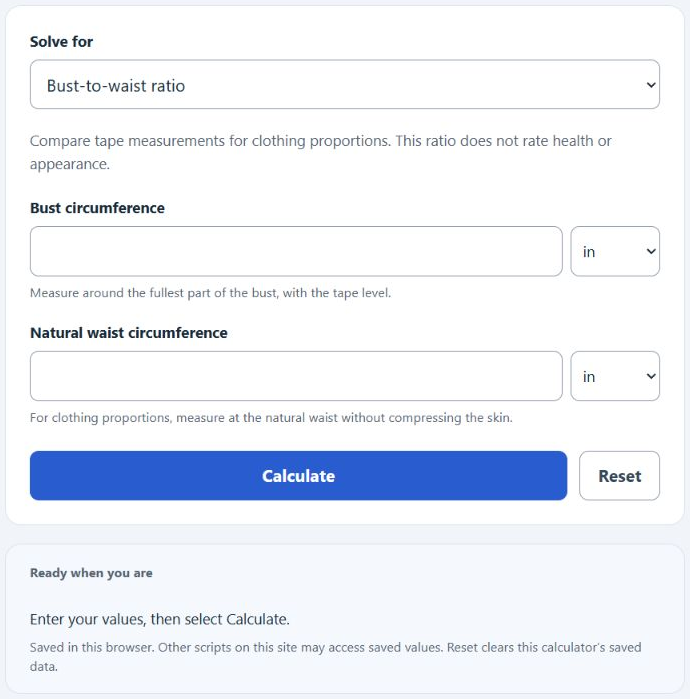
Select a ratio, missing circumference, clothing shape estimate or adult waist–hip reference. Enter the measurements shown in inches or centimeters; unit changes convert the current quantity.
Bust to Waist Ratio Formula
The calculator uses the following formulas, with explicit selections for each task.
Ratio mode:
Waist–hip reference mode uses a separately measured screening waist:
Bust circumference and Waist circumference modes rearrange the ratio formula:
- BWR: bust-to-waist ratio (unitless)
- Bust: circumference around the fullest part of the chest
- Waist: natural waist circumference for clothing proportions; for the screening reference, measure midway between the lowest palpable rib and the top of the hip bone after a normal breath out
- Hip: circumference at the widest part of the hips and seat
- WHR: waist-to-hip ratio
The ratio mode reports bust divided by waist as X:1. Choose Bust circumference or Waist circumference to solve for that value. Clothing shape estimate retains the original fixed-inch heuristic, explained in Calculation details; it is not a validated sizing standard or health assessment. Waist–hip reference is a separate adult screening comparison using its own measurement method.
Reference Tables
The first table shows arithmetic comparisons, not ideal proportions or body-shape diagnoses. Both inches and centimeters work since the ratio is unitless.
| Bust-to-Waist Ratio | Bust minus waist, relative to waist | Interpretation |
|---|---|---|
| Below 1.05 | Less than 5% | May include a bust smaller than the waist |
| 1.05 to below 1.20 | 5% to under 20% | Descriptive only |
| 1.20 to below 1.35 | 20% to under 35% | Does not determine body shape |
| 1.35 and up | 35% or more | Not a health or appearance rating |
| Adult Waist–Hip Reference Comparison | Female | Male |
|---|---|---|
| Below reference (not a diagnosis) | Below 0.85 | Below 0.90 |
| At reference | 0.85 | 0.90 |
| Above reference | Above 0.85 | Above 0.90 |
Examples and FAQ
Example 1. Bust 38 in, waist 28 in. BWR = 38 / 28 = 1.357. The bust is about 35.7% larger than the waist, a description of the measurements rather than a body-shape classification.
Example 2. You know your waist is 76 cm and you want a 1.25 ratio for a sewing pattern. Bust = 1.25 × 76 = 95 cm.
Does the unit matter? No. As long as bust and waist use the same unit, the ratio is identical. Mixing inches and centimeters in the calculator is fine because it converts internally.
Where do I measure my waist? Use the natural waist for clothing proportions. For the adult screening reference, use the midpoint between the lowest palpable rib and the top of the hip bone after a normal breath out. Keep the tape level without compressing the skin.
Why does the body shape mode ask for hips? Bust-to-waist alone cannot distinguish an hourglass from an inverted triangle. Adding hip circumference lets the calculator apply its original fixed-inch clothing heuristic. This rough label is not a validated sizing system and can change with overall size.
Is a higher ratio better? No. The ratio describes proportion, not health or appearance. The separate waist–hip reference uses 0.85 for females and 0.90 for males, but cannot diagnose individual risk. Do not use it for children or pregnancy. See the WHO consultation on waist and hip measurement and published waist–hip screening study. Age, ethnicity and other factors affect interpretation.