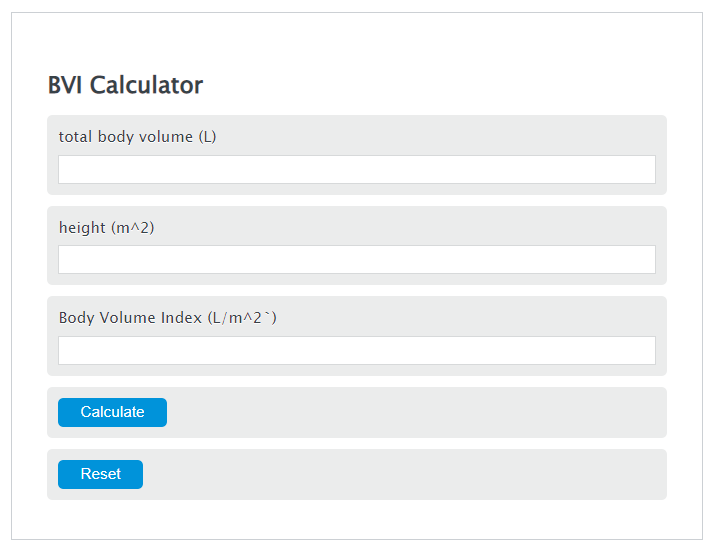
Estimate Body Volume Index from sex, height, weight, waist and hip measurements, plus view BMI-based healthy weight ranges for your height.
Medical note: Adult BMI is a screening metric, not a diagnosis, and this calculator is not intended to set weight-loss targets. If results concern you (especially if BMI is below the normal range) or you are struggling with eating/weight concerns, please seek help from a qualified healthcare professional.
How to Interpret TBV/Height² (BVI) on This Page
The TBV/height² value calculated here is a mathematical normalization of total body volume by height and does not have universally accepted clinical cutoffs. Comparisons are most meaningful when total body volume is measured consistently using the same method and protocol over time (or across people).
Related Calculators
- Hamwi Equation Calculator
- Neck To Height Ratio Calculator
- Height to Waist Circumference Calculator
- Calories To Pounds Calculator
- All Health and Medical Calculators
Body Volume Index Formula
Variables:
- BVI is the Body Volume Index (L/m^2)
- TBV is the total body volume (L)
- H is the height (m)
To calculate Body Volume Index (as defined on this page), divide the total body volume by the square of the height.
How to Calculate Body Volume Index?
The following steps outline how to calculate the Body Volume Index.
- First, determine the total body volume (L).
- Next, determine the height (m).
- Next, gather the formula from above = BVI = TBV / H^2.
- Finally, calculate the Body Volume Index.
- After inserting the variables and calculating the result, check your answer with the calculator above.
Example Problem :
Use the following variables as an example problem to test your knowledge.
total body volume (L) = 70
height (m) = 1.75
BVI = 70 / (1.75^2) = 22.8571 L/m^2
FAQs
What is the difference between Body Volume Index (BVI) and Body Mass Index (BMI)?
BMI is calculated as body mass divided by height squared (BMI = mass / height²). The BVI calculated on this page is calculated as total body volume divided by height squared (BVI = TBV / height²). Because body volume and body mass are related through body density, this BVI is essentially a volume-normalized analogue of BMI rather than a direct measure of fat distribution.
Note: In some publications, “Body Volume Index” refers to a 3D body-scan–based index intended to reflect body shape (including central/abdominal volume). That use is different from the simple TBV / height² calculation used here.
Why is it important to calculate Body Volume Index?
Normalizing total body volume by height can be useful for comparing overall body size across different heights or for tracking changes in overall body volume over time. It does not, by itself, separate fat from muscle (or quantify fat distribution), so it is best interpreted alongside other measurements.
Can BVI be used to track fitness progress?
It can track changes in total body volume relative to height, but it cannot tell whether a change is due to fat, muscle, or fluid shifts. For fitness progress, consider using BVI together with other metrics (for example, circumference measurements or body composition estimates).
How can I measure my total body volume for BVI calculation?
Total body volume can be measured using methods such as water displacement and air displacement plethysmography (ADP). 3D body scanners can also estimate body volume, though accuracy varies by device and protocol.