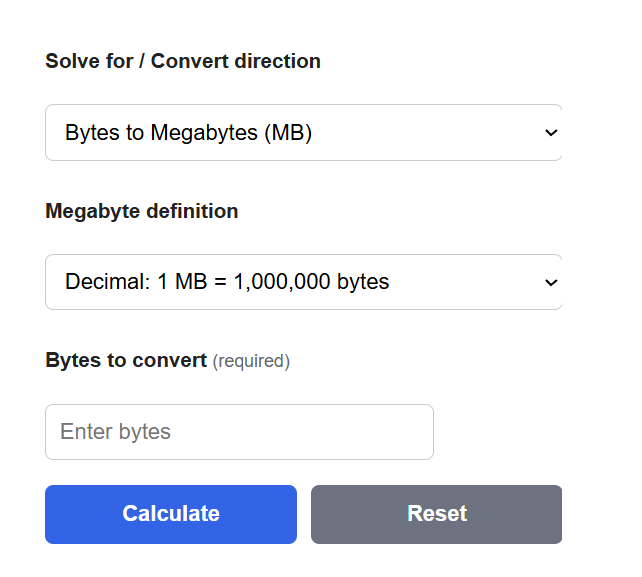
Calculate megabytes from bytes instantly with this Bytes to MB converter, supporting both decimal (1,000,000) and binary (1,048,576) definitions.
Bytes to MB Formula
The conversion depends on which definition of a megabyte you use. There are two common conventions:
MB = Bytes / 1,000,000 (decimal, SI)
MB = Bytes / 1,048,576 (binary, MiB)
To go the other direction, multiply instead of divide:
Bytes = MB * 1,000,000 or Bytes = MB * 1,048,576
- Bytes: the number of bytes you are starting with or solving for.
- MB: the number of megabytes you are solving for or starting with.
- 1,000,000: the number of bytes in one megabyte under the decimal (SI) definition, equal to 10^6.
- 1,048,576: the number of bytes in one megabyte under the binary definition, equal to 2^20. This unit is also called a mebibyte (MiB).
The converter lets you pick the direction (bytes to MB or MB to bytes) and the definition (decimal or binary). When you choose bytes to MB it divides your input by the selected factor; when you choose MB to bytes it multiplies. The decimal factor is what drive makers and network speeds usually use, while operating systems such as Windows usually report storage using the binary factor.
Bytes per Unit Reference
This table shows how many bytes make up each common storage unit under both definitions.
| Unit | Decimal (bytes) | Binary (bytes) |
|---|---|---|
| 1 KB | 1,000 | 1,024 |
| 1 MB | 1,000,000 | 1,048,576 |
| 1 GB | 1,000,000,000 | 1,073,741,824 |
| 1 TB | 1,000,000,000,000 | 1,099,511,627,776 |
Common byte counts converted to megabytes (decimal) for quick reference:
| Bytes | MB (decimal) | MB (binary) |
|---|---|---|
| 500,000 | 0.5 | 0.4768 |
| 1,000,000 | 1 | 0.9537 |
| 5,000,000 | 5 | 4.7684 |
| 10,485,760 | 10.4858 | 10 |
Example Problems
Example 1. You have a file that is 8,400,000 bytes and want its size in MB using the decimal definition. Divide by 1,000,000: 8,400,000 / 1,000,000 = 8.4 MB.
Example 2. Your operating system reports a 3 MB file and you want the exact byte count it uses (binary). Multiply by 1,048,576: 3 * 1,048,576 = 3,145,728 bytes.
Frequently Asked Questions
Why do I get two different answers for the same number of bytes? There are two accepted definitions of a megabyte. The decimal definition uses 1,000,000 bytes per MB and is standard for storage marketing and data transfer rates. The binary definition uses 1,048,576 bytes per MB (more precisely a mebibyte) and is what many operating systems use when showing file sizes. Pick the one that matches the source of your number.
Which definition should I use? If you are checking a hard drive or SSD capacity, a download size, or a network speed, use the decimal factor of 1,000,000. If you are matching what Windows or another OS shows for a file, use the binary factor of 1,048,576.
How do I convert MB back to bytes? Multiply the number of megabytes by the same factor you would divide by. For decimal that is 1,000,000, and for binary that is 1,048,576. Switch the converter to MB to Bytes mode to do this automatically.