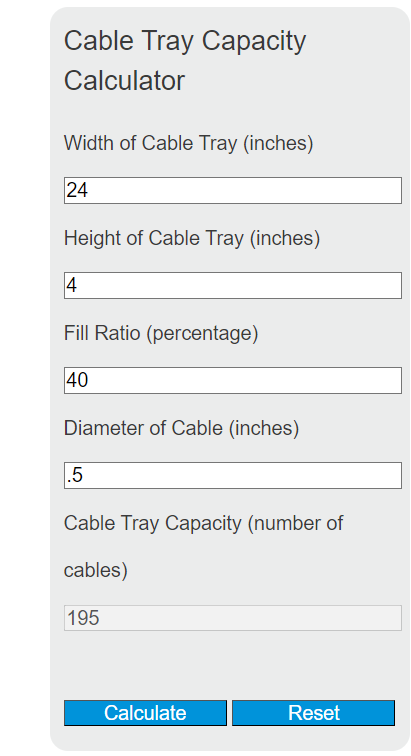
Calculate cable tray capacity, fill ratio, width, height, or cable diameter from four known values using inches, feet, cm, or meters.
Related Calculators
- Conduit Shrink Calculator
- Steel Deflection Calculator
- St Venant Torsional Constant Calculator
- Plastic Modulus Calculator
- All Construction Calculators
Cable Tray Capacity Formula
The calculator uses cable tray cross-sectional area, selected fill ratio, and cable cross-sectional area to estimate how many same-size round cables fit in a tray. Length inputs are converted to inches for the calculation, then converted back to the selected unit when solving for width, height, or cable diameter.
- Ac = cross-sectional area of one cable
- N = cable tray capacity, in number of cables
- W = inside width of the cable tray
- H = inside height of the cable tray
- FR = fill ratio, as a percent
- D = outside diameter of one cable
- pi = 3.14159
If you leave capacity blank, the calculator divides the usable tray area by the area of one cable. If you leave width or height blank, it rearranges the capacity formula to find the missing tray dimension. If you leave fill ratio blank, it calculates the percent of tray area occupied by the entered number of cables. If you leave cable diameter blank, it applies the diameter mode formula shown above.
Typical Cable Tray Fill Ratio References
Fill ratio is the portion of the tray cross-section allowed to be occupied by cables. Use the project specification or applicable electrical code when it is available.
| Fill ratio | Common meaning | Result in the calculator |
|---|---|---|
| 25% | Conservative allowance with more spare space | Lower cable count |
| 40% | Common planning value for tray fill estimates | Moderate cable count |
| 50% | Higher use of tray area | Higher cable count |
Length Unit Conversions Used
| Unit | Equivalent in inches |
|---|---|
| 1 inch | 1 in |
| 1 foot | 12 in |
| 1 centimeter | 0.393701 in |
| 1 meter | 39.3701 in |
Cable Tray Capacity Examples
Example 1: Calculate cable tray capacity
You have a tray that is 12 in wide and 4 in high. The fill ratio is 40%, and each cable has a 0.5 in diameter.
The calculator returns about 97.78 cables. For a whole-cable limit, round down to 97 cables.
Example 2: Calculate required tray width
You need space for 50 cables. The tray height is 3 in, the fill ratio is 40%, and each cable has a 0.5 in diameter.
The required tray width is about 8.18 in.
Cable Tray Capacity FAQ
Should the calculated cable capacity be rounded?
Yes. If the result is a decimal number of cables, round down when deciding the maximum whole number of cables that can fit. For example, a result of 97.78 means the practical whole-cable capacity is 97 cables.
Does this work for different cable sizes in the same tray?
This calculator assumes all cables have the same outside diameter. If you have mixed cable sizes, calculate the area of each cable size separately, add the cable areas together, and compare that total with the allowed tray fill area.
Is fill ratio the same as actual code-compliant tray fill?
Not always. The fill ratio is a simplified area-based input. Actual cable tray requirements can depend on cable type, voltage, tray type, ventilation, spacing, ampacity, and local electrical code. Use the calculator for estimating, then check the required standard for final sizing.