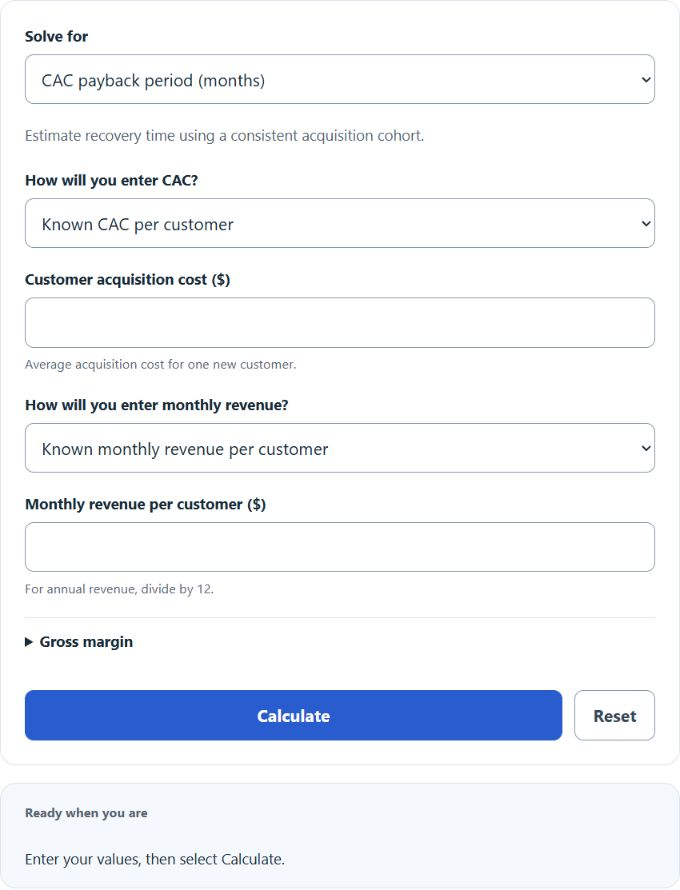
Calculate how many months it takes to recover customer acquisition cost from CAC, monthly revenue per customer, and gross margin, or solve for the maximum CAC that hits a target payback.
CAC Payback Period Formula
CPP = CAC / (ARPA * GM)
- CPP is the CAC payback period, in months
- CAC is the customer acquisition cost, the average sales and marketing cost to win one customer ($)
- ARPA is the average monthly revenue per customer ($/month)
- GM is the gross margin expressed as a decimal (for example 0.80 for 80%); use 1 to calculate on revenue instead of gross profit
The calculator also solves the formula in reverse. To find the most you can afford to spend acquiring a customer while still hitting a target payback period:
Max CAC = T * ARPA * GM
To find the monthly revenue each customer must generate to recover a known CAC within a target period:
Required ARPA = CAC / (T * GM)
- T is the target payback period, in months
In payback mode, you can enter CAC directly or let the calculator derive it from total sales and marketing spend divided by new customers won. Revenue per customer works the same way: enter it directly or derive it from new MRR divided by new customers. The gross margin field is optional. Leaving it blank calculates a simple revenue payback, while entering a margin produces the gross-margin-adjusted payback that investors typically use. The result includes the break-even month and the percentage of CAC recovered after 6 and 12 months.
Interpreting CAC Payback
Payback depends on retention, gross margin, contract size, payment timing and the acquisition cohort. The calculator reports descriptive time bands, not a universal rating or a recommendation to increase spending. Compare results using the same cost, revenue and margin definitions.
A shorter payback returns acquisition cost sooner under the model assumptions. A maximum CAC result is the ceiling implied by your chosen target; it does not establish affordability or account for churn, overhead or cash constraints. Stripe explains the monthly-profit payback formula and its context.
Example Problems
Example 1: Finding the payback period. A SaaS startup spends $5,600 on sales and marketing in a month and wins 10 new customers, so its CAC is $5,600 / 10 = $560. Those customers add $500 in new MRR, so the average revenue per customer is $50 per month. Gross margin is 80%. Monthly gross profit per customer is $50 * 0.80 = $40. The payback period is $560 / $40 = 14 months. After 12 months, only about 86% of the acquisition cost has been recovered, and the company breaks even on these customers in month 14.
Example 2: Finding the maximum affordable CAC. A company charges $150 per month per customer, runs a 75% gross margin, and wants to recover acquisition costs within 12 months. The maximum affordable CAC is 12 * $150 * 0.75 = $1,350. As long as the blended cost of winning a customer stays at or below $1,350, the payback period stays at or under a year.
Frequently Asked Questions
Should I use revenue or gross margin in the calculation?
Gross margin gives the more accurate answer. Revenue overstates how fast you recover CAC because serving a customer has real costs such as hosting, support, and onboarding. A company with $100 ARPA and a 70% margin only recovers $70 of CAC per customer each month, not $100. The simple revenue version is still useful for quick estimates or when you do not know your margin, which is why the gross margin field in the calculator is optional. When comparing against investor benchmarks, use the gross-margin-adjusted number, because that is how the benchmarks are computed.
What is a good CAC payback period?
A useful target depends on customer retention, cash constraints, contract size, service costs and acquisition channel. Compare like-for-like cohort definitions and test how the result changes when revenue or margin falls. A short calculated period alone does not show that acquisition spending is sustainable.
How is CAC payback different from the LTV to CAC ratio?
LTV to CAC measures total return: how much lifetime profit a customer generates per dollar of acquisition cost. CAC payback measures speed: how quickly that dollar comes back. A company can have a strong 4:1 LTV to CAC ratio but a 24-month payback, which means the economics work on paper while the business burns cash for two years per customer cohort. Investors look at both together, using payback to judge cash efficiency and LTV to CAC to judge long-term profitability.