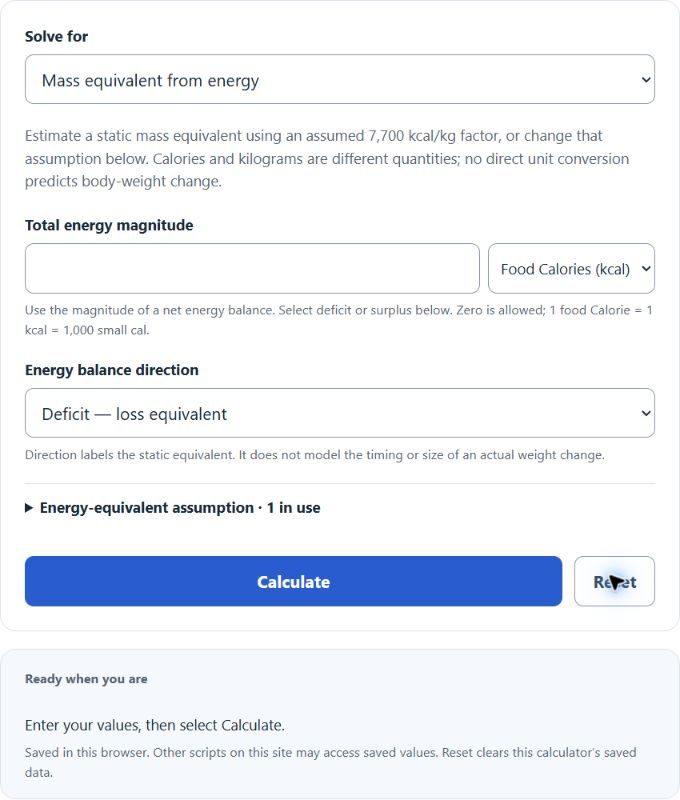
Calculate a static energy–mass equivalent using an explicit kcal/kg assumption, in either direction. Dietary Calories, small calories and SI energy units differ; a fixed factor does not predict body-weight change.
Assumptions Assumptions
- Static energy-equivalent model: equivalent mass = net energy (kcal) ÷ an assumed kcal/kg factor. It does not model body-weight dynamics, metabolic adaptation, body composition, glycogen or water shifts.
- Use a nonnegative net energy magnitude and choose deficit (loss equivalent) or surplus (gain equivalent). These labels describe the static assumption, not a predicted weight outcome.
- Default 7,700 kcal/kg is an illustrative static rule. It is not a fixed property of all body tissue; any alternative positive factor is a separate assumption.
- Unit conversion used: 1 kcal = 4.184 kJ.
- Results are estimates and not medical or dietary advice.
When to Use This Calculator
- Comparing static mass equivalents under an explicit net energy and kcal/kg assumption.
- Converting a target weight change into an equivalent energy budget.
- Understanding why a fixed factor cannot forecast long-term weight change: energy expenditure and body composition change over time.
Input Definitions
- Energy — net energy in kcal (Cal) or kJ; the calculator converts kJ to kcal internally using 1 kcal = 4.184 kJ.
- Mass equivalent — a nonnegative kilogram magnitude labeled by deficit or surplus. It is not a prediction of measured body weight.
- Energy per kg factor (F) — your assumed kcal per kg of static mass equivalent. The default is 7,700; changing it tests a different assumption, not a validated tissue constant.
- Conversions — kg = kcal ÷ F; kcal = kg × F; kJ = kcal × 4.184; kcal = kJ ÷ 4.184.
- All Unit Converters
- Cal to kWh Conversion Calculator
- Cal to kW Conversion Calculator
- Cal to Btu Conversion Calculator
Cal to kg Formula
The following formulas relate nonnegative energy and mass-equivalent magnitudes using an assumed positive factor F in kcal/kg. Energy and mass are different quantities; this is a model assumption, not a direct unit conversion.
Mass equivalent (kg) = energy (kcal) ÷ F (kcal/kg)
Energy (kcal) = mass equivalent (kg) × F (kcal/kg)
- Default F = 7,700 kcal/kg is an illustrative fixed-factor assumption; it does not predict actual weight loss or gain.
- Other positive factors, such as 7,500 or 8,500 kcal/kg, test different assumptions. They are not established universal factors for body tissue.
- 1 kcal = 4.184 kJ (so Ekcal = EkJ ÷ 4.184, and EkJ = Ekcal × 4.184).
- Input convention: enter a nonnegative magnitude and select deficit for a loss equivalent or surplus for a gain equivalent. Actual body-weight changes require a dynamic model.
How do you convert calories to kilograms? Divide energy in kcal by the chosen kcal/kg factor (if energy is in kJ, first divide by 4.184 to get kcal).
How do you convert kilograms to calories? Multiply the desired kg change by the kcal/kg factor (multiply by 4.184 to express the result in kJ).
Cal to kg Conversion Table
| Energy (kcal) | Mass equivalent (kg) |
|---|---|
| 250 | 0.032 |
| 500 | 0.065 |
| 750 | 0.097 |
| 1,000 | 0.130 |
| 1,500 | 0.195 |
| 2,000 | 0.260 |
| 2,500 | 0.325 |
| 3,000 | 0.390 |
| 3,500 | 0.455 |
| 4,000 | 0.519 |
| 5,000 | 0.649 |
| 7,500 | 0.974 |
| 7,700 | 1.000 |
| 10,000 | 1.299 |
| 15,400 | 2.000 |
| 23,100 | 3.000 |
| 30,800 | 4.000 |
| 38,500 | 5.000 |
| * Existing values rounded to 3 decimals using an assumed constant F = 7,700 kcal/kg. Select deficit or surplus to label the equivalent. These values do not forecast body-weight changes or timing. | |
Example Problem
Convert 3,500 kcal to kilograms using F = 7700 kcal/kg.
Use the formula: Δkg = Ekcal ÷ F.
Static mass equivalent = 3500 ÷ 7700 ≈ 0.455 kg. A deficit labels a loss equivalent and a surplus labels a gain equivalent; neither predicts an actual 0.455 kg scale-weight change.