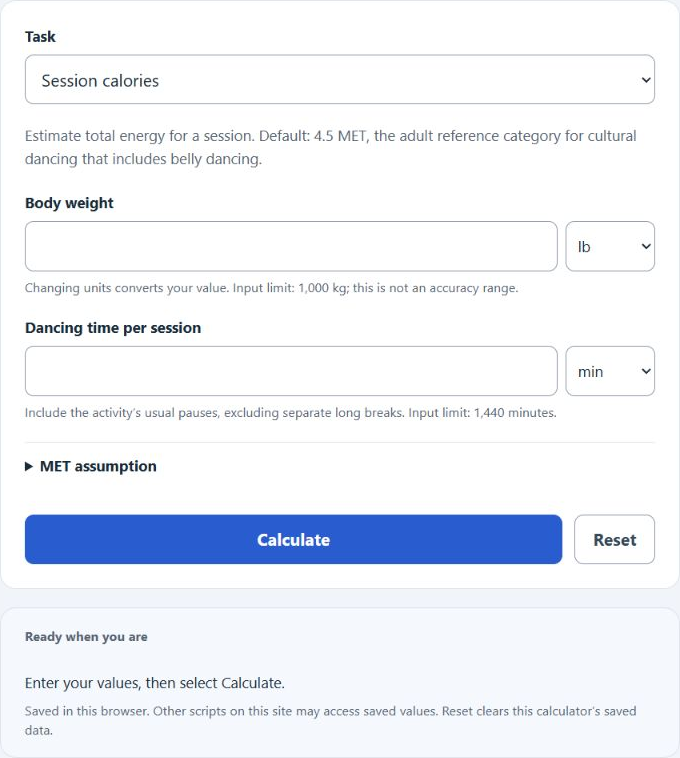
Estimate total energy from belly dancing by weight, duration and a MET assumption, project weekly class totals, or find time corresponding to an energy amount. The default is 4.5 MET; a documented override is optional.
Calories Burned Belly Dancing Formula
The calculator uses an oxygen-based MET estimate for total energy, including resting energy during the activity. It assumes 3.5 mL oxygen/kg/min per standard MET and about 5 kcal/L oxygen. This convention gives 5% more than the approximate MET * kg * hours convention.
- MET = metabolic equivalent: default 4.5 for the 2024 Adult Compendium category of cultural dancing that includes belly dancing; an override requires your supporting source
- weight_kg = body weight in kilograms (lb × 0.45359237)
- minutes = time spent dancing
Weekly class total multiplies the per-session result by classes per week. A fractional frequency is a long-run average, such as 0.5 for one class every two weeks. Time for an energy amount rearranges the formula to solve for minutes:
MET values are population estimates, not measurements of individual styles or classes. The cited Adult Compendium targets ages 19–59. Actual burn varies with effort, usual pauses and metabolism; this calculator does not infer a MET from a style name, sweating or shimmies.
Reference Tables
Estimated total kcal per hour. The 4.5 MET column is the sourced reference category; 3.0, 5.5 and 6.5 are hypothetical sensitivity scenarios, not validated belly-dancing intensity presets. You can enter a documented MET in the optional override. Pounds are converted before rounding:
| Body weight | Scenario (3.0) | Reference (4.5) | Scenario (5.5) | Scenario (6.5) |
|---|---|---|---|---|
| 120 lb (about 54.4 kg) | 171 | 257 | 314 | 371 |
| 150 lb (about 68.0 kg) | 214 | 321 | 393 | 464 |
| 180 lb (about 81.6 kg) | 257 | 386 | 472 | 557 |
| 210 lb (about 95.3 kg) | 300 | 450 | 550 | 650 |
Use the reference category or a documented session MET. These values describe assumptions, not labels inferred from how a class feels:
| MET assumption | Basis |
|---|---|
| Scenario (3.0) | An illustrative lower MET; not established here for slow drills or posture work |
| Reference (4.5) | Compendium code 03025: cultural dancing, including belly dancing |
| Scenario (5.5) | An illustrative higher MET; not established here for shimmies or a steady class |
| Scenario (6.5) | An illustrative higher MET; not established here for vigorous belly-dancing performance |
Quick Example
A 150 lb dancer takes a 60-minute class using the reference assumption (MET 4.5):
Weight = 150 × 0.45359237 = 68.0388555 kg. Estimated kcal = 4.5 × 3.5 × 68.0388555 / 200 × 60 ≈ 321.5 kcal
Two identical classes per week give about 643.0 kcal/week, or 2,571.9 kcal across exactly four weeks. Four weeks is not a calendar month. These totals include resting energy and cannot be converted directly into predicted fat loss; NIH guidance explains why simple fixed calorie rules can overestimate weight loss.
FAQ
Does this estimate establish exercise intensity? The 4.5 MET reference is a population activity category. This calculator cannot establish your individual cardiovascular effort or decide whether a class meets a personal exercise goal.
Why is my smartwatch number different? Wearables and this calculator can use different methods and assumptions. This model uses body weight, duration and MET; it does not validate a device or establish a fixed percentage difference between methods.
Do shimmies change the estimate? The calculator does not infer a MET adjustment for shimmies. Use the default cultural-dancing category or enter a documented session MET rather than assigning an unsupported preset.