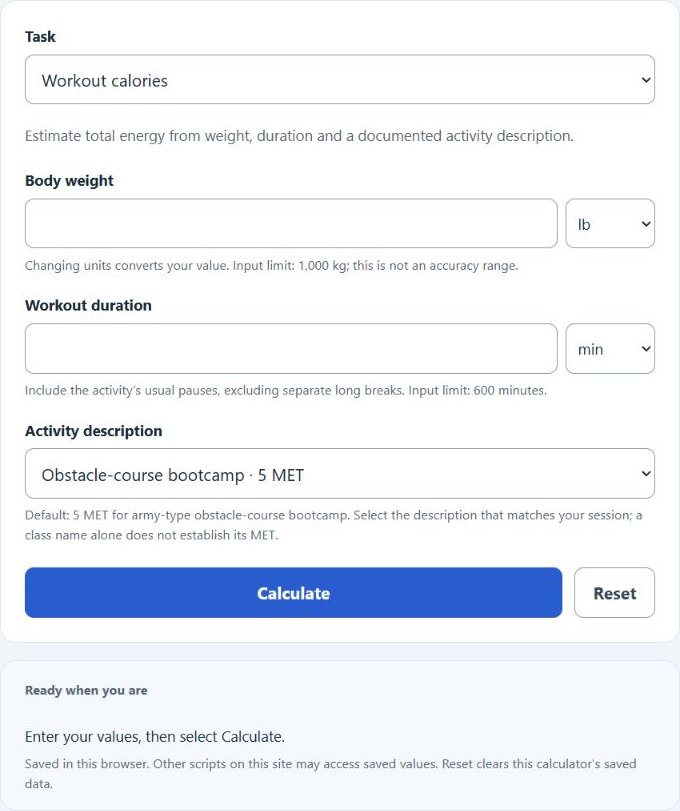
Estimate total calories used during a bootcamp workout, or the time corresponding to an energy amount, using body weight and a documented activity description. Results include resting energy and are not an exercise prescription or prediction of weight loss.
Calories Burned Bootcamp Formula
Multiply the selected activity’s MET by 3.5, body weight in kilograms and workout minutes, then divide by 200. The default is the 2024 Adult Compendium’s army-type obstacle-course bootcamp category at 5 MET (code 02008); choose a circuit or HIIT category when that description better matches your session.
- Light circuit: 3.5 MET (02034); moderate circuit: 5 MET (02035). These categories describe circuits rather than universal bootcamp pace levels.
- Obstacle-course bootcamp: 5 MET (02008); bodyweight circuit: 6 MET (02032).
- Vigorous circuit with kettlebells, aerobic movement and minimal rest: 7.5 MET (02040); vigorous HIIT with burpees, mountain climbers, squat jumps or Tabata: 11 MET (02214). Select Your documented MET only when you have a supported session value.
Quick Bootcamp Calorie Chart
The chart below uses the default 5 MET obstacle-course bootcamp category and the oxygen-based formula above. It includes resting energy, uses 1 lb = 0.45359237 kg, and rounds only the displayed calorie totals. Category estimates are not individual measurements; the Adult Compendium targets ages 19–59.
| Body Weight | 30 Minutes | 45 Minutes | 60 Minutes |
|---|---|---|---|
| 125 lb | 149 calories | 223 calories | 298 calories |
| 155 lb | 185 calories | 277 calories | 369 calories |
| 185 lb | 220 calories | 330 calories | 441 calories |
| 205 lb | 244 calories | 366 calories | 488 calories |
What Changes Your Bootcamp Calories Burned?
- Body weight: the model gives about 32% more total energy for 205 lb than 155 lb at the same duration and MET. This proportional estimate does not establish an individual’s measured burn.
- Workout time: the model gives twice the total energy for 60 minutes as for 30 minutes at the same weight and constant MET.
- Activity assumption: at the same weight and duration, 7.5 MET gives 50% more energy than 5 MET, while 3.5 MET gives 30% less. These are comparisons between specified categories, not guaranteed differences between named class intensities.
- Exercise mix: choose the category that describes your activity mix, effort and usual pauses. Exclude separate long breaks from the entered duration; a class name alone does not determine its MET.
What Is a Bootcamp Workout?
Bootcamp workouts combine strength and cardio intervals in one session. Common movements include squats, lunges, push-ups, kettlebell work, battle ropes, rows, jumps, carries, and short runs with limited rest between stations.
How to Use the Calculator
- Choose Workout calories or Time for an energy amount, then enter body weight in pounds or kilograms. Changing units converts the value.
- For workout calories, enter duration in minutes or hours. For time, enter an energy amount in kcal.
- Choose the activity description that matches your session. The default is obstacle-course bootcamp at 5 MET; a custom documented MET is required only when that option is selected.
- Select Calculate for the estimate and its details. Editing inputs keeps the previous result until you calculate again. Reset clears this calculator’s saved data.
Example
At the default 5 MET, 150 lb converts to 68.0388555 kg. For 30 minutes, estimated total energy is 5 × 3.5 × 68.0388555 ÷ 200 × 30 = 178.6019956875 kcal, displayed as approximately 178.6 kcal. The same constant-rate model gives approximately 50.39 minutes for 300 kcal. These are estimates, not measured burn or prescribed workouts.