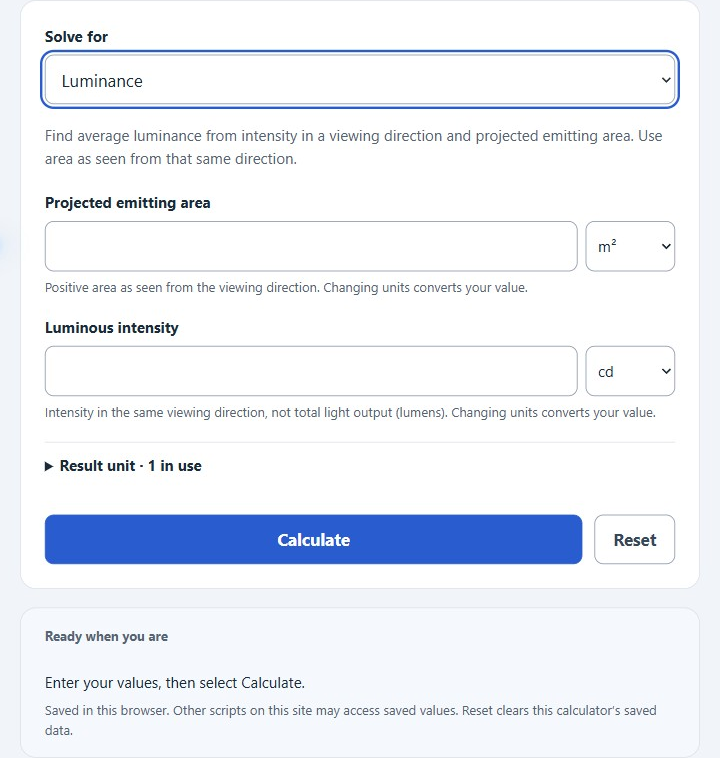
Calculate emitting area, luminance, or luminous intensity in the viewing direction from any two values, with cd/m², cd/ft², cd/yd², and cd/kcd units.
Candela Per Square Meter Formula
The calculator uses the relationship between luminance, luminous intensity, and projected emitting area. Candela per square meter, written as cd/m², is the SI unit of luminance.
- L = luminance, in candela per square meter (cd/m²)
- I = luminous intensity in the viewing direction, in candelas (cd)
- A = projected emitting area, in square meters (m²)
To calculate luminous intensity, the formula is rearranged as:
To calculate projected emitting area, the formula is rearranged as:
Choose the value to solve for, then enter its two named inputs in the same viewing direction. Changing input units converts your values; the optional Result unit section controls the displayed answer even when collapsed. The calculation uses projected area and uniform or correctly area-averaged luminance.
- Calculate luminance: enter luminous intensity and projected emitting area. The result is candela per unit area.
- Calculate luminous intensity: enter luminance and projected emitting area. The result is the intensity in the viewing direction.
- Calculate emitting area: enter luminance and luminous intensity. The result is the projected area needed to produce that intensity at that luminance.
Common Unit Conversions for Luminance and Area
These conversions are useful when checking results that use square feet, square yards, or kilocandelas.
| Quantity | Unit | Equivalent in base unit |
|---|---|---|
| Area | 1 ft² | 0.09290304 m² |
| Area | 1 yd² | 0.83612736 m² |
| Luminance | 1 cd/ft² | 10.7639104167 cd/m² |
| Luminance | 1 cd/yd² | 1.1959900463 cd/m² |
| Luminous intensity | 1 kcd | 1000 cd |
Illustrative Luminance Comparisons
| Source or surface | Approximate luminance | Notes |
|---|---|---|
| Computer monitor | 100 to 400 cd/m² | Illustrative range only; check the monitor specification |
| Television screen | 200 to 1000 cd/m² | Illustrative range only; check the television specification and mode |
| Office white paper under bright lighting | 100 to 300 cd/m² | Illustrative reflected-light example; illumination and reflectance matter |
| Outdoor sky | Thousands of cd/m² | Illustrative order of magnitude, not a supplied measurement; weather and direction matter |
Example Calculations
Example 1: Calculate luminance
You have a projected emitting area of 2 m² and a luminous intensity of 500 cd.
The luminance is 250 cd/m².
Example 2: Calculate luminous intensity
You have a luminance of 300 cd/m² and a projected emitting area of 0.5 m².
The luminous intensity in the viewing direction is 150 cd.
FAQ
What does candela per square meter measure?
Candela per square meter measures luminance. It describes directional light per projected area, based on luminous intensity divided by that area. This ratio is average luminance; a uniform luminance can be used directly in I = L × A. It is not the same as total light output.
Why does the calculator use projected emitting area?
Luminance is based on the area as seen from the viewing direction. If a surface is tilted, its projected area is smaller than its physical surface area. For a flat surface viewed straight on, the projected area is the same as the visible face area.
Is cd/m² the same as nit?
Yes. One nit is equal to one candela per square meter. For example, 500 nits is the same as 500 cd/m².