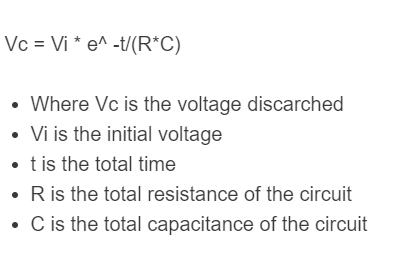
Solve RC discharge voltage, time to a target, or bleeder resistance with selectable R, C, and time units plus current, charge, energy, and τ milestones.
Capacitor Discharge Formula
The calculator uses the ideal RC discharge model, where a charged capacitor discharges through a resistor. The main time constant is:
To calculate voltage after an elapsed time:
To calculate the time needed to reach a target voltage:
To calculate the required discharge resistance for a target time:
To calculate the required capacitance for a target time:
The calculator also uses these related formulas for charge, current, energy, and resistor power:
- τ = RC time constant, in seconds
- R = discharge resistance, in ohms
- C = capacitance, in farads
- V(t) = capacitor voltage after elapsed time
- V0 = initial capacitor voltage
- Vt = target or final capacitor voltage
- t = elapsed or desired discharge time, in seconds
- Q(t) = capacitor charge after elapsed time, in coulombs
- I(t) = discharge current through the resistor, in amperes
- E(t) = stored energy in the capacitor, in joules
- P(t) = resistor power at that moment, in watts
If you choose voltage, current, charge, and energy after elapsed time, the calculator applies the exponential voltage formula first, then uses that voltage to calculate current, charge, energy, and resistor power.
If you choose time to discharge to a target voltage, it solves the exponential discharge equation for time. The target voltage must be greater than zero and less than the starting voltage.
If you choose required resistor or required capacitance, it rearranges the same target-voltage formula to find the missing RC component value for your desired discharge time.
RC Discharge Time Constant Reference
A capacitor does not discharge linearly. Each time constant removes the same percentage of the voltage that remains, not the same number of volts.
| Elapsed Time | Voltage Remaining | Voltage Discharged | Common Meaning |
|---|---|---|---|
| 1τ | 36.79% | 63.21% | One time constant |
| 2τ | 13.53% | 86.47% | Mostly discharged |
| 3τ | 4.98% | 95.02% | Often considered nearly discharged |
| 4τ | 1.83% | 98.17% | Very low remaining voltage |
| 5τ | 0.67% | 99.33% | Practical discharge estimate |
Capacitance Unit Conversions
| Unit | Equivalent in Farads | Example |
|---|---|---|
| pF | 0.000000000001 F | 1000 pF = 1 nF |
| nF | 0.000000001 F | 1000 nF = 1 µF |
| µF | 0.000001 F | 1000 µF = 1 mF |
| mF | 0.001 F | 1000 mF = 1 F |
| F | 1 F | 1 F = 1,000,000 µF |
Example Calculations
Example 1: Voltage after elapsed time
You have a 1000 µF capacitor charged to 12 V. It discharges through a 10 kΩ resistor for 5 seconds.
- C = 1000 µF = 0.001 F
- R = 10 kΩ = 10,000 Ω
- V0 = 12 V
- t = 5 s
The capacitor voltage after 5 seconds is about 7.28 V.
Example 2: Time to reach a target voltage
You have a 470 µF capacitor charged to 24 V. It discharges through a 4.7 kΩ resistor. You want to know how long it takes to reach 3 V.
- C = 470 µF = 0.00047 F
- R = 4.7 kΩ = 4700 Ω
- V0 = 24 V
- Vt = 3 V
The capacitor reaches 3 V after about 4.60 seconds.
FAQ
What does one time constant mean in capacitor discharge?
One time constant is the product of resistance and capacitance, written as τ = R × C. After one time constant, the capacitor voltage has fallen to about 36.8% of its starting voltage. After five time constants, it has fallen to about 0.67% of its starting voltage.
Does a capacitor ever discharge to exactly zero volts?
In the ideal RC equation, the voltage approaches zero but never reaches exactly zero. In real circuits, leakage, measurement limits, dielectric behavior, and connected loads affect the final measured voltage. For practical work, 5τ is often used as a rough discharge point, but safety procedures may require more than a formula-based estimate.
Why does stored energy fall faster than voltage?
Capacitor energy is proportional to voltage squared: E = 0.5 × C × V². If the voltage falls to 50% of its starting value, the stored energy falls to 25% of the starting energy. This is why the calculator reports both voltage remaining and energy remaining separately.