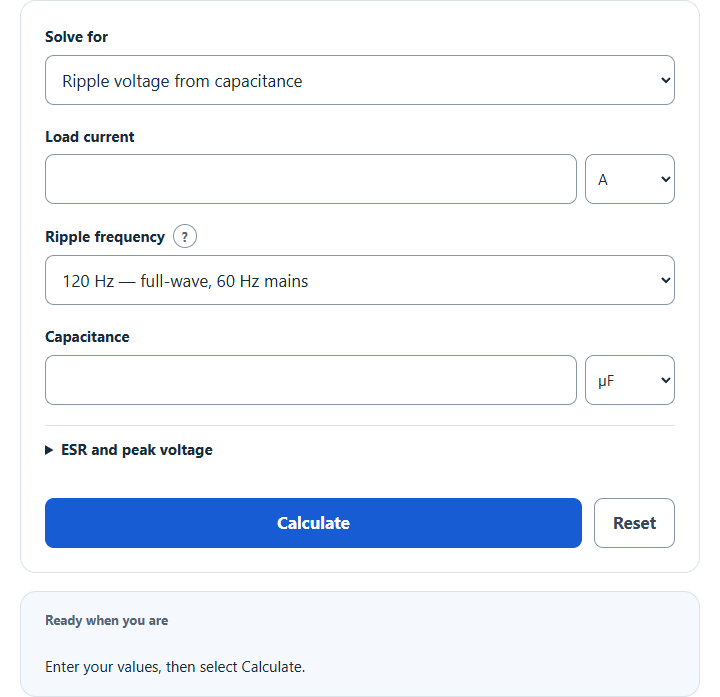
Calculate capacitor ripple voltage, or the smoothing capacitor size you need, from load current and ripple frequency, with optional ESR and percent ripple.
Related Calculators
- Heat Dissipation Calculator
- LED Inrush Current Calculator
- Short Circuit Current Calculator
- Constant Phase Element Calculator
- All Physics Calculators
Capacitor Ripple Voltage Formula
The capacitor ripple voltage calculation is based on the charge-discharge relationship for a smoothing capacitor:
- Vpp = peak-to-peak ripple voltage, in volts (V)
- I = load or discharge current, in amperes (A)
- f = ripple frequency, in hertz (Hz)
- C = capacitance, in farads (F)
The same relationship can be rearranged to calculate any missing value:
If you enter load current, ripple frequency, and capacitance, the calculator finds peak-to-peak ripple voltage. Choose Required capacitance instead to find the capacitance for an allowable ripple voltage. All values are converted to base units first: amperes, hertz, farads, and volts.
Capacitor Ripple Current and Rating
Choose Ripple current (RMS) when you know the total RMS current leaving the rectifier and the steady DC current drawn by the load. Use measured or simulated currents from the same operating point. The rectifier RMS value must include both its DC component and the intervals between charging pulses.
Capacitor ripple current (A RMS) = √(rectifier RMS current² − DC load current²). The capacitor takes the difference between rectifier and load current. At steady state it gains and loses the same charge each cycle, so its average current is zero. This relationship assumes one capacitor or capacitor bank and a nearly constant load current. If the load current pulses, use the RMS of the capacitor branch current from a waveform measurement or circuit simulation.
Ripple voltage alone cannot tell you the RMS current. Transformer and wiring impedance, the rectifier and the shape of the charging pulses all affect it. Ripple current heats the capacitor through its equivalent series resistance (ESR). Compare against the datasheet allowance for the actual frequency and temperature, using the manufacturer’s method for mixed frequencies if needed. Check voltage, temperature and lifetime separately.
For example, enter 2.5 A total rectifier RMS current and 1.5 A DC load current. The capacitor ripple current is 2 A RMS. Entering a 2.4 A allowance shows that 2 A is below the entered limit.
Common Ripple Frequency Values
Ripple frequency depends on the circuit that is charging the capacitor. Use the ripple frequency seen by the capacitor, not always the mains frequency.
| Circuit type | Input frequency | Typical ripple frequency |
|---|---|---|
| Half-wave rectifier | 50 Hz mains | 50 Hz |
| Half-wave rectifier | 60 Hz mains | 60 Hz |
| Full-wave bridge rectifier | 50 Hz mains | 100 Hz |
| Full-wave bridge rectifier | 60 Hz mains | 120 Hz |
| Switching power supply output capacitor | Switching frequency | Usually the switching frequency, or a related harmonic |
Capacitance Unit Reference
| Unit | Meaning | Farads equivalent |
|---|---|---|
| F | farad | 1 F |
| mF | millifarad | 0.001 F |
| µF | microfarad | 0.000001 F |
| nF | nanofarad | 0.000000001 F |
Example Calculations
Example 1: Calculate ripple voltage
You have a 0.5 A load, a 120 Hz ripple frequency, and a 2200 µF capacitor.
The peak-to-peak ripple voltage is about 1.89 V.
Example 2: Calculate required capacitance
You want to keep ripple voltage to 0.25 V with a 1 A load and 100 Hz ripple frequency.
The required capacitance is 0.04 F, or 40,000 µF.
FAQs
Is capacitor ripple voltage peak-to-peak or RMS?
This calculator uses peak-to-peak ripple voltage. That means it estimates the voltage difference between the highest and lowest points of the capacitor voltage during one ripple cycle. RMS ripple voltage is a different value and depends on the waveform shape.
Does this formula include capacitor ESR?
No. The formula Vpp = I / (f × C) estimates ripple caused by capacitor discharge. Real capacitors also have equivalent series resistance, or ESR, which can add extra ripple voltage:
For low-voltage or high-current supplies, ESR ripple can be significant and should be checked separately.
Why does higher capacitance reduce ripple voltage?
A larger capacitor stores more charge for the same voltage change. During the time between charging pulses, it can supply the load current with a smaller voltage drop. In the formula, capacitance is in the denominator, so increasing capacitance lowers the calculated ripple voltage.