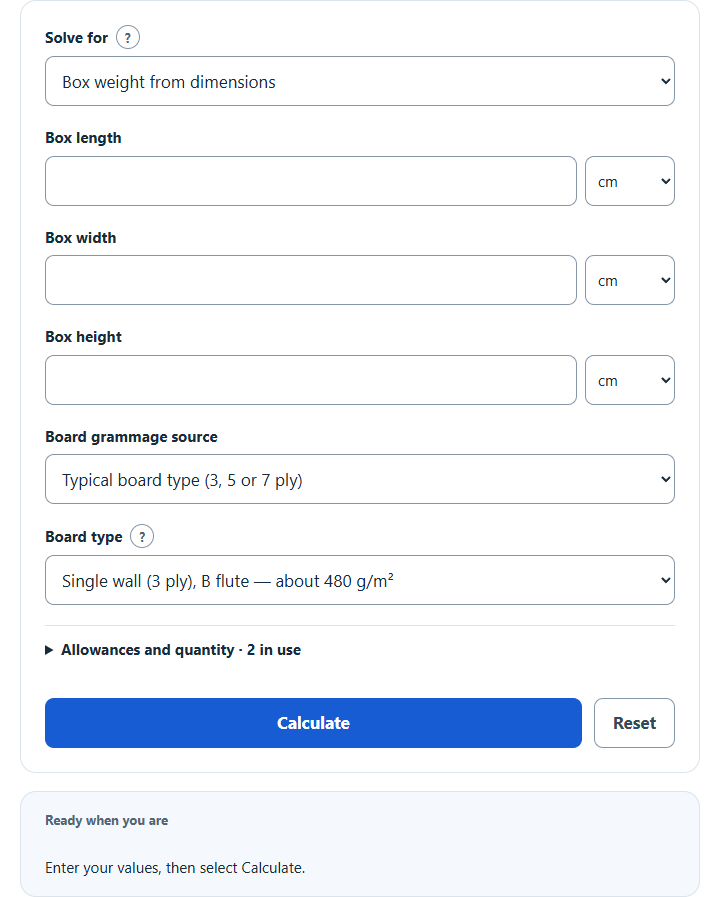
Calculate corrugated cardboard box weight from length, width and height, using a typical 3-ply, 5-ply or 7-ply board or your supplier’s GSM.
- Business Finance Calculators
- All Weight Calculators
- Stretch Film Weight Calculator
- Pallet Volume Calculator
- Box Volume Calculator
Calculator Functions
| Function | What it does | What it requires |
|---|---|---|
| Box weight from dimensions | Estimates the weight of an empty corrugated box from its size, by working out the flat blank it is cut from | Requires the box length, width and height and a board grammage source |
| Sheet or blank weight | Finds the weight of a flat sheet or a measured box blank | Requires the sheet length and width and a board grammage source |
| Board grammage from paper layers | Estimates the combined board grammage in g/m² from the papers the board is made of | Requires the wall construction, the liner and fluting paper grammages and the flute take-up factor |
The two weight functions take the board grammage in one of three ways: a typical board type (3, 5 or 7 ply), the combined grammage quoted by a supplier, or an estimate from the paper layers. Lengths can be entered in mm, cm or inches. Optional settings add a quantity, an extra mass allowance in percent and, for a box, the joint and blank-width allowances. Results are given in g, kg, lb and oz.
Cardboard Box Weight Formulas
| M | Board mass (g) |
| A | Area of the flat blank or sheet (m²) |
| G | Combined board grammage (g/m²) |
An extra mass allowance of a percent multiplies M by (1 + a ÷ 100), and a quantity multiplies the result by the number of boxes.
Box weight from dimensions
BL = 2 × (L + W) + J
BW = W + H + t
BL and BW are the blank length and width, L, W and H are the box length, width and height, J is the joint (glue flap) allowance and t is the blank-width allowance. The blank is that of a regular slotted container, the common shipping box whose outer flaps are each half the box width so that they meet in the middle [1]. The top and bottom flaps together therefore add one box width to the height. J defaults to 35 mm and t to 6 mm, and both can be changed.
A 44 × 33 × 23 cm box has a blank of 2 × (440 + 330) + 35 = 1,575 mm by 330 + 230 + 6 = 566 mm, which is 0.89145 m². In single wall B flute board at about 480 g/m², it weighs 0.89145 × 480 = 427.9 g.
| Board type | Typical grammage |
|---|---|
| Single wall (3 ply), F flute, light | 350 g/m² |
| Single wall (3 ply), E flute | 400 g/m² |
| Single wall (3 ply), B flute | 480 g/m² |
| Single wall (3 ply), C flute | 540 g/m² |
| Single wall (3 ply), heavy duty | 640 g/m² |
| Double wall (5 ply), EB flute | 750 g/m² |
| Double wall (5 ply), BC flute | 900 g/m² |
| Double wall (5 ply), heavy duty | 1,150 g/m² |
| Triple wall (7 ply) | 1,500 g/m² |
Sheet or blank weight
sheet width
This skips the blank estimate, so it is the closer method when the real blank size is known. A 100 × 50 cm sheet of double wall BC flute board at about 900 g/m² is 0.5 m² and weighs 450 g.
Board grammage from paper layers
Lo and Li are the outer and inner liner grammages, F is the fluting paper grammage and k is the take-up factor: the length of fluting paper used per unit length of board. Each liner counts once and the fluting counts k times, because it is longer than the board it sits in. C flute has a take-up factor of approximately 1.44 [2], and the calculator starts at 1.43. Double wall board adds a middle liner and a second flute with its own factor, and an adhesive mass in g/m² can be added.
Two 125 g/m² liners with a 112 g/m² fluting paper at 1.43 give 125 + 125 + 112 × 1.43 = 410.16 g/m², which is 84.0 lb per 1,000 ft².
Limits of This Estimate
- The result is the mass of the board alone. Tape, staples, glue, printing, coatings and inserts add weight, and die-cut styles use a different blank from the slotted box assumed here.
- The board types, the 35 mm and 6 mm allowances and the suggested take-up factors are typical values, and the same flute is made in different weights. A supplier figure for combined grammage is more reliable. These estimates are based on the best available data and estimations.
- Board gains and loses moisture with humidity, so a box on a scale can differ from the estimate by a few percent.
- This is the physical weight of an empty box. It is not the dimensional weight a carrier bills from the box volume.
Sources
- Fibre Box Association, Box Styles Basics: the regular slotted container, with outer flaps one-half the box width
- U.S. EPA, Sample Calculation of the Postconsumer Fiber Content of a Corrugated Container: combined board weight from liners plus fluting times the take-up factor, and the C flute factor