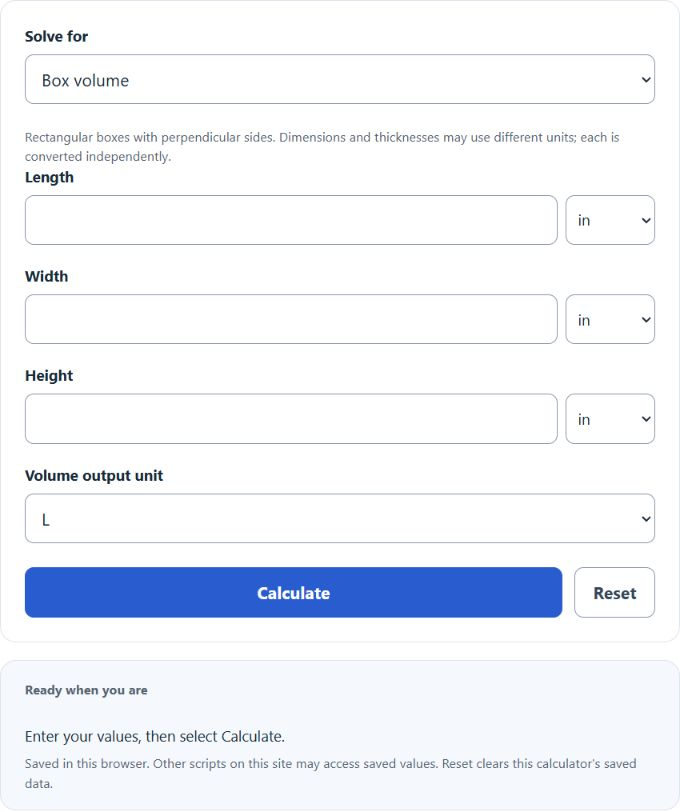
Calculate box volume or a missing dimension in mixed units, or estimate usable internal capacity from wall thickness with litres, gallons, area and diagonal.
- All Volume Calculators
- Surfboard Volume Calculator
- All Math and Numbers Calculators
- Column Volume Calculator
Box Volume Formula
The volume of a rectangular box is found by multiplying its length, width, and height. If you already know the volume and two dimensions, you can rearrange the same formula to find the missing dimension.
- V = box volume
- L = box length
- W = box width
- H = box height
The calculator converts each dimension to metres before applying the formula, then converts the answer into the selected output unit. Dimensions may use different units. US gallons mean US liquid gallons.
- To calculate volume: enter length, width, and height. The calculator multiplies the three dimensions.
- To calculate a missing dimension: select Missing dimension, enter the two known sides and volume, choose whether the result is length, width or height, and select the output unit.
- To estimate internal capacity: select Internal capacity and enter exterior dimensions. Subtract two side walls from length and width, and base plus lid thickness from height. Enter zero lid thickness for an open top. The planned fill percentage changes the filled-volume scenario, while the primary answer remains total internal capacity.
Common Box Volume Unit Conversions
Use these values to understand how the selected units relate to each other.
| Unit | Equivalent |
|---|---|
| 1 foot | 12 inches |
| 1 centimeter | 0.393701 inches |
| 1 meter | 39.3701 inches |
| 1 cubic foot | 1,728 cubic inches |
| 1 cubic centimeter | 0.0610237 cubic inches |
| 1 cubic meter | 61,023.7 cubic inches |
Typical Box Volume Reference Values
| Box Dimensions | Volume in Cubic Inches | Volume in Cubic Feet |
|---|---|---|
| 6 in × 6 in × 6 in | 216 in³ | 0.125 ft³ |
| 12 in × 12 in × 12 in | 1,728 in³ | 1 ft³ |
| 18 in × 12 in × 12 in | 2,592 in³ | 1.5 ft³ |
| 24 in × 18 in × 18 in | 7,776 in³ | 4.5 ft³ |
Example Problems
Example 1: Calculate box volume
You have a box that is 20 inches long, 12 inches wide, and 10 inches high.
The box volume is 2,400 cubic inches.
Example 2: Calculate missing height
You know a box has a volume of 6 cubic feet. The length is 3 feet and the width is 2 feet.
The missing height is 1 foot.
FAQ
What dimensions do I use for box volume?
Use the inside length, inside width, and inside height if you need usable storage capacity. Use the outside dimensions if you need shipping size, package size, or space the box takes up.
Why do length, width, and height need matching units?
The dimensions must represent the same measurement scale before multiplication. The calculator converts each length to metres first, then converts the result to your selected volume unit. You may enter different units for different dimensions.
Is box volume the same as capacity?
Box volume is the total three-dimensional space based on length, width, and height. Capacity usually means how much the box can actually hold. If the box has thick walls, rounded corners, packing material, or an irregular interior, the usable capacity may be slightly less than the calculated rectangular volume.