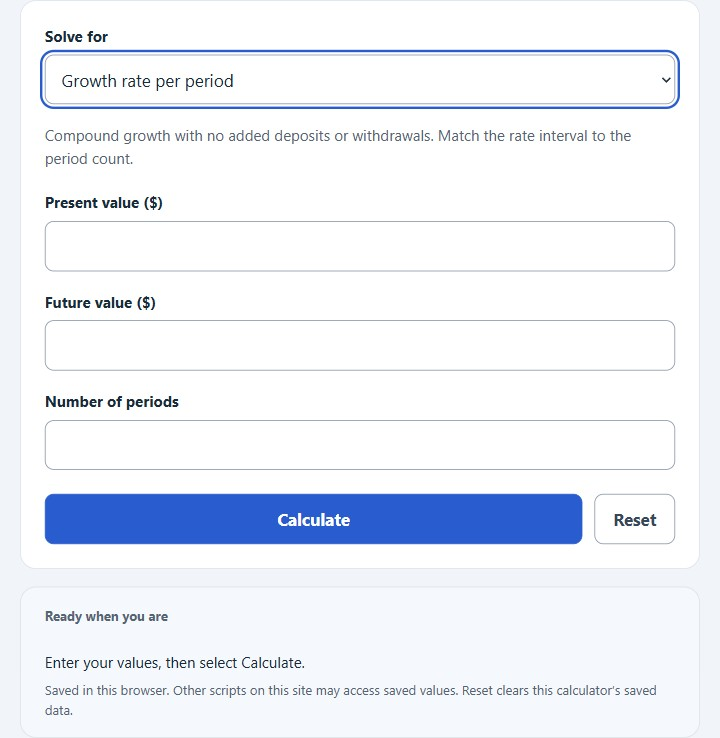
Select periodic growth rate, future value, present value, or periods. Enter the three known values for constant compound growth without added deposits or withdrawals.
Catch-Up Growth Formula
The catch-up growth calculation uses compound growth. Choose the value to solve and enter the three known values. Amounts are nonnegative USD estimates; rates can describe growth or decline down to −100%, and periods can be nonnegative fractions. Inverse cases with no unique solution are reported.
- FV = future value, or the target ending amount
- PV = present value, or the starting amount
- CG = catch-up growth rate per period, expressed as a percent
- n = number of compounding periods
The future value function calculates where a starting value will end after growing at the catch-up rate for a set number of periods. The catch-up growth rate function calculates the required periodic growth rate needed to move from the present value to the future value. The number of periods function calculates how long it will take to reach the future value at a given growth rate. The present value function calculates the starting value needed to reach a future value at a given growth rate and number of periods.
Growth Rate and Period Reference
The tables below are mathematical examples, not expected returns or investment benchmarks. The growth rate period must match the period count. For example, if the growth rate is annual, then the number of periods should be years.
| Growth Rate per Period | Multiplier After 5 Periods | Multiplier After 10 Periods | Multiplier After 20 Periods |
|---|---|---|---|
| 2% | 1.1041 | 1.2190 | 1.4859 |
| 5% | 1.2763 | 1.6289 | 2.6533 |
| 8% | 1.4693 | 2.1589 | 4.6610 |
| 10% | 1.6105 | 2.5937 | 6.7275 |
| Starting Value | Target Value | Periods | Required Catch-up Growth Rate |
|---|---|---|---|
| $1,000 | $1,500 | 5 | 8.4472% |
| $2,500 | $5,000 | 10 | 7.1773% |
| $10,000 | $25,000 | 15 | 6.2990% |
Example Problems
Example 1: Calculate future value
You start with $5,000, the catch-up growth rate is 6% per period, and the value grows for 8 periods.
The future value is $7,969.24.
Example 2: Calculate catch-up growth rate
You need a present value of $12,000 to grow to $20,000 over 6 periods.
The required catch-up growth rate is 8.8867% per period.
FAQ
What does catch-up growth rate mean?
Catch-up growth rate is the periodic compound growth rate needed for a starting value to reach a target value within a set number of periods. In this calculator, it is treated like a compound growth rate for money or another numeric value.
Do periods have to be years?
No. Periods can be years, months, quarters, or any consistent interval. The important rule is that the growth rate and periods must use the same interval. If the rate is monthly, the period count should be in months. If the rate is annual, the period count should be in years.
Why are three known values required?
Select the value to solve; its input is hidden. The other three values determine the answer when a unique solution exists. Zero growth, zero periods, zero starting value or a complete loss can make an inverse undefined, impossible or nonunique. The model excludes deposits, withdrawals, taxes, fees and inflation, and it does not guarantee an actual return.