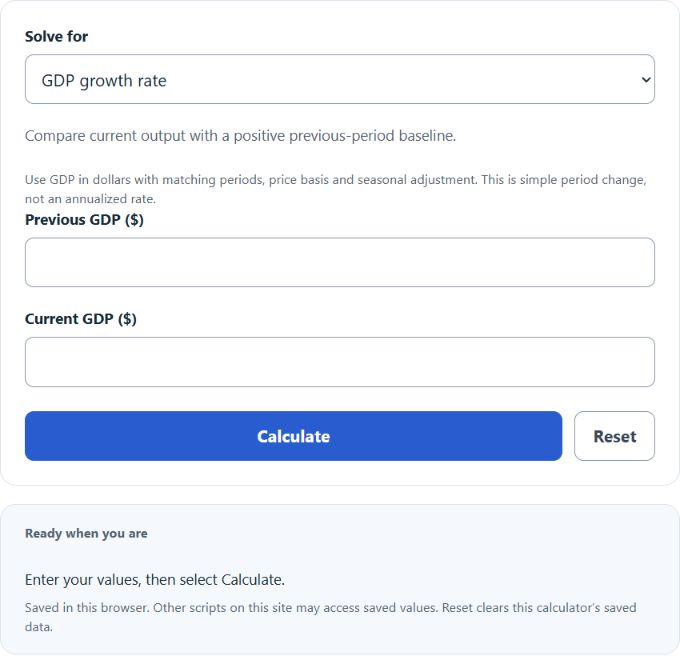
Select GDP growth rate, previous GDP, or current GDP, then enter the two required values.
- All Business Calculators
- GDP Per Capita Calculator
- National Income Calculator
- Population Growth Calculator
- Real GDP Calculator
- Economic Growth Calculator
- GDP Per Capita Calculator
GDP Growth Rate Formula
The GDP growth rate measures how much economic output changed from one period to the next. It compares the current period's GDP to the previous period's GDP and expresses the difference as a percentage of the previous period.
- GDPG = GDP growth rate as a percentage
- GDPc = GDP in the current period
- GDPp = GDP in the previous period
This formula is useful for year-over-year, quarter-over-quarter, or any other period-to-period comparison as long as both GDP values are measured on the same basis.
How to Use the GDP Growth Rate Calculator
- Select the value to solve for.
- Enter the two required GDP or growth values.
- Make sure both values use the same units, currency, and reporting method.
- Calculate the result to find the percentage increase or decrease.
For the most meaningful comparison, use GDP figures that are:
- From matching time intervals, such as one quarter to the previous quarter or one year to the previous year
- Reported in the same currency
- Either both nominal GDP or both real GDP
- Either both seasonally adjusted or both unadjusted
How to Interpret the Result
| Result | Meaning |
|---|---|
| Positive value | The economy expanded compared with the previous period. |
| Zero | Economic output was unchanged. |
| Negative value | The economy contracted compared with the previous period. |
A higher growth rate generally signals stronger economic activity, but context matters. Very high GDP growth can sometimes reflect rebound effects, temporary stimulus, or inflation-driven increases rather than broad-based long-term improvement.
Example
If GDP increased from 21.00 trillion to 21.84 trillion, the growth rate would be:
In this case, GDP grew by 4.00% over the period being measured.
Nominal GDP vs. Real GDP
The calculator works with either nominal GDP or real GDP, but the interpretation changes depending on which one you use:
- Nominal GDP includes changes in prices and output.
- Real GDP adjusts for inflation and is usually better for measuring actual economic growth.
If your goal is to understand whether the economy produced more goods and services, real GDP is usually the better input. If you use nominal GDP, part of the measured growth may come from higher prices rather than higher production.
Quarterly, Annual, and Annualized Growth
GDP growth can be reported in several ways. The formula above gives the simple period-to-period percentage change. For quarterly data, some analysts also convert that quarterly change into an annualized rate.
Simple quarter-over-quarter growth:
Annualized quarterly growth:
These two values are not the same. A quarterly change shows what happened during that specific quarter, while an annualized rate estimates what growth would look like if the same quarterly pace continued for a full year.
Why GDP Growth Rate Matters
GDP growth is one of the most widely used indicators of economic performance because it helps summarize whether total output is rising or falling. Economists, businesses, investors, and policymakers often monitor GDP growth to evaluate:
- Overall economic expansion or contraction
- Business cycle strength
- Changes in demand, production, and income
- Whether policy conditions may be too weak or too strong
On its own, GDP growth does not describe everything about economic health. It does not directly show income distribution, living standards, unemployment quality, or whether growth is sustainable.
Common Mistakes When Calculating GDP Growth
- Mixing time periods: comparing a quarterly GDP value to an annual GDP value produces a misleading result.
- Mixing nominal and real GDP: this blends inflation-adjusted and non-adjusted figures.
- Using different currencies: GDP must be stated in the same monetary unit for both periods.
- Ignoring the base period: the previous period is the baseline, so even a small absolute change can create a large percentage if the starting GDP was small.
- Using zero as the previous GDP: growth is undefined when the prior value is zero because division by zero is not possible.
Multi-Period Average Growth
If you want the average annual growth over several years instead of a single period change, a compound annual growth rate can be more informative.
Where n is the number of years. Multiply the result by 100 to convert it to a percentage. This is useful when GDP changes across multiple periods and you want one smoothed yearly growth rate.
FAQ
Can GDP growth be negative?
Yes. A negative GDP growth rate means the economy produced less output than it did in the previous period.
Is a higher GDP growth rate always better?
Not always. Strong growth is often positive, but extremely rapid growth can be driven by inflation, temporary shocks, or unsustainable borrowing. Quality and stability of growth also matter.
What does a GDP growth rate of 0% mean?
A result of 0% means GDP stayed the same between the two periods.
Why is the previous period in the denominator?
The previous period acts as the baseline. Using it in the denominator converts the change in GDP into a relative percentage, which makes comparisons more meaningful across different GDP levels.
Should I use nominal GDP or real GDP in this calculator?
Use nominal GDP when you want total output measured at current prices. Use real GDP when you want inflation-adjusted growth that better reflects changes in actual production.