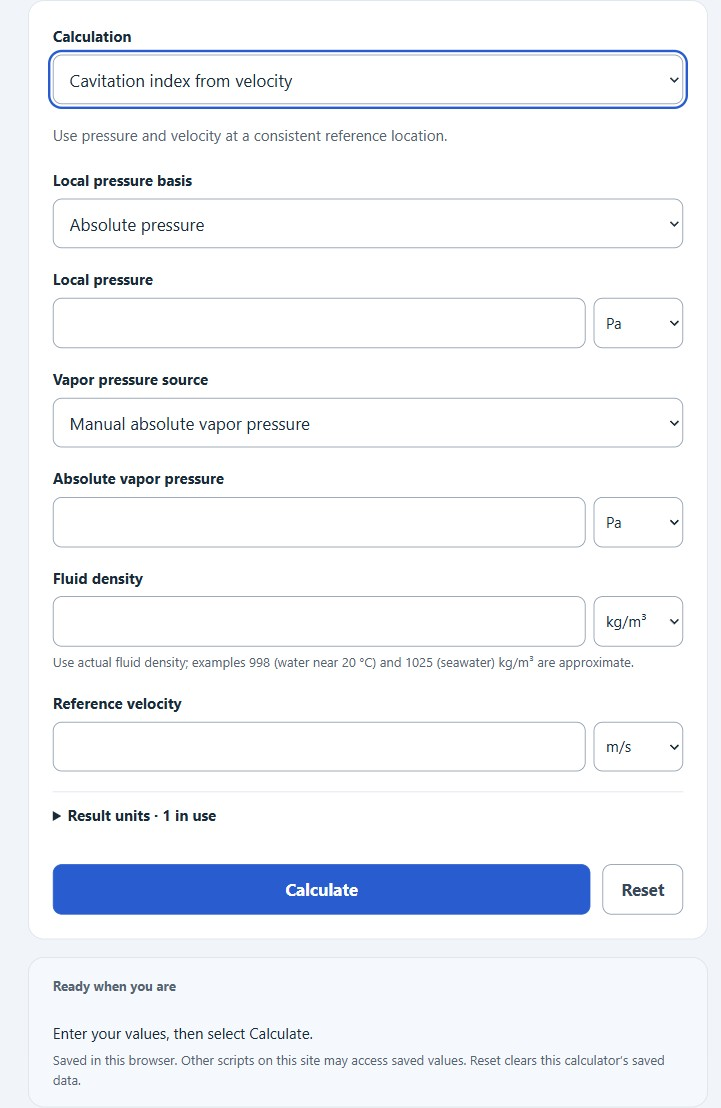
Calculate cavitation index and pump Thoma number from pressure, vapor pressure, density, velocity, flow rate, pipe diameter, and NPSH.
Related Calculators
- Compressibility Calculator
- Average Density Calculator
- Superficial Gas Velocity Calculator
- TFA – Total Flow Area Calculator
- All Physics Calculators
Cavitation Index Formula
The following formula is used to calculate the Cavitation Index.
Variables:
- CI is the Cavitation Index
- P is the absolute local reference pressure in the flow field (Pa)
- Pv is the absolute saturation vapor pressure of the fluid (Pa)
- ρ is the fluid density (kg/m^3)
- V is the local flow velocity (m/s)
To calculate the Cavitation Index, subtract the vapor pressure of the fluid from the local pressure in the flow field. Then, multiply the fluid density by half and the local flow velocity squared. Finally, divide the first result by the second result.
What is a Cavitation Index?
A Cavitation Index is a dimensionless number used in fluid dynamics and hydraulics to determine the possibility of cavitation occurring in a fluid flow system. Cavitation is a phenomenon where rapid changes in pressure in a liquid lead to the formation of small vapor-filled cavities, which can cause significant damage to equipment. The Cavitation Index compares reference absolute pressure above saturation pressure with dynamic pressure. Lower values can indicate greater cavitation susceptibility under comparable conditions, but there is no universal safe threshold: geometry and equipment-specific inception data are needed. Pump mode reports available Thoma coefficient, NPSHa/H, separately from required coefficient, NPSHr/H. Meeting NPSHr alone does not guarantee cavitation-free operation or an adequate design margin.
How to Calculate Cavitation Index?
The following steps outline how to calculate the Cavitation Index (CI).
- First, choose the calculation and enter local reference pressure with its unit and absolute or gauge basis. Gauge mode adds an estimated standard-atmosphere pressure for elevation; it does not model current weather.
- Next, enter absolute vapor pressure, or estimate it for pure liquid water from 0.01 °C to below 373.946 °C. Use actual fluid density; it does not automatically follow temperature.
- Next, determine the fluid density (ρ) in kilograms per cubic meter (kg/m^3).
- Next, determine the local flow velocity (V) in meters per second (m/s).
- Next, gather the formula from above: CI = (P – Pv) / (0.5 * ρ * V^2).
- Finally, calculate the Cavitation Index (CI).
- After inserting the variables and calculating the result, check your answer with the calculator above.
Example Problem:
Use the following variables as an example problem to test your knowledge:
local absolute pressure in the flow field (P) = 500 Pa
vapor pressure of the fluid (Pv) = 200 Pa
fluid density (ρ) = 1000 kg/m^3
local flow velocity (V) = 10 m/s; the mathematical example gives CI = 0.006 and does not demonstrate a safe operating condition.