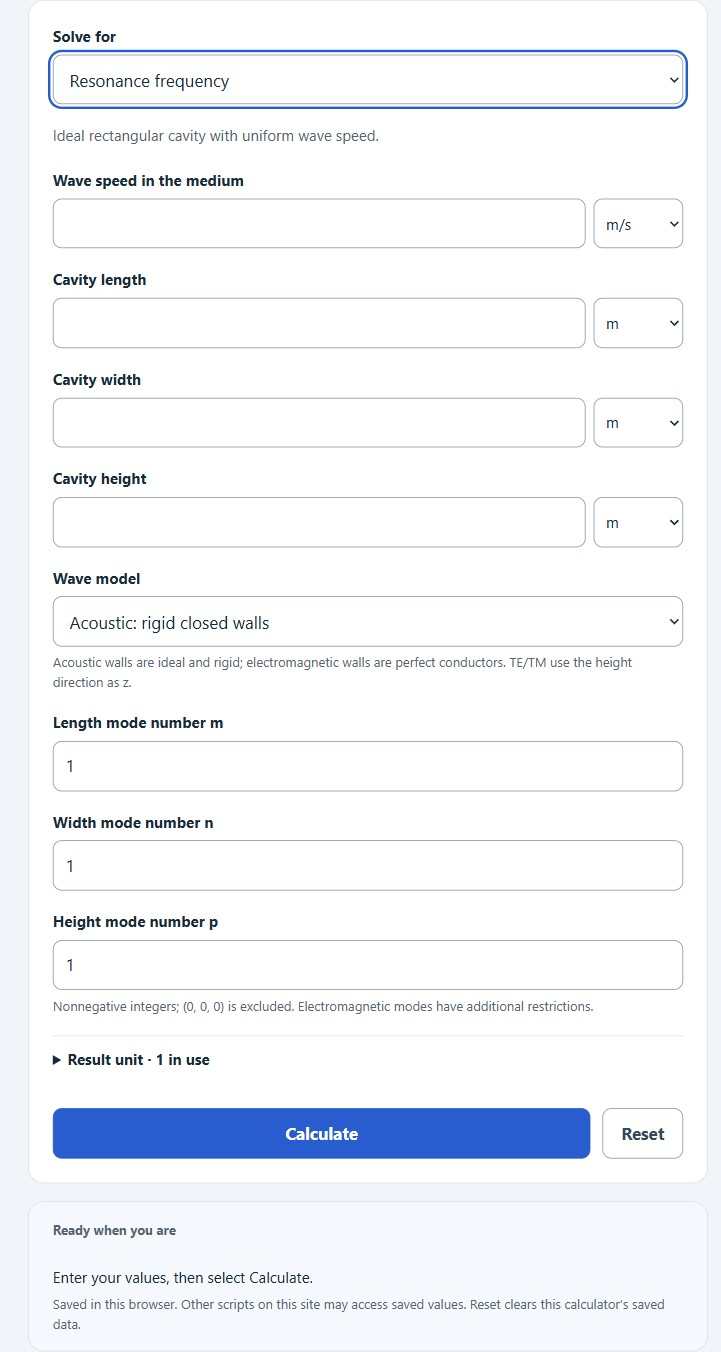
Calculate ideal rectangular cavity resonance frequency, wave speed, length, width, or height for rigid-wall acoustic or conducting electromagnetic TE/TM modes.
Related Calculators
- Electrical Length Calculator
- Velocity Factor Calculator
- Beat Frequency Calculator
- Peak Envelope Power (PEP) Calculator
- All Physics Calculators
Cavity Resonance Formula
The calculator uses the ideal rectangular cavity resonance relationship for a mode identified by integer mode numbers m, n, and p. Acoustic mode assumes rigid closed walls. Electromagnetic modes assume perfectly conducting walls and a homogeneous medium, with TE/TM defined relative to the height (z) axis. Acoustic indices are nonnegative and not all zero; TE requires p ≥ 1 and m or n ≥ 1; TM requires m,n ≥ 1 and allows p = 0. Losses and coupling are not modeled.
To solve for wave speed:
To solve for cavity length:
To solve for cavity width:
To solve for cavity height:
- fmnp = resonance frequency for the selected cavity mode
- v = wave speed in the cavity medium
- L = cavity length
- W = cavity width
- H = cavity height
- m = length-direction mode number
- n = width-direction mode number
- p = height-direction mode number
Choose the value to solve for, then enter the four displayed known physical values and the wave model and mode numbers. The calculator converts the selected units to base units, applies the formula, and converts the answer to the selected result unit.
If you solve for a dimension, the corresponding mode number must be greater than zero. For example, you cannot solve for L when m = 0, because that mode does not depend on the length term.
Common Wave Speeds for Cavity Calculations
Use a wave speed that matches the type of wave and the medium inside the cavity.
| Wave or medium | Typical speed | Use case |
|---|---|---|
| Sound in air at about 20°C | 343 m/s | Acoustic cavity or room mode estimates |
| Sound in water | about 1480 m/s | Fluid-filled acoustic cavities |
| Electromagnetic wave in vacuum (air is approximate) | 299,792,458 m/s | Microwave or RF rectangular cavities |
| Electromagnetic wave in a dielectric | c / sqrt(εrμr) | Cavities filled with non-air material |
Mode Number Reference
| Mode numbers | What changes the frequency? | Notes |
|---|---|---|
| (1, 0, 0) | Length only | Rigid-wall acoustic mode; frequency is independent of width and height. |
| (0, 1, 0) | Width only | Rigid-wall acoustic mode; frequency is independent of length and height. |
| (0, 0, 1) | Height only | Rigid-wall acoustic mode; frequency is independent of length and width. |
| (1, 1, 1) | Length, width, and height | All three dimensions contribute; (1,1,1) is permitted in each model. |
Example Calculations
Example 1: Calculate resonance frequency
Suppose the wave speed is 343 m/s, the cavity dimensions are L = 0.5 m, W = 0.4 m, H = 0.3 m, and the mode is (1, 1, 1).
The resonance frequency is about 792.6 Hz.
Example 2: Calculate cavity length
Suppose the resonance frequency is 500 MHz, the vacuum wave speed is 299,792,458 m/s, H = 0.5 m, W = 0.4 m, and the conducting electromagnetic TE mode is (1, 0, 1), with z along height. Width does not affect this mode; both length and height contribute.
The required cavity length is about 0.3746 m, or about 37.5 cm.
FAQ
Why can the mode numbers not all be zero?
If m, n, and p are all zero, every term inside the square root becomes zero. That would give a zero-frequency result, which is not a usable cavity resonance mode in this formula. At least one mode number must be greater than zero; electromagnetic modes must also satisfy the TE/TM restrictions above.
What happens if one mode number is zero?
A zero mode number removes that direction from the frequency calculation. For example, if m = 0, the term (m/L)2 is zero, so the resonance frequency does not depend on length. That is why you cannot solve for length when m = 0.
How do I choose the value to calculate?
Select the unknown in “Solve for” and enter the four displayed known values. A dimension inverse requires a positive corresponding mode number and a positive remaining squared term. Inputs at or too close to the limiting frequency cannot produce a reliable finite positive dimension.