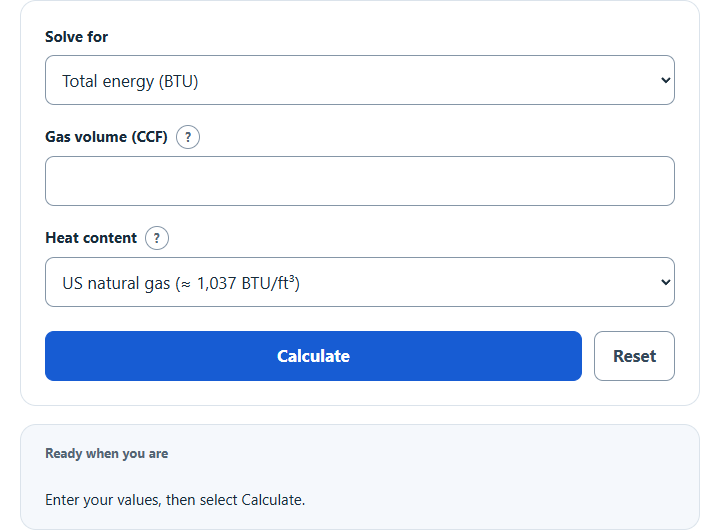
Convert CCF to BTU using the US average natural gas heat content or your supplier’s factor, and get therms, MMBtu, BTU to CCF or CFH to BTU/h.
Ccf To Btu Formula
The following equation is used to calculate the Total BTU.
- Where BTU is the total BTU
- CF is the conversion factor (BTU/CCF)
- CCF is the volume in CCF
To calculate the total BTU, multiply the conversion factor by the volume.
| Volume (CCF) | Energy (BTU) |
|---|---|
| 0.10 | 10,370 |
| 0.25 | 25,925 |
| 0.50 | 51,850 |
| 0.75 | 77,775 |
| 1 | 103,700 |
| 2 | 207,400 |
| 3 | 311,100 |
| 4 | 414,800 |
| 5 | 518,500 |
| 7.5 | 777,750 |
| 10 | 1,037,000 |
| 12 | 1,244,400 |
| 15 | 1,555,500 |
| 20 | 2,074,000 |
| 25 | 2,592,500 |
| 30 | 3,111,000 |
| 40 | 4,148,000 |
| 50 | 5,185,000 |
| 75 | 7,777,500 |
| 100 | 10,370,000 |
| *Illustrative heat content of 1,037 BTU/ft³ gives 103,700 BTU/CCF. This is an assumption for this table; actual supplier factors vary by gas composition, measurement conditions, region and time. | |
What is a Ccf To Btu Calculator?
Definition:
A Ccf To Btu Calculator is a tool that determines one of the three values—Total BTU, volume in CCF, or conversion factor (BTU/CCF)—when the other two values are provided.
How to Calculate Total BTU?
Example Problem:
The following example outlines the steps and information needed to calculate the Total BTU.
First, determine the volume. In this example, the volume is 150 CCF.
Next, use an illustrative heat content of 1,020 BTU/ft³, equivalent to 102,000 BTU/CCF.
Finally, calculate the Total BTU using the formula above:
BTU = CF * CCF
BTU = 102000 * 150
BTU = 15300000 BTU
FAQ
What determines the conversion factor (BTU/CCF)?
The conversion factor is determined by the energy content of the gas and may vary based on factors such as its composition and the supplier’s measurements.
What does CCF stand for?
CCF stands for hundred cubic feet, a unit of volume commonly used to measure the quantity of natural gas.
Can the calculator compute any missing value?
Yes. Select the value to solve for, enter the two known values, and select Calculate. A positive heat content allows zero energy or volume when solving the corresponding quantity. Zero volume cannot determine heat content, and heat-content solving requires positive energy.