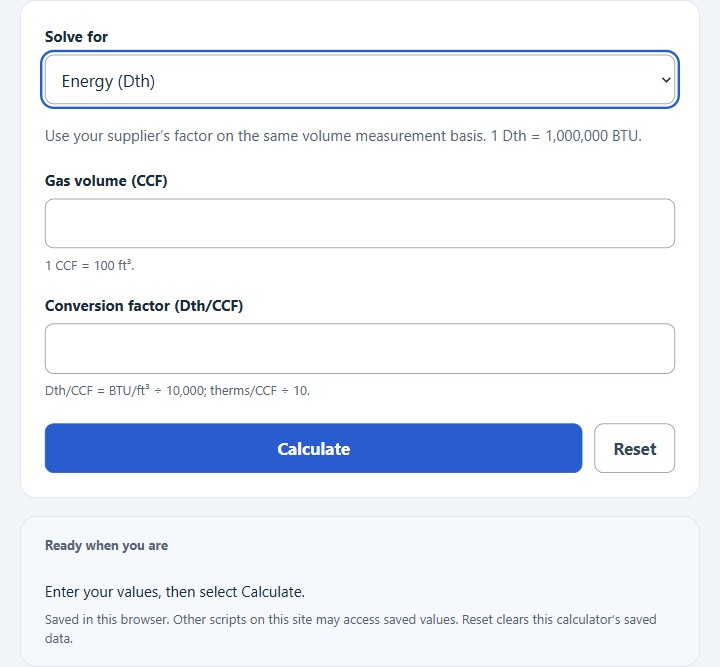
Choose Energy, Gas volume, or Conversion factor, enter the two known values, and select Calculate. Use the supplier’s Dth-per-CCF factor on the same volume measurement basis.
Ccf To Dth Formula
The following equation shows the relationship between volume, energy, and conversion factor.
- Where E is the energy (Dth)
- V is the volume (Ccf)
- CF is the conversion factor (Dth per Ccf)
Select the value to solve for and enter the two known values. Energy = volume × factor; volume = energy ÷ factor; factor = energy ÷ volume.
| Ccf | Dth |
|---|---|
| 1 | 0.104 |
| 2 | 0.207 |
| 5 | 0.519 |
| 10 | 1.037 |
| 15 | 1.556 |
| 20 | 2.074 |
| 25 | 2.593 |
| 30 | 3.111 |
| 40 | 4.148 |
| 50 | 5.185 |
| 60 | 6.222 |
| 75 | 7.778 |
| 80 | 8.296 |
| 90 | 9.333 |
| 100 | 10.370 |
| 150 | 15.555 |
| 200 | 20.740 |
| 300 | 31.110 |
| 400 | 41.480 |
| 500 | 51.850 |
| Uses an illustrative higher heating value of 1,037 BTU/ft³, equivalent to 103,700 BTU/CCF, 1.037 therms/CCF or 0.1037 Dth/CCF. Actual supplier factors vary. 1 Dth = 10 therms = 1,000,000 BTU. | |
What is a Ccf To Dth Calculator?
Definition:
A Ccf to Dth Calculator is a tool that converts between volume measured in Ccf and energy measured in Dth using a conversion factor. It allows you to compute the missing parameter when any two values are provided.
How to Calculate Ccf To Dth?
Example Problem:
The following example outlines the steps and information needed to calculate the missing value.
First, determine the volume. In this example, assume the volume is 200 Ccf.
Next, use an illustrative conversion factor of 0.1037 Dth per Ccf (1,037 BTU/ft³).
Finally, calculate the energy using the formula above:
E = V × CF
E = 200 × 0.1037
E = 20.74 Dth
FAQ
What do Ccf and Dth represent?
Ccf stands for hundred cubic feet and Dth stands for decatherms, which measure the volume and energy content of natural gas respectively.
How is the conversion factor determined?
Use the gas supplier’s measured heat content on the same volume measurement basis. Dth/CCF = BTU/ft³ ÷ 10,000 = therms/CCF ÷ 10. No universal factor or temperature, pressure, compressibility or billing correction is assumed.
How do I choose the value to calculate?
Select the value to solve for, enter the two shown inputs, and select Calculate. A positive factor permits zero energy or volume for those solves. Factor solving requires positive energy and volume; zero volume cannot determine a factor.