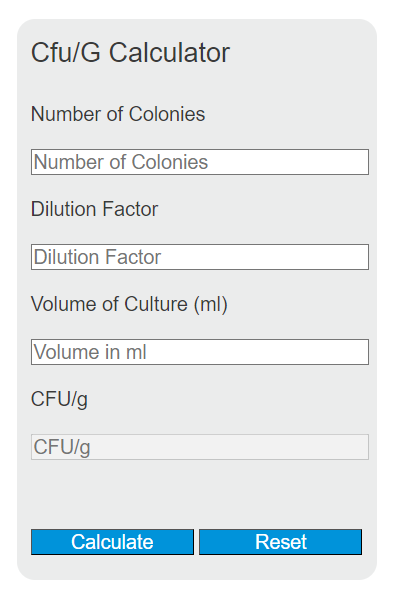
Calculate CFU/g from colony count, reciprocal dilution factor, sample mass, and plated volume, or solve for any missing value with log10 results.
Related Calculators
- Cfu/Ml Calculator
- 10 Fold Dilution Calculator
- Transformation Efficiency Calculator
- Plasmid Molar Ratio Calculator
- All Biology Calculators
CFU/g Formula
The calculator uses the standard colony count relationship between colonies, dilution factor, sample mass, and CFU concentration. The dilution factor is entered as the reciprocal of the dilution. For example, a 10-6 dilution is entered as 1,000,000.
To solve for the other fields, the same equation is rearranged:
- CFU/g = colony forming units per gram
- CFU/kg = colony forming units per kilogram
- C = number of colonies counted
- DF = dilution factor entered as the reciprocal of the dilution
- Mg = sample mass in grams
- Mkg = sample mass in kilograms
If you leave the CFU concentration blank, the calculator computes CFU/g or CFU/kg from the colony count, dilution factor, and sample mass. If you leave colonies, dilution factor, or mass blank, it rearranges the same formula to solve for that missing value. The calculator converts kilograms to grams internally when needed, and converts CFU/g to CFU/kg by multiplying by 1,000.
Common Dilution Factors and Count Ranges
| Dilution | Enter as dilution factor | Scientific notation |
|---|---|---|
| 10-1 | 10 | 1e1 |
| 10-2 | 100 | 1e2 |
| 10-3 | 1,000 | 1e3 |
| 10-6 | 1,000,000 | 1e6 |
| Plate count | Typical interpretation |
|---|---|
| 0 colonies | Report as below the detection limit for the method, not necessarily sterile. |
| 1 to 29 colonies | Often considered low-count and less statistically reliable. |
| 30 to 300 colonies | Common countable range for many standard plate count methods. |
| More than 300 colonies | Often considered too numerous to count, unless your method specifies otherwise. |
CFU/g Examples
Example 1: You count 45 colonies from a 10-6 dilution, and the sample mass is 25 g.
The result is 1.8 × 10⁶ CFU/g.
Example 2: You know the concentration is 2.5 × 10⁵ CFU/g, the dilution factor is 10,000, and the sample mass is 10 g. To solve for colonies:
The expected colony count is 250 colonies.
CFU/g Calculator FAQ
What dilution factor should you enter?
Enter the reciprocal of the dilution. If the plate came from a 10-4 dilution, enter 10,000 or 1e4. Do not enter 0.0001, because the calculator expects the dilution factor, not the dilution fraction.
What is the difference between CFU/g and CFU/kg?
CFU/g expresses colony forming units per gram. CFU/kg expresses colony forming units per kilogram. Since 1 kg equals 1,000 g, a value in CFU/kg is 1,000 times the same concentration expressed in CFU/g.
Does this calculation include plated volume?
This calculator uses colonies, dilution factor, and sample mass. If your lab method uses a plated volume correction, apply that correction before entering the values or adjust the formula according to your method. For example, if only 0.1 mL was plated and your method requires correction for that volume, the result is typically multiplied by 10.