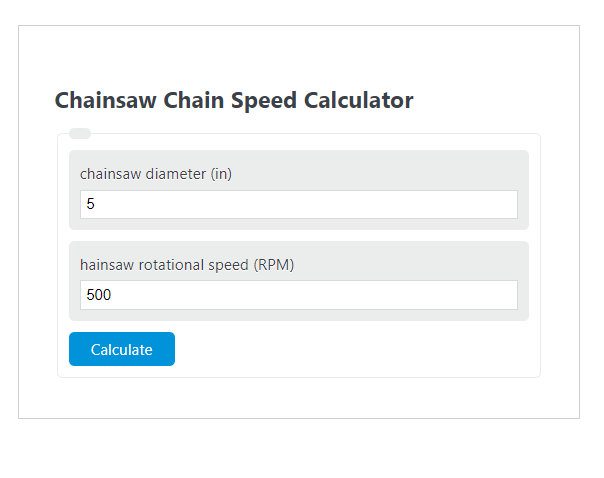
Calculate chainsaw chain speed in ft/s, m/s, ft/min and mph from chain pitch, engine RPM and drive sprocket teeth for quick or detailed setup.
- All Construction Calculators
- Tip Speed Calculator
- Spindle Speed Calculator
- Surface Speed (SFM) Calculator
Chain Speed Formula
- Pitch — chain pitch in inches (distance between three consecutive rivets, divided by two)
- Teeth — number of teeth on the drive sprocket (usually 6, 7, or 8)
- RPM — engine speed in revolutions per minute
- 720 — converts in/min to ft/s (12 in/ft × 60 s/min)
The factor of 2 accounts for the fact that one chain link advances by two pitch-lengths per sprocket tooth (each drive link spans two rivets). For metric output, multiply ft/s by 0.3048 to get m/s. The Quick mode assumes a 7-tooth sprocket; switch to Detailed if your saw uses a 6 or 8-tooth rim.
Reference Tables
Common chain pitches and where you find them:
| Pitch | Typical Saw Class | Common Use |
|---|---|---|
| 1/4″ | Mini / carving | Top-handle, carving bars |
| .325″ | Mid-size homeowner | 40–55 cc saws |
| 3/8″ | Pro / large homeowner | 60+ cc saws, felling |
| .404″ | Large pro / harvester | Big timber, mills |
How to read your result:
| Chain Speed | Interpretation |
|---|---|
| Below 15 m/s (49 ft/s) | Too slow for efficient cutting |
| 15–20 m/s (49–66 ft/s) | Below optimal, but workable |
| 20–27 m/s (66–89 ft/s) | Sweet spot for most chainsaws |
| 27–30 m/s (89–98 ft/s) | Tuned pro saw territory |
| Above 30 m/s (98 ft/s) | Recheck inputs; rare in practice |
Worked Example
A Stihl MS 261 running .325″ pitch chain on a 7-tooth rim sprocket at 13,500 RPM:
- 0.325 × 2 × 7 × 13,500 = 61,425 in/min
- 61,425 ÷ 12 = 5,118.75 ft/min
- 5,118.75 ÷ 60 = 85.3 ft/s (26.0 m/s)
That puts the saw squarely in the efficient cutting range.
FAQ
Does bar length affect chain speed? No. Bar length changes how much chain is in motion but not how fast it moves. Speed depends only on pitch, sprocket teeth, and RPM.
Should I measure RPM at idle or wide open? Use the maximum (no-load) RPM from your saw’s spec sheet to compare against the cutting-speed ranges above. Under load in the cut, actual RPM drops 20–30%.
Why does a bigger sprocket make the chain faster? More teeth means more chain pulled per revolution. Going from a 7-tooth to an 8-tooth rim raises chain speed by about 14%, but it also loads the engine more and can pull RPM down if the saw is underpowered.