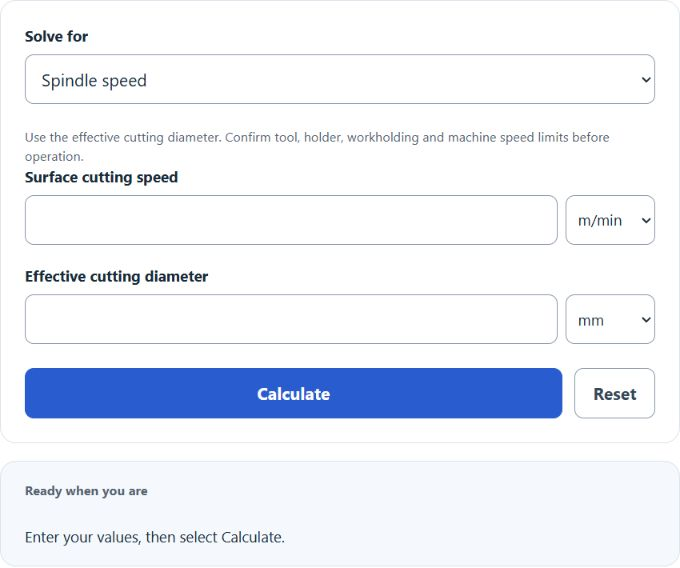
Calculate spindle speed, surface cutting speed, or spindle diameter by selecting the unknown and entering the two displayed values using m/min, ft/min, mm, in, and RPM for machining.
Spindle Speed Formula
The spindle speed calculator uses cutting speed, tool or workpiece diameter, and spindle speed. In metric units, the base formula is:
Rearranged for each missing value:
For inch and ft/min inputs, the equivalent formula is:
- V = surface speed or cutting speed
- D = effective cutting diameter of the tool or rotating workpiece at the cut
- N = spindle speed in revolutions per minute, RPM
- pi = 3.14159
If you select surface cutting speed, the calculator multiplies diameter by RPM and converts the result into a linear cutting speed.
If you select effective cutting diameter, the calculator rearranges the formula to find the diameter that matches the entered cutting speed and RPM.
If you select spindle speed, the calculator solves for RPM from the entered surface speed and diameter.
Typical Cutting Speed Ranges
Actual cutting speed depends on the tool material, coating, machine rigidity, coolant, and operation. These broad illustrative ranges are not recommendations for a specific tool or setup. Use the tool supplier’s cutting data and verify machine, holder and workholding limits.
| Material | HSS Tool, m/min | Carbide Tool, m/min | Approx. Carbide, ft/min |
|---|---|---|---|
| Aluminum | 60 to 150 | 200 to 600 | 650 to 1970 |
| Mild steel | 20 to 35 | 100 to 250 | 330 to 820 |
| Stainless steel | 10 to 25 | 60 to 160 | 200 to 525 |
| Cast iron | 15 to 30 | 80 to 200 | 260 to 655 |
| Brass | 50 to 100 | 150 to 400 | 490 to 1310 |
Example Calculations
Example 1: Calculate spindle speed
You have a 10 mm diameter tool and a cutting speed of 100 m/min.
The spindle speed is about 3183 RPM.
Example 2: Calculate surface speed
You have a 0.5 in diameter tool running at 3000 RPM.
The cutting speed is about 392.7 ft/min.
FAQ
What diameter should you enter?
Enter the effective cutting diameter. For milling, this is usually the cutter diameter. For turning, this is usually the workpiece diameter at the cut. For drilling, use the drill diameter.
Why does a larger diameter need a lower RPM?
At the same RPM, a larger diameter has a higher surface speed because the outside edge travels farther during each revolution. To keep the same cutting speed, RPM must decrease as diameter increases.
Is spindle speed the same as feed rate?
No. Spindle speed is rotational speed in RPM. Feed rate is how fast the tool moves through the material, usually in mm/min, in/min, mm/rev, or in/rev. Spindle speed is calculated from cutting speed and diameter, while feed rate also depends on chip load, number of flutes, or feed per revolution.