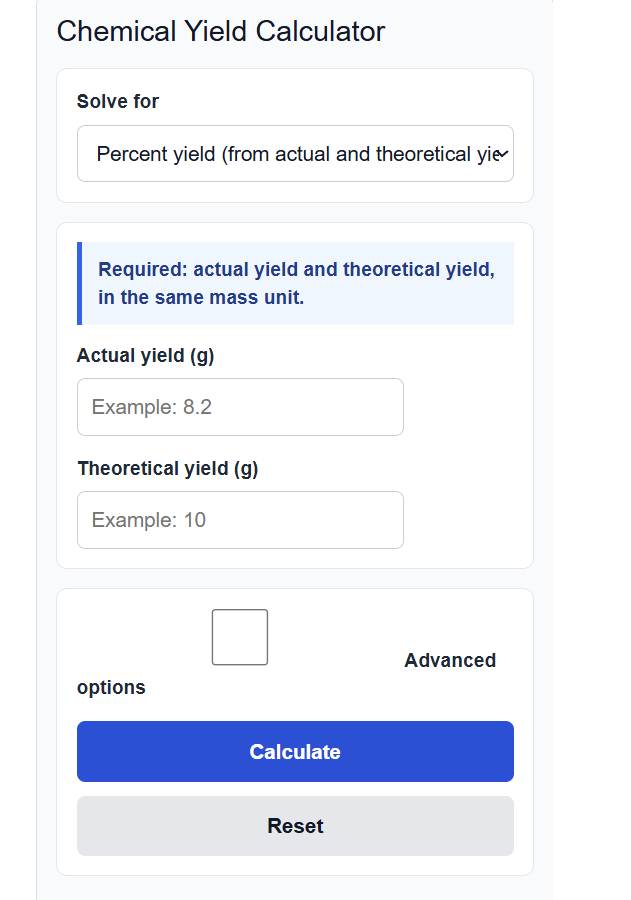
Calculate the percent, actual, or theoretical yield of any chemical reaction from the limiting reactant, mole ratio, and product molar mass.
Chemical Yield Formula
The calculator works with the standard yield equations used in stoichiometry. Which formula it applies depends on what you are solving for.
Percent yield compares what you actually collected to the most you could have collected:
Percent Yield = (Actual Yield / Theoretical Yield) * 100
Theoretical yield is the maximum mass of product the limiting reactant can form:
Theoretical Yield = moles of limiting reactant * mole ratio * molar mass of product
When you start from a mass of reactant instead of moles, the calculator first converts that mass to moles using the reactant molar mass:
moles of reactant = mass of reactant / molar mass of reactant
You can also rearrange the percent yield equation to recover either of the other two quantities:
Actual Yield = Theoretical Yield * Percent Yield / 100
Theoretical Yield = Actual Yield / Percent Yield * 100
The variables are:
- Actual Yield: the mass of product you measured in the lab after the reaction and any purification.
- Theoretical Yield: the mass of product predicted by stoichiometry if the reaction went to completion with no losses.
- Percent Yield: the ratio of actual to theoretical yield, expressed as a percentage of reaction efficiency.
- Moles of limiting reactant: the amount of the reactant that runs out first and caps how much product can form.
- Mole ratio: the number of moles of product formed per mole of the limiting reactant, taken from the balanced equation.
- Molar mass of product: the mass of one mole of the product in grams per mole.
Choose the “Solve for” option that matches the value you need. The percent yield mode takes your measured and predicted masses and returns the efficiency. The theoretical yield mode builds the prediction from the limiting reactant, either from moles or from a mass you convert. The remaining two modes rearrange the percent yield formula to find an actual yield or to back-calculate the theoretical yield. Keep actual and theoretical yields in the same mass unit so the percentage stays correct.
How to Interpret a Percent Yield
Percent yield tells you how efficient a reaction was. Use this table as a rough guide to what a result means in practice.
| Percent Yield | Interpretation |
|---|---|
| 90% to 100% | Excellent. Very little product was lost. |
| 80% to 90% | Very good. Typical for a well run synthesis. |
| 70% to 80% | Good. Acceptable for many multi step reactions. |
| 50% to 70% | Moderate. Losses from side reactions or transfers. |
| Below 50% | Low. Check the procedure and limiting reactant. |
| Above 100% | Impossible in theory. The product likely still holds water, solvent, or impurities. |
Common molar masses you may need when finding a theoretical yield are listed below.
| Compound | Molar Mass (g/mol) |
|---|---|
| Water (H2O) | 18.02 |
| Carbon dioxide (CO2) | 44.01 |
| Sodium chloride (NaCl) | 58.44 |
| Glucose (C6H12O6) | 180.16 |
| Aspirin (C9H8O4) | 180.16 |
Example Problems
Example 1. A reaction predicts a theoretical yield of 10 grams of product, and you collect 8.2 grams. Divide the actual yield by the theoretical yield and multiply by 100. The percent yield is (8.2 / 10) * 100 = 82%. That falls in the very good range.
Example 2. You react 0.5 moles of a limiting reactant that forms product in a 1 to 1 mole ratio, and the product has a molar mass of 18.02 grams per mole. The theoretical yield is 0.5 * 1 * 18.02 = 9.01 grams. If you then measure 7.5 grams of product, the percent yield is (7.5 / 9.01) * 100 = 83.2%.
Frequently Asked Questions
Why is my actual yield always lower than the theoretical yield?
Real reactions lose product in ways the math does not account for. Some reactant fails to react, side reactions form other products, and material is left behind during filtering, transferring, and drying. Because of these losses, the actual yield is almost always below the theoretical maximum, so a percent yield under 100% is normal.
Can a percent yield be more than 100%?
In theory no, because you cannot collect more product than the limiting reactant allows. In practice a value above 100% means your measured product is not pure. It usually still contains leftover solvent, water, or unreacted starting material that adds extra mass. Drying the sample fully and reweighing it normally brings the value back below 100%.
How do I find the theoretical yield if I only know the mass of a reactant?
Switch the theoretical yield mode to enter a mass. Divide the reactant mass by its molar mass to get moles, multiply by the mole ratio from the balanced equation to get moles of product, then multiply by the molar mass of the product. The calculator runs these three steps for you when you supply the reactant mass, reactant molar mass, mole ratio, and product molar mass.