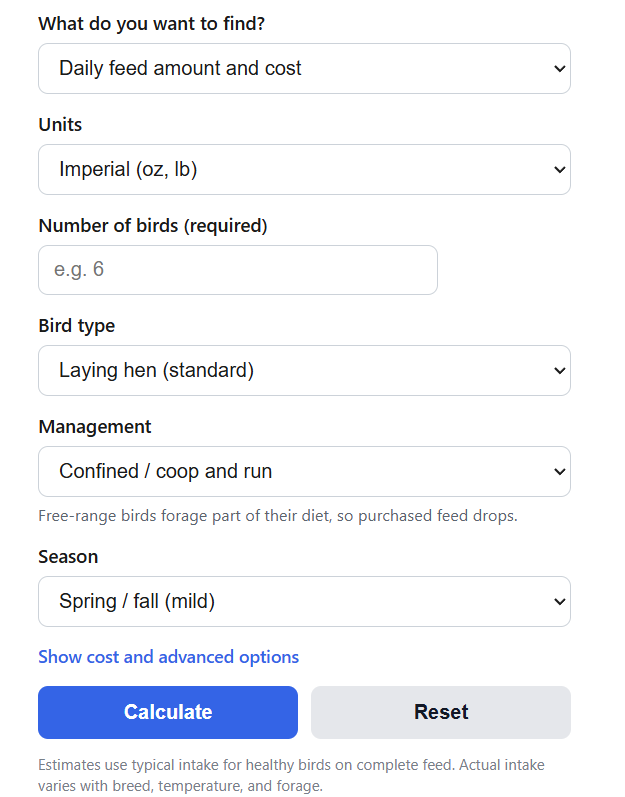
Calculate how much feed your chickens need per day, week, and month from flock size, bird type, and season, plus feed cost per month and how long your feed supply will last.
Chicken Feed Amount Formula
F = N * R * M * S * (1 + W/100)
- F is the total feed your flock needs per day (grams)
- N is the number of birds
- R is the base intake per bird per day (grams), set by bird type
- M is the management factor (1.0 confined, 0.9 semi free range, 0.75 free range)
- S is the season factor (1.0 mild, 0.95 hot, 1.12 cold)
- W is the feed waste percentage from your feeder style
The calculator's second mode answers how long your current feed supply will last:
D = A / F
- D is the number of days your feed will last
- A is the amount of feed on hand (same weight unit as F)
When you enter a feed price and your hens' lay rate, the calculator also finds your feed cost per dozen eggs:
CPD = (r * 7 * p) / (E / 12)
- CPD is the feed cost per dozen eggs ($)
- r is the feed one hen uses per day, including waste (lb or kg)
- p is the feed price per lb or per kg
- E is the eggs one hen lays per week
In the daily feed mode, the calculator multiplies the base intake for your bird type by the management and season factors, adds your waste percentage, and reports per-bird and whole-flock amounts by day, week, and month, plus bags per month and monthly cost if you enter a bag size and price. In the supply mode, it divides the feed you have on hand by the flock's daily consumption to give the days remaining and an estimated run-out date.
Daily Feed Intake by Bird Type
Base intake is for a confined bird in mild weather eating a complete feed. These are the values the calculator starts from before applying your adjustments.
| Bird type | Per bird per day | Per bird per month |
|---|---|---|
| Chick (0 to 8 weeks) | 1 oz (30 g) | 2 lb (0.9 kg) |
| Bantam | 1.8 oz (50 g) | 3.3 lb (1.5 kg) |
| Pullet / grower (8 to 20 weeks) | 3.2 oz (90 g) | 6 lb (2.7 kg) |
| Laying hen (standard) | 4.1 oz (115 g) | 7.6 lb (3.5 kg) |
| Dual-purpose breed | 4.9 oz (140 g) | 9.3 lb (4.2 kg) |
| Broiler / meat bird | 6 oz (170 g) | 11.2 lb (5.1 kg) |
Feed Cost per Dozen Eggs by Lay Rate
A standard hen eats about 1.75 lb of feed per week whether she lays well or poorly, so your feed cost per dozen eggs depends heavily on lay rate. The table assumes 1.75 lb per hen per week and shows why older or molting hens make eggs much more expensive.
| Eggs per hen per week | Feed per dozen eggs | Cost per dozen at $0.40/lb | Cost per dozen at $0.60/lb |
|---|---|---|---|
| 3 (older hens) | 7.0 lb | $2.80 | $4.20 |
| 4 (average backyard) | 5.25 lb | $2.10 | $3.15 |
| 5 (good layer) | 4.2 lb | $1.68 | $2.52 |
| 6 (peak production) | 3.5 lb | $1.40 | $2.10 |
Chicken Feed Amount Example
Example 1: You keep 12 standard laying hens in a coop and run, in mild spring weather, with an average feeder (10% waste). Base intake is 115 g, and both the management and season factors are 1.0. Per hen, feed used is 115 * 1.0 * 1.0 * 1.10 = 126.5 g per day. The flock needs 12 * 126.5 = 1,518 g, or about 3.35 lb per day, which is roughly 100 lb per month, almost exactly two 50 lb bags.
Example 2: You have a 50 lb bag and 8 free-range hens in winter, and want to know how long it will last. Per hen: 115 * 0.75 * 1.12 = 96.6 g per day. The flock eats 8 * 96.6 = 772.8 g, or about 1.70 lb per day. D = 50 / 1.70 = about 29 days, so plan to buy more feed within four weeks.
FAQ
How much feed does one chicken need per day? A standard adult laying hen eats about 0.25 lb (roughly 1/2 cup or 115 g) of complete feed per day. Broilers eat more, around 6 oz per day, while bantams need less than half of what a standard hen eats. Growing birds ramp up gradually, from about 1 oz per day as chicks to 3 to 4 oz as pullets.
Why do free-range chickens need less purchased feed? Birds with access to pasture forage insects, seeds, and greens that replace part of their ration, typically cutting purchased feed by 20 to 30% in the growing season. They still need complete feed available at all times, because forage alone rarely supplies enough protein and calcium for consistent laying.
Should I feed more in winter? Yes. Chickens burn extra calories to stay warm, so intake typically rises 10 to 15% once temperatures drop below about 40°F (4°C). The calculator's winter setting applies a 12% increase. Offering a small amount of scratch grain in the evening is a common way to supply that extra energy overnight.