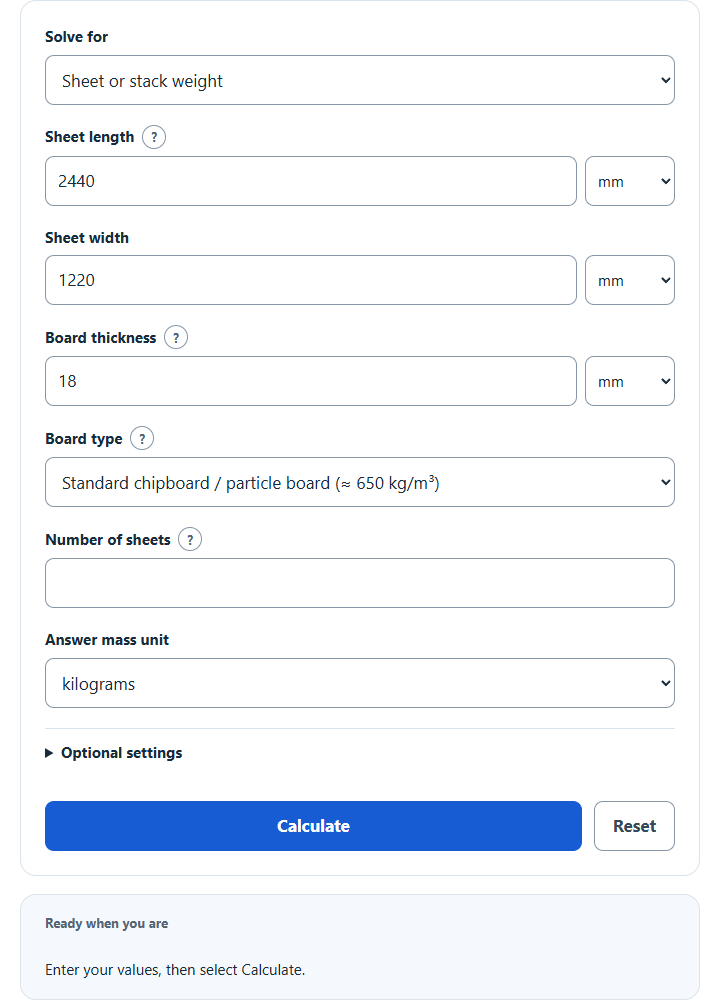
Estimate chipboard or particle board weight per sheet, per m² or for a stack, from a standard 18 mm sheet and typical density, or enter your own sizes.
Chipboard Weight Formula
The calculator multiplies board volume by density. The weight mode multiplies sheet mass by a whole-sheet count; capacity mode divides a mass limit by the planned mass per sheet and rounds down.
For the capacity mode:
- Length, Width, Thickness — sheet dimensions
- Mass allowance — additional mass percentage; blank means zero
- Density — mass per unit volume of the board
- Quantity — number of identical sheets
Dimensions are converted to meters and density to kg/m³ before multiplying. Results include kilograms or pounds, with metric tonnes and US short tons in the calculation details. Use the finished product’s density or mass when facings, moisture or other additions matter. The estimate does not establish safe lifting, stacking or transport.
Typical Chipboard Densities and Sheet Weights
The 550, 650 and 750 kg/m³ presets are illustrative assumptions, not grade standards. Kronospan’s raw-particleboard environmental declaration EPD-KRO-20230007-CBA1-EN describes its covered 12–38 mm P2/P3/P5 products at 595–695 kg/m³, with a declared example at 639 kg/m³. Use your specific product data for a closer estimate.
Approximate mass of one 4 × 8 ft sheet, assuming exactly 650 kg/m³ and no additional allowance. Thicknesses use exact inch conversions.
| Thickness | Mass (lb) | Mass (kg) |
|---|---|---|
| 1/4 in (6.35 mm) | 27.05 | 12.27 |
| 1/2 in (12.7 mm) | 54.10 | 24.54 |
| 5/8 in (15.875 mm) | 67.63 | 30.68 |
| 3/4 in (19.05 mm) | 81.16 | 36.81 |
| 1 in (25.4 mm) | 108.21 | 49.08 |
Worked Example and FAQ
Example: Ten sheets of 4 × 8 ft chipboard, 3/4 in thick, at an assumed 650 kg/m³.
- Volume per sheet: 2.4384 × 1.2192 × 0.01905 = 0.056633693184 m³
- Mass per sheet: 0.056633693184 × 650 = 36.8119 kg (81.1563 lb)
- Total for 10 sheets with zero allowance: 368.119 kg (811.563 lb)
Does the calculator account for facings? Use the finished panel’s declared density or mass, or enter a supplier-supported additional mass percentage. There is no universal melamine allowance.
Why can actual mass differ? Product thickness tolerances, density, resin, moisture and facings vary. Use product-specific data and weigh the panel when precision is needed.
Can I use this for MDF or OSB? The same volume-times-density arithmetic applies to a uniform rectangular panel, but supply the correct product density. Chipboard presets do not establish other products’ properties.