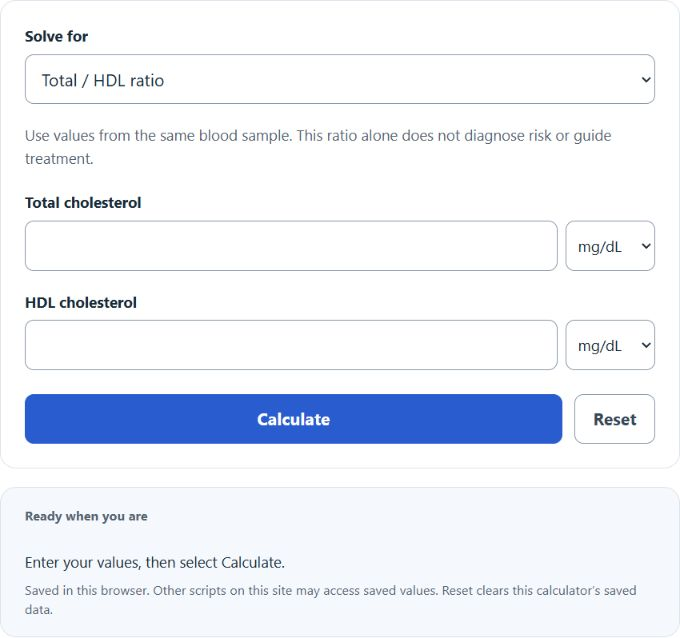
Calculate your cholesterol ratio from total and HDL cholesterol, or find the missing total cholesterol or HDL value in mg/dL or mmol/L.
Cholesterol Ratio Formula
The cholesterol ratio is the total cholesterol value divided by the HDL cholesterol value. It is written as a total-to-HDL ratio.
- Ratio = cholesterol ratio, written as total cholesterol to HDL cholesterol
- TC = total cholesterol
- HDL = high-density lipoprotein cholesterol
- mg/dL = milligrams per deciliter
- mmol/L = millimoles per liter
Choose the value to solve for, then enter the other two values. The calculator divides total cholesterol by HDL for the ratio, multiplies HDL by the ratio for total cholesterol, or divides total cholesterol by the ratio for HDL.
The ratio is unitless. Total cholesterol and HDL must be in comparable units before the ratio is calculated. The calculator supports both mg/dL and mmol/L.
How to Interpret a Total-to-HDL Ratio
The total-to-HDL ratio is descriptive, not a 2026 ACC/AHA treatment target. Current clinical decisions use the complete cardiovascular-risk assessment together with LDL-C and non-HDL-C goals and, when appropriate, ApoB and lipoprotein(a). Do not use this ratio alone to diagnose risk or change treatment.
Common Cholesterol Unit Conversions
| Cholesterol Value | Equivalent Value |
|---|---|
| 100 mg/dL | 2.59 mmol/L |
| 150 mg/dL | 3.88 mmol/L |
| 200 mg/dL | 5.17 mmol/L |
| 250 mg/dL | 6.47 mmol/L |
Example Calculations
Example 1: Find cholesterol ratio
You have total cholesterol of 200 mg/dL and HDL cholesterol of 50 mg/dL.
The cholesterol ratio is 4.0.
Example 2: Find HDL cholesterol
You have total cholesterol of 180 mg/dL and a cholesterol ratio of 3.6.
The HDL cholesterol value is 50 mg/dL.
FAQ
What is a good cholesterol ratio?
The ratio is a descriptive calculation, not a stand-alone risk category or treatment target. Interpret total cholesterol, HDL-C, LDL-C, non-HDL-C, and the full clinical risk assessment together.
Why does HDL affect the cholesterol ratio so much?
HDL is the denominator, so a higher HDL value lowers the ratio for a fixed total cholesterol value. A low ratio caused by high HDL does not necessarily mean low cardiovascular risk.
Can I compare mg/dL and mmol/L values directly?
No. Total cholesterol and HDL should be in the same unit system before calculating the ratio. If one value is in mg/dL and the other is in mmol/L, convert one of them first. For cholesterol, 1 mmol/L is about 38.67 mg/dL.