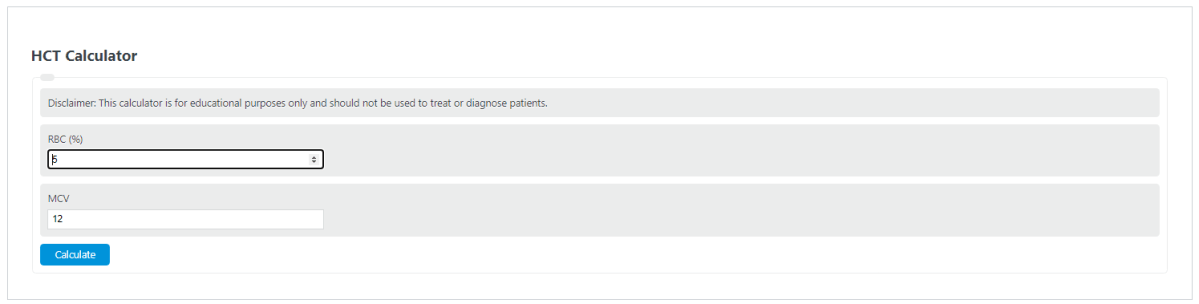
Calculate hematocrit, red blood cell count, or mean corpuscular volume from the other two CBC values.
Medical note: This calculator is for educational purposes only and is not a substitute for professional medical advice, diagnosis, or treatment. Do not use it to diagnose anemia/polycythemia or to change medications. The “HCT ↔ Hgb” tool uses a rough estimate that may be inaccurate—confirm results with a laboratory CBC and your clinician. If you have concerning symptoms (e.g., chest pain, shortness of breath, fainting, severe weakness, or black/bloody stool) or very abnormal values, seek urgent medical care. For reference ranges and interpretation, use your lab report and reputable medical resources (e.g., MedlinePlus/NIH).
- All Health and Medical Calculators
- MAP Calculator (Mean Arterial Blood Pressure)
- Resting Heart Rate Calculator
- Average Blood Pressure Calculator
- Absolute Lymphocyte Count
HCT Formula
The following formula is used to calculate a hematocrit:
- Where HCT is the hematocrit
- RBC is the red blood cell count (typically reported as ×106/µL or ×1012/L)
- MCV is the mean corpuscular volume (typically in fL)
To calculate HCT, multiply the red blood cell count (RBC) by the mean corpuscular volume (MCV), then divide by 10.
HCT Definition
What is HCT?
HCT, short for hematocrit, is the proportion of blood volume occupied by red blood cells. It is commonly reported as a percent (%) or as a fraction (L/L).
Example Problem
How to calculate HCT?
- First, determine the red blood cell count (RBC).
For this example, the RBC is 4.7 ×10^6/µL.
- Next, determine the mean corpuscular volume (MCV).
For this problem, the MCV is 90 fL.
- Finally, calculate the hematocrit.
Using the formula above, the hematocrit is found to be:
HCT = RBC * MCV / 10
HCT = 4.7 * 90 / 10
HCT = 42.3%