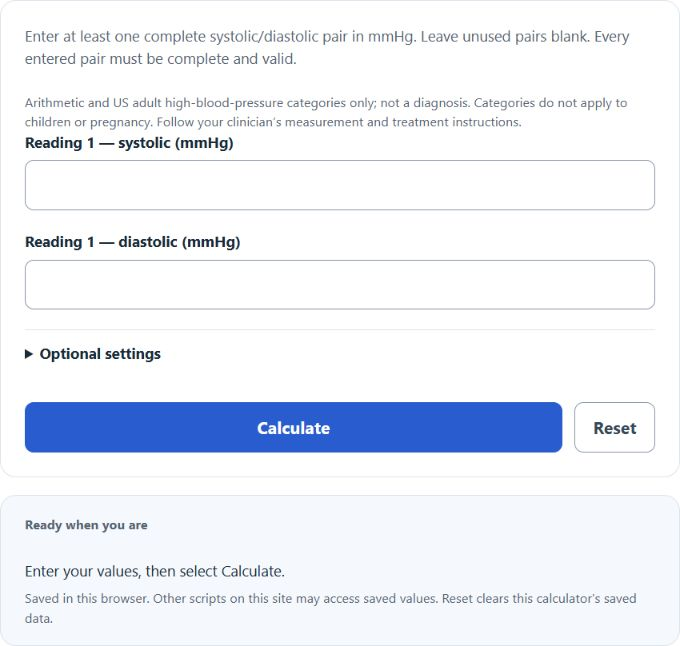
Average up to six systolic/diastolic reading pairs in mmHg. Review the adult high-blood-pressure reference category, individual high-reading alerts, pulse pressure and a traditional MAP estimate. This is not a diagnosis.
Related Calculators
- MAP Calculator (Mean Arterial Blood Pressure)
- R-R Interval Heart Rate Calculator
- E/A Ratio Calculator
- Stress Test Heart Rate Calculator
- All Health and Medical Calculators
Mean Arterial Pressure (MAP) Estimate Formula
Blood-pressure averages use the arithmetic mean of systolic values and the arithmetic mean of diastolic values separately. For example, 120/80, 118/78 and 122/82 average to 120/80 mmHg. The traditional MAP approximation is a different quantity:
Variables:
- MAP is the Mean Arterial Pressure estimate (mmHg)
- DBP is the diastolic blood pressure (mmHg)
- SBP is the systolic blood pressure (mmHg)
To calculate the traditional MAP estimate, multiply diastolic pressure by 2, add systolic pressure, then divide by 3. At 120/80 mmHg this gives approximately 93.3 mmHg. The one-third pulse-pressure rule can be inaccurate and does not replace measured MAP or clinical assessment.
How to Calculate Mean Arterial Pressure (MAP)?
The following steps outline how to calculate the Mean Arterial Pressure (MAP) estimate.
- First, determine the diastolic blood pressure (mmHg).
- Next, determine the systolic blood pressure (mmHg).
- Next, gather the formula from above = MAP ≈ (2*DBP + SBP) / 3.
- Finally, calculate the MAP estimate.
- After inserting the variables and calculating the result, check your answer with the calculator above.
Example Problem :
Use the following variables as an example problem to test your knowledge.
diastolic blood pressure (mmHg) = 80
systolic blood pressure (mmHg) = 120
MAP ≈ (2*80 + 120) / 3 = 93.3 mmHg
Adult high-blood-pressure reference categories follow the American Heart Association chart. They do not apply to children or pregnancy and cannot establish a diagnosis. Do not average away an individual extreme reading. For a reading above 180 systolic or 120 diastolic, repeat after at least one minute and seek prompt professional advice if it remains high. With serious symptoms such as chest pain, breathlessness, weakness or trouble speaking, call emergency services immediately (911 in the US).