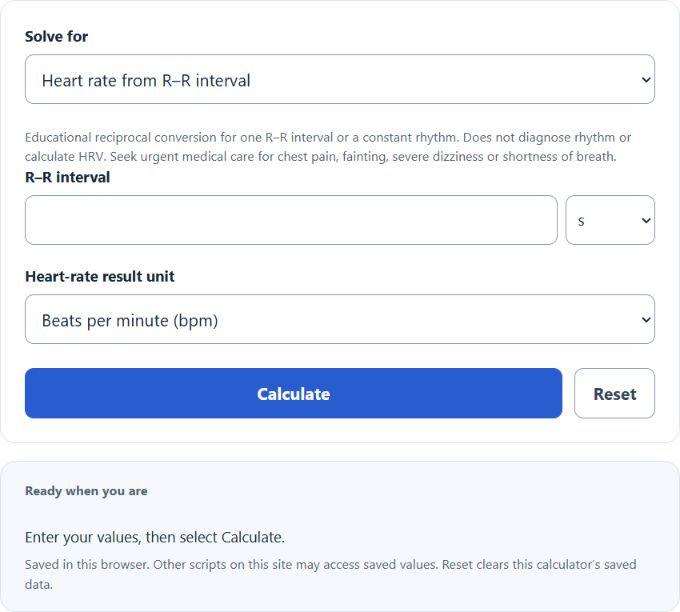
Calculate heart rate from R-R interval or R-R interval from heart rate, with bpm, seconds, milliseconds, ECG box counts, and rhythm metrics.
Note: Educational use only. This calculator is not medical advice, not for diagnosis, and not a substitute for clinician ECG interpretation. If you have concerning symptoms (such as chest pain, shortness of breath, fainting, severe dizziness) or an unexpectedly very low/high heart rate, seek urgent medical care. The last successful input snapshot is saved in this browser and recomputed on restoration; use Reset to clear this calculator’s saved data.
Related Calculators
- QTcF Calculator
- Average Blood Pressure Calculator
- Breaths Per Minute Calculator
- Pulmonary Vascular Resistance Calculator
- All Health and Medical Calculators
R-R Interval Heart Rate Formula
Variables:
- HR is the heart rate (beats per minute)
- RRI is the R-R interval (seconds)
There are 60 seconds in one minute. If each cardiac cycle lasts RRI seconds, then the number of beats per minute is 60 divided by RRI. The relationship is reciprocal, not linear: the local change is approximately 16.7 ms per bpm at 60 bpm and 4.2 ms per bpm at 120 bpm. This asymmetry is why heart rate variability (HRV) researchers work with R-R intervals in milliseconds rather than converting to bpm first, where the nonlinearity would distort variance calculations.
For irregular rhythms such as atrial fibrillation, a single R-R measurement reflects only instantaneous rate. Averaging several consecutive intervals gives a more representative value. Clinicians typically report average heart rate over a defined time window rather than relying on any single interval.
R-R Interval Reference Table
The table below shows corresponding R-R intervals for common heart rates, with clinical classification based on adult resting norms (normal range: 60 to 100 bpm).
| HR (bpm) | RR Interval (ms) | RR Interval (s) | Classification |
|---|---|---|---|
| 30 | 2000 | 2.000 | Extreme bradycardia |
| 40 | 1500 | 1.500 | Bradycardia |
| 50 | 1200 | 1.200 | Bradycardia |
| 60 | 1000 | 1.000 | Normal (lower limit) |
| 70 | 857 | 0.857 | Normal |
| 75 | 800 | 0.800 | Normal |
| 80 | 750 | 0.750 | Normal |
| 90 | 667 | 0.667 | Normal |
| 100 | 600 | 0.600 | Normal (upper limit) |
| 110 | 545 | 0.545 | Tachycardia |
| 120 | 500 | 0.500 | Tachycardia |
| 150 | 400 | 0.400 | Tachycardia |
| 180 | 333 | 0.333 | Tachycardia |
| 200 | 300 | 0.300 | Extreme tachycardia |
ECG Paper Method: The 300 and 1500 Rules
When reading a physical ECG strip at the standard paper speed of 25 mm/s, heart rate can be estimated without arithmetic by counting ECG boxes between two consecutive R waves. At 25 mm/s: each large box (5 mm) = 0.20 s; each small box (1 mm) = 0.04 s. There are exactly 300 large boxes and 1500 small boxes per minute at this speed.
| Large Boxes | Heart Rate (bpm) |
|---|---|
| 1 | 300 |
| 2 | 150 |
| 3 | 100 |
| 4 | 75 |
| 5 | 60 |
| 6 | 50 |
| 7 | 43 |
| 8 | 38 |
| Small Boxes | Heart Rate (bpm) |
|---|---|
| 10 | 150 |
| 12 | 125 |
| 15 | 100 |
| 20 | 75 |
| 25 | 60 |
| 30 | 50 |
| 37.5 | 40 |
| 50 | 30 |
The 1500 rule is more accurate at higher heart rates because small boxes provide finer resolution. At 50 mm/s (used in pediatric ECGs and some arrhythmia recordings), divide 600 by large boxes or 3000 by small boxes. Mnemonic for the 300 rule: 300, 150, 100, 75, 60, 50 for one through six large boxes.
What is the R-R Interval?
The R-R interval is the time between the peaks of two successive R waves in the QRS complex of an ECG. The ECG records the heart’s electrical cycle as a repeating waveform: the P wave (atrial depolarization, triggering atrial contraction), the QRS complex (ventricular depolarization, triggering ventricular contraction and blood ejection), and the T wave (ventricular repolarization, resetting the ventricles). The R wave is the tall, sharp, positive deflection at the apex of the QRS complex.
The R wave is used as the timing reference because it is the most prominent and precisely identifiable landmark in the waveform, for both manual measurement with calipers and automated detection algorithms. P and T waves are broader and lower-amplitude, making precise peak timing less reliable. Reliable HRV analysis requires adequate sampling, validated R-peak detection, and careful correction of artifacts and ectopic beats.
Normal resting R-R intervals in healthy adults fall between approximately 600 ms (100 bpm) and 1000 ms (60 bpm). In sinus rhythm the beat-to-beat variation is small but measurable, with magnitude depending on the person, recording conditions and measurement method. In atrial fibrillation, R-R intervals are characteristically irregular and unpredictable, a defining diagnostic feature. Clinicians assess both the mean R-R interval (for rate) and its regularity (for rhythm classification).
The R-R Interval and Heart Rate Variability
Heart rate variability (HRV) is derived entirely from sequential R-R intervals. It quantifies how much those intervals fluctuate beat to beat, reflecting the balance between sympathetic and parasympathetic branches of the autonomic nervous system. Parasympathetic (vagal) activity lengthens R-R intervals and increases their variability; sympathetic activity shortens them and reduces variability. Higher resting HRV is generally associated with better cardiovascular fitness; chronically low HRV is associated with increased cardiovascular mortality risk.
| Metric | What It Measures | Illustrative reported values (protocol-dependent; not diagnostic) |
|---|---|---|
| SDNN | Standard deviation of all R-R intervals (24-hour recording) | ~100 to 180 ms |
| RMSSD | Root mean square of successive R-R differences; reflects parasympathetic tone | 27 to 72 ms |
| pNN50 | Percentage of consecutive R-R differences exceeding 50 ms | 3 to 20% at rest; declines with age |
| Mean RR | Average R-R interval (60,000 divided by mean RR in ms gives rate over complete intervals; not generally mean instantaneous HR) | 600 to 1000 ms (60 to 100 bpm) |
The 1996 Task Force discussed SDNN below 50 ms in 24-hour recordings and specific clinical risk settings; this is not a universal diagnostic threshold for short recordings. RMSSD emphasizes short-term beat-to-beat variation. Recording length, artifacts, age, breathing and clinical context affect interpretation.
Conventional time-domain HRV metrics use normal-to-normal interval data, commonly in milliseconds. For an equal small change in RR, conversion to bpm produces a larger change at shorter intervals (higher rates). Interval variability and rate variability are different measures and should not be interchanged. This is a direct consequence of the reciprocal, nonlinear relationship between R-R interval and heart rate described in the formula section above.
References
- Task Force of the European Society of Cardiology and the North American Society of Pacing and Electrophysiology. “Heart rate variability: Standards of measurement, physiological interpretation and clinical use.” Circulation. 1996;93(5):1043-1065.
- Shaffer F, Ginsberg JP. “An Overview of Heart Rate Variability Metrics and Norms.” Frontiers in Public Health. 2017;5:258. (Source for RMSSD normal range of 27 to 72 ms.)
- ECG paper speed and box timing conventions follow AHA/ACC standard: 25 mm/s with large boxes of 5 mm (0.20 s) and small boxes of 1 mm (0.04 s).
- For ECG basics and clinical interpretation, see NIH MedlinePlus: Electrocardiogram.