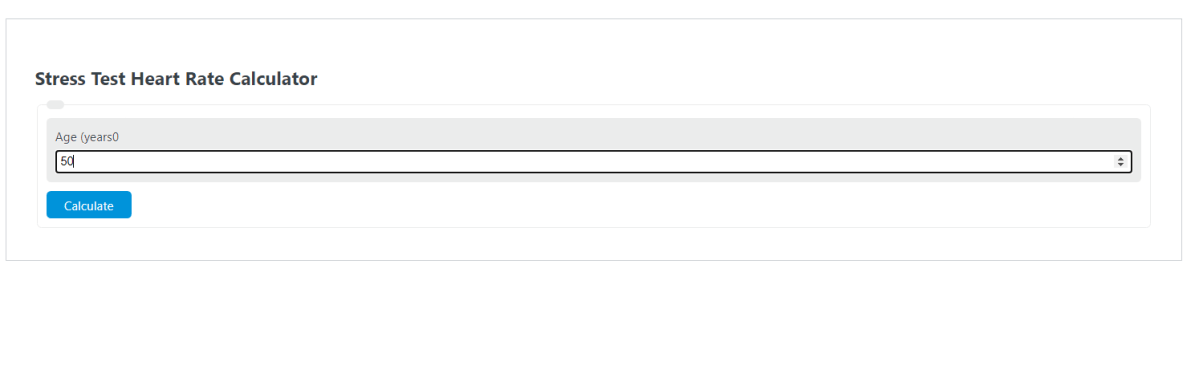
Estimate age-predicted maximum heart rate and the common 85% stress-test reference in bpm. Educational only—not medical advice or test interpretation.
Medical note: This calculator provides educational estimates and is not medical advice or an exercise prescription. Do not attempt to perform a “stress test” on yourself; clinical stress testing should be done under medical supervision with individualized stop criteria. If you have chest pain/pressure, unusual shortness of breath, dizziness/fainting, known/suspected heart disease, or take rate-limiting medicines (e.g., beta blockers), get clinician guidance; stop exercise and seek urgent care for concerning symptoms.
- All Health and Medical Calculators
- Heart Rate Zone Calculator
- Heart Rate Reserve Calculator (HRR)
- Anaerobic Threshold Calculator
Age-Predicted Maximum Heart Rate (HRmax) Formula
This calculator estimates age-predicted maximum heart rate and the common 85% reference threshold often discussed during supervised exercise stress testing. These numbers are useful for context, but they are still estimates and should not be treated as a personal diagnosis, exercise prescription, or a self-test stopping rule.
- HRmax = estimated maximum heart rate in beats per minute
- HR85% = 85% reference level derived from estimated maximum heart rate
- A = age in years
The classic age-based estimate is simple and widely recognized, while the alternative equation often gives a slightly different result. Because real heart-rate response varies from person to person, two healthy people of the same age can reach different peak heart rates under the same test conditions.
What this calculator does
When you enter your age, the calculator estimates:
- your age-predicted maximum heart rate
- the 85% reference threshold based on that estimate
If you already know an estimated maximum heart rate, the calculator can also reverse the classic equation to estimate the corresponding age value.
This reverse calculation is only an algebraic rearrangement of the classic formula. It does not represent biologic age, cardiovascular age, or a medical assessment.
Why the 85% value is often mentioned
In supervised cardiac stress testing, reaching about 85% of age-predicted maximum heart rate is often used as one marker that the test reached a meaningful workload. However, it is only one piece of interpretation. Test quality and clinical meaning also depend on symptoms, ECG findings, blood pressure response, exercise capacity, heart-rate recovery, medications, and the reason the test was ordered.
Example using age 50
Using the classic age-based estimate:
That corresponds to an estimated maximum heart rate of 170 bpm and an 85% reference level of about 145 bpm.
Using the alternative equation for the same age:
This difference shows why age-predicted formulas should be viewed as reference tools rather than exact physiologic limits.
Quick reference table
| Age (years) | Estimated HRmax (bpm) | 85% Reference Threshold (bpm) |
|---|---|---|
| 20 | 200 | 170 |
| 30 | 190 | 162 |
| 40 | 180 | 153 |
| 50 | 170 | 145 |
| 60 | 160 | 136 |
| 70 | 150 | 128 |
| 80 | 140 | 119 |
What can change actual stress test heart rate?
The heart rate you reach during a monitored stress test is influenced by more than age alone. Important factors include:
- Medications: especially beta blockers and other rate-limiting drugs
- Test type: treadmill, cycle, or pharmacologic stress protocols can produce different responses
- Fitness level: training status affects workload tolerance and heart-rate behavior
- Symptoms: chest discomfort, shortness of breath, dizziness, or fatigue may end a test before any target number is reached
- Cardiac rhythm and conduction: arrhythmias or pacing can alter the expected response
- Environment and physiology: heat, dehydration, caffeine, anxiety, sleep, and illness can all shift heart rate
How to interpret your result
- A higher or lower estimated HRmax does not by itself confirm fitness, disease, or test performance.
- Reaching 85% does not automatically mean a stress test is normal.
- Failing to reach 85% does not automatically mean a stress test is abnormal.
- Clinical interpretation depends on the full picture, not one number.
Safety note
This calculator is for educational estimation only. A diagnostic cardiac stress test should be performed and interpreted in an appropriate medical setting. If you have chest pain, fainting, unusual shortness of breath, known heart disease, or you take medications that affect heart rate, use individualized medical guidance rather than relying on a generic age-based estimate.