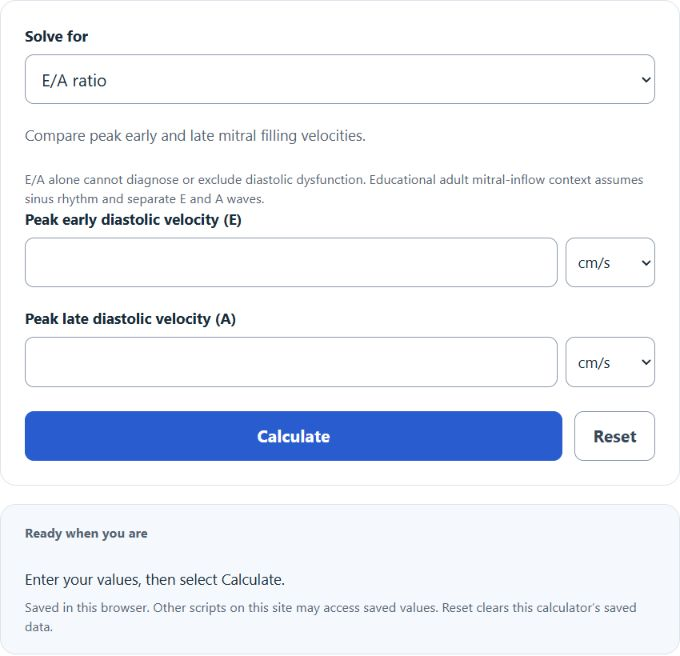
Calculate the mitral E/A ratio, solve for missing E or A velocity, and view educational interpretation context. E/A alone cannot diagnose or exclude diastolic dysfunction.
Related Calculators
- Cardiac Output Echo Calculator
- Effective Orifice Area Calculator
- Aortic Cross-Sectional Area To Height Ratio Calculator
- Chronotropic Response Index Calculator
- All Health and Medical Calculators
E/A Ratio Formula
The following formula is used to calculate the E/A ratio for a given peak early diastolic velocity (E) and peak late diastolic velocity (A).
Formula source: ASE 2025 diastolic-function guidance. Earlier guidance: Nagueh SF, Smiseth OA, Appleton CP, et al. Recommendations for the evaluation of left ventricular diastolic function by echocardiography: an update from the American Society of Echocardiography and the European Association of Cardiovascular Imaging (J Am Soc Echocardiogr. 2016;29[4]:277–314)
Variables:
- EA is the E/A ratio
- E is the peak early diastolic velocity
- A is the peak late diastolic velocity
To calculate the E/A ratio, divide the peak early diastolic velocity (E) by the peak late diastolic velocity (A).
What is an E/A Ratio?
The E/A ratio is a measurement used in echocardiography to assess diastolic function of the heart. It is the ratio of the peak velocity of early (E) to late (A) ventricular filling. This ratio helps in evaluating how well the heart relaxes and fills with blood during diastole. Normal and pseudonormal filling can share an E/A value. Interpretation requires age, rhythm, loading conditions and additional echocardiographic measurements. E/A is not applicable when the A wave is absent or when E and A waves are fused.
How to Calculate E/A Ratio?
The following steps outline how to calculate the E/A Ratio.
- First, measure the peak early diastolic velocity (E).
- Next, measure the peak late diastolic velocity (A).
- Finally, convert E and A to matching units and calculate EA = E / A.
- After inserting the values and calculating the result, check your answer with the calculator above.
Example Problem :
Use the following variables as an example problem to test your knowledge.
Peak Early Diastolic Velocity (E) = 0.8 m/s
Peak Late Diastolic Velocity (A) = 0.6 m/s