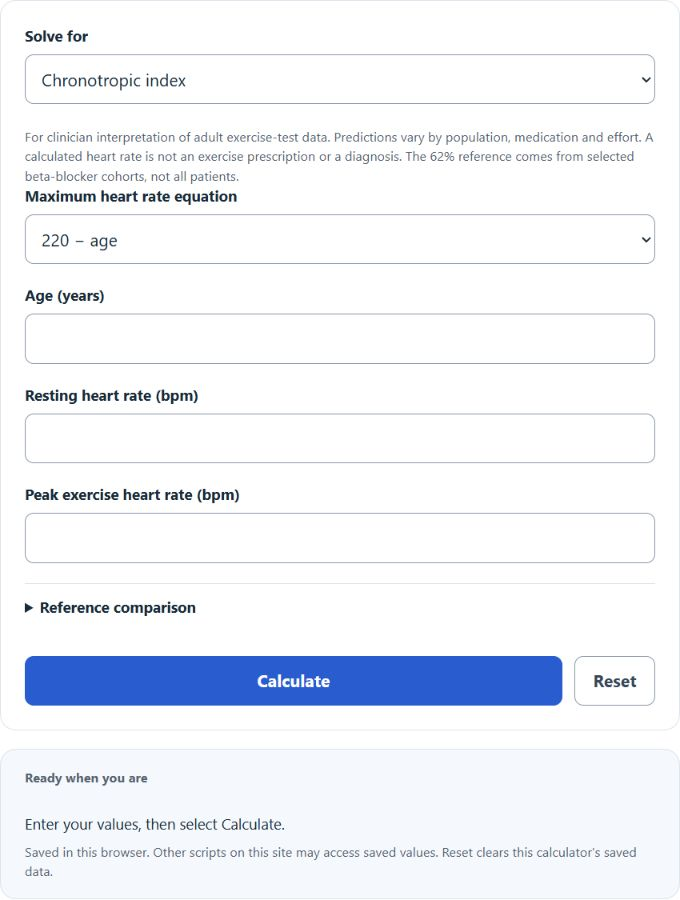
Calculate chronotropic response index, an algebraic heart rate for a selected reserve percentage, or a single-stage metabolic–chronotropic ratio. Clinical interpretation depends on the test, medication, effort, and prediction equation.
Related Calculators
- Central Venous Pressure Calculator
- DO2 Calculator
- Inspiratory To Expiratory Ratio Calculator
- Conicity Index Calculator
- All Health and Medical Calculators
Chronotropic Response Index Formula
The chronotropic response index, or CRI, compares the heart rate reserve you achieved during exercise with the heart rate reserve predicted from your age and resting heart rate.
- CRI = chronotropic response index, expressed as a percentage
- HRmax = maximum heart rate reached during exercise, in beats per minute
- HRrest = resting heart rate, in beats per minute
- age = age in years
- 220 – age = age-predicted maximum heart rate
- (220 – age) – HRrest = predicted heart rate reserve
- HRmax – HRrest = achieved heart rate reserve
For the heart rate for a selected index mode, the calculator rearranges the CRI relationship. This is an algebraic result, not an exercise prescription. The displayed formulas use 220 minus age; other selectable population equations or an entered maximum replace that term.
- Target Peak HR = heart rate needed during exercise, in beats per minute
- Target CRI = selected chronotropic response threshold, as a percentage
- HRrest = resting heart rate, in beats per minute
- age = age in years
The CRI mode calculates the fraction of predicted heart-rate reserve achieved. Automatic reference comparisons use the 220-minus-age equation; other equations accept a clinician-selected reference. The selected-index mode offers 62%, 80%, 85%, or a custom reserve percentage without prescribing an exercise target. The single-stage metabolic–chronotropic ratio divides the stage HR-reserve fraction by (stage METs − 1)/(actual peak METs − 1), assuming 1 resting MET; it is not a fitted regression slope.
Common Chronotropic Response Thresholds
| Situation | Common threshold | General interpretation |
|---|---|---|
| 220-minus-age model, no beta-blocker specified | CRI < 80% | May suggest chronotropic incompetence |
| Selected beta-blocker study cohorts, 220-minus-age reserve | CRI ≤ 62% | Research criterion; not a universal rule for all beta-blocker users or other equations |
| Selected reserve percentage | 85% of predicted HR reserve | Not the same as 85% of predicted maximum HR; not a prescribed endpoint |
Example Chronotropic Response Calculations
Example 1: CRI from a stress test
You are 50 years old, your resting heart rate is 70 bpm, and your maximum exercise heart rate is 145 bpm.
A CRI of 75% is below the standard 80% threshold, so it may suggest chronotropic incompetence if you are not taking a beta-blocker.
Example 2: Target peak heart rate
You are 60 years old, your resting heart rate is 65 bpm, and you want the target peak heart rate for an 80% CRI.
The algebraic heart rate is 141 bpm. A clinician must determine appropriate testing or exercise limits.
Chronotropic Response Index FAQ
What does a low chronotropic response index mean?
A low CRI means your heart rate did not rise as much as expected during exercise compared with your predicted heart rate reserve. This can suggest chronotropic incompetence, but the result should be interpreted with the full stress test report, symptoms, medications, rhythm findings, and clinical history.
Why does beta-blocker use change the threshold?
Beta-blockers can blunt heart-rate response. The ≤62% HR-reserve criterion was studied in selected patients on metoprolol tartrate or atenolol, excluding heart failure, pacemakers, atrial fibrillation and ECG abnormalities (Khan et al., 2005). It is not automatically paired with the Brawner denominator or a single-stage metabolic ratio. Comparisons do not establish a diagnosis. The ACC/AHA/HRS guideline discusses the common 80% expected-reserve criterion and individualized assessment.
What if my resting heart rate is higher than my age-predicted maximum heart rate?
The formula requires the selected maximum heart rate to exceed resting heart rate. Otherwise the denominator is zero or negative. Check the inputs and seek clinical interpretation. Population equations include Tanaka (healthy adults), Brawner (beta-blocked coronary disease, ages 40–80 with preserved ventricular function), and Gulati (asymptomatic women); none is an exact individual maximum. The historical metabolic–chronotropic model uses the 220-minus-age prediction and adequate exercise-test data.