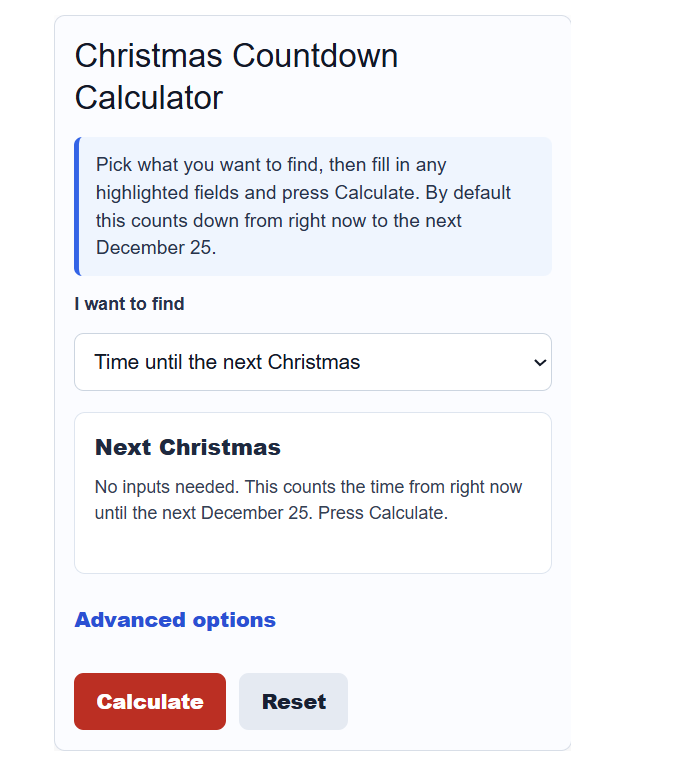
Calculate the exact days, hours, minutes, and seconds until Christmas with a live countdown to December 25, plus sleeps and shopping days remaining.
Christmas Countdown Formula
The countdown works from the gap between the current moment and midnight on December 25. Christmas always falls on the same calendar date, so the only moving part is the current date and time.
D = floor( (X - T) / 86400 )
The remaining hours, minutes, and seconds come from the leftover part of that gap:
H = floor( R / 3600 ), M = floor( (R mod 3600) / 60 ), S = R mod 60
Two common extras are the number of sleeps and the number of shopping days:
Sleeps = ceil( (X - T) / 86400 )
- D: whole days left until Christmas.
- X: the time of the target Christmas (midnight on December 25), in seconds.
- T: the current time, in seconds.
- R: the seconds left over after the whole days are removed, equal to (X - T) minus D days.
- H, M, S: the hours, minutes, and seconds shown alongside the day count.
- Sleeps: nights of sleep before Christmas morning, which rounds the day gap up rather than down.
The "time until the next Christmas" mode finds the upcoming December 25 automatically. If this year's date has already passed, it rolls the target forward to next year. The "specific year" mode locks the target to the December 25 of the year you type. The "days from a chosen date" mode replaces the current time with a date you pick, which is handy for planning from a future start point. Shopping days count only Monday through Friday between the start and Christmas.
Christmas Dates and Weekdays by Year
December 25 never changes, but the day of the week it lands on does. Use this to see how a given year's countdown ends.
| Year | Christmas Date | Day of Week |
|---|---|---|
| 2024 | December 25 | Wednesday |
| 2025 | December 25 | Thursday |
| 2026 | December 25 | Friday |
| 2027 | December 25 | Saturday |
| 2028 | December 25 | Monday |
| 2029 | December 25 | Tuesday |
| 2030 | December 25 | Wednesday |
Note that 2028 skips from Saturday in 2027 to Monday in 2028 because 2028 is a leap year, which adds an extra day to the calendar.
Converting the Day Count
Once you have the day count, you can express it in other units. This table shows the simple conversions the calculator uses for weeks and sleeps.
| Measure | How it is found | Example at 60 days |
|---|---|---|
| Weeks | Days divided by 7 | 8.6 weeks |
| Sleeps | Day gap rounded up | 60 sleeps |
| Shopping days | Weekdays only (Mon-Fri) | about 43 days |
| Hours | Days times 24 | 1,440 hours |
Example Problems
Example 1. It is December 1 and you want to know how long until Christmas the same year. December has 31 days, so the gap to December 25 is 25 minus 1, which is 24 days. Divide by 7 to get about 3.4 weeks. Because you count the nights before Christmas morning, that is 24 sleeps.
Example 2. You pick December 25, 2026 in the specific year mode while standing on June 19, 2026. From June 19 to December 25 is 189 days when you include the partial first day, which the calculator reports as 188 full days plus the leftover hours. Since 2026 ends on a Friday, the shopping day count is the number of weekdays in that stretch, roughly 135 days.
Frequently Asked Questions
Why does the day count drop by one near midnight? The calculator measures whole days, so it rounds down. When less than a full day remains before midnight on December 25, the day figure shows 0 while the hours, minutes, and seconds keep ticking. The sleeps figure rounds up instead, so it still shows 1 to reflect the final night.
What is the difference between days and sleeps? Days is the number of complete 24-hour periods left. Sleeps counts the nights you will go to bed before Christmas morning, which is the day gap rounded up. On Christmas Eve you usually have 0 full days left but 1 sleep to go.
Does the countdown account for leap years? Yes. The tool uses real calendar dates, so any February 29 between now and Christmas is already included in the day total. This is why the weekday Christmas falls on can jump by two days across a leap year rather than one.