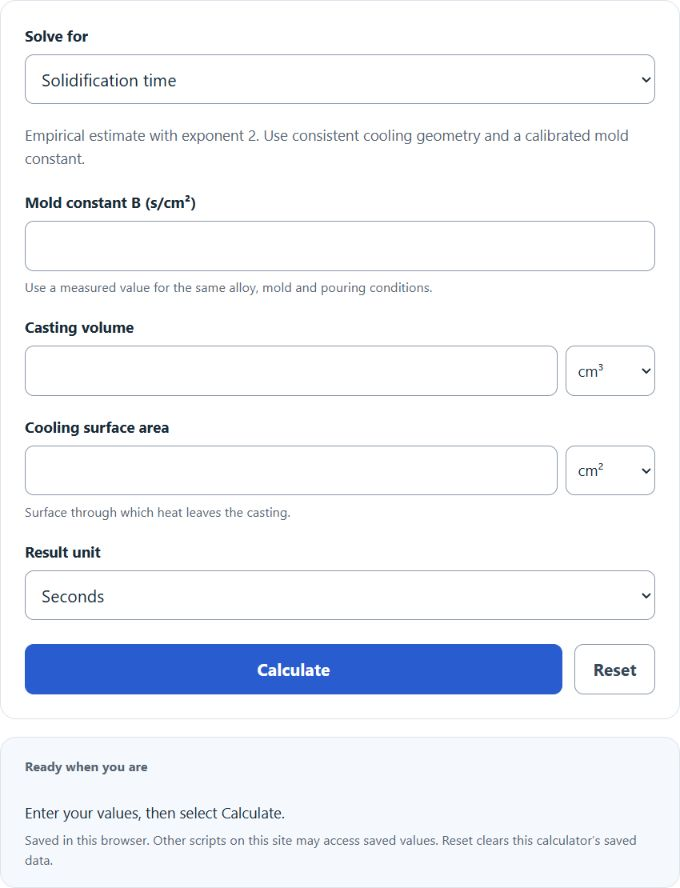
Calculate Chvorinov’s rule to find the selected mold constant, casting volume, cooling surface area, or solidification time from three known values.
Chvorinov’s Rule Formula
Chvorinov’s rule estimates the solidification time of a casting from its volume-to-surface-area ratio. This calculator uses the common exponent value of 2.
Rearranged forms used to solve for a missing value:
- ts = solidification time
- B = mold constant, in seconds/cm² for this calculator
- V = volume of the casting
- A = cooling surface area through which heat leaves the casting
- V/A = casting modulus, a length that compares volume to cooling surface area
Select the desired solve mode. To calculate solidification time, enter the mold constant, volume, and surface area. To calculate the mold constant, enter the solidification time, volume, and surface area. To solve for volume or surface area, enter the other three known values. The calculator converts volume to cm³, surface area to cm², and time to seconds before applying the formula.
Unit Conversions Used in the Calculation
| Quantity | Input unit | Base unit conversion |
|---|---|---|
| Volume | cm³ | 1 cm³ |
| Volume | m³ | 1,000,000 cm³ |
| Volume | in³ | 16.387064 cm³ |
| Surface area | m² | 10,000 cm² |
| Surface area | in² | 6.4516 cm² |
| Time | minutes | 60 seconds |
| Time | hours | 3,600 seconds |
How Casting Modulus Affects Solidification Time
| V/A value | Meaning | Effect on solidification |
|---|---|---|
| Small V/A | More cooling surface area compared with volume | Shorter solidification time |
| Large V/A | More volume compared with cooling surface area | Longer solidification time |
| Doubled V/A | Casting modulus doubles | Solidification time becomes 4 times larger, if B stays the same |
Example Problems
Example 1: Calculate solidification time
Suppose the mold constant is 4 seconds/cm², the casting volume is 500 cm³, and the surface area is 250 cm².
The solidification time is 16 seconds.
Example 2: Calculate mold constant
Suppose the casting solidifies in 45 seconds, with a volume of 300 cm³ and a surface area of 200 cm².
The mold constant is 20 seconds/cm².
FAQ
What does the mold constant include?
The mold constant includes the effects of the mold material, metal properties, pouring conditions, and heat transfer behavior. It is not a universal value. You usually determine it from experimental data or use a value given for the same metal and mold setup.
Why does the calculator use volume divided by surface area?
Volume divided by surface area measures how much casting material must cool relative to the area available for heat removal. A casting with high volume and low surface area cools more slowly. A thin casting with more surface area compared with its volume cools faster.
Does Chvorinov’s rule give the exact freezing time?
It gives an estimate. The result is most useful for comparing castings or checking design changes. Actual solidification can vary because of alloy behavior, mold temperature, superheat, chills, risers, and nonuniform geometry.