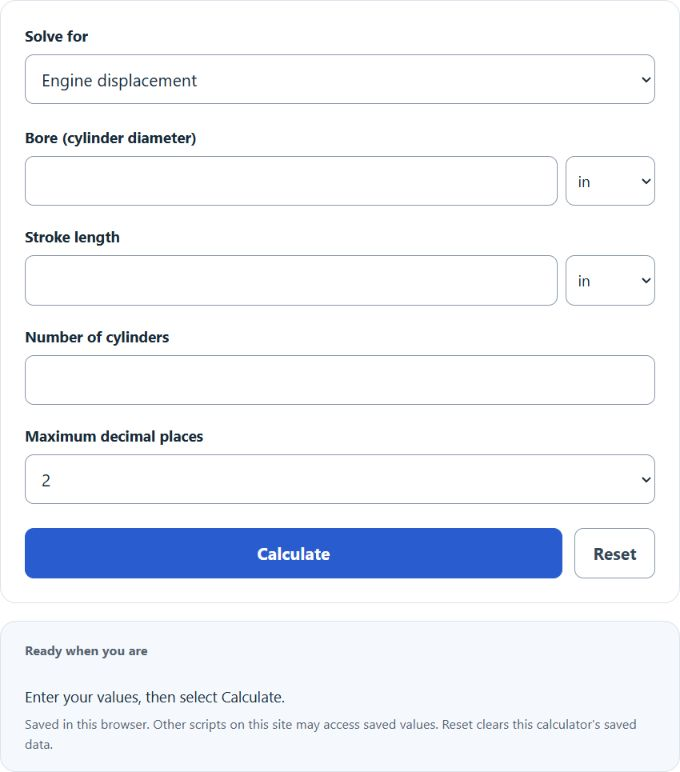
Calculate engine cubic inch displacement (CID) from bore, stroke, and cylinder count, with cc and liter conversions after Calculate.
CID Formula
CID stands for cubic inch displacement, the total volume the pistons sweep through inside an engine. The calculator finds it from the bore, the stroke, and the number of cylinders.
CID = N * (pi/4) * B^2 * S
When you solve for a missing dimension instead, the same formula is rearranged. To find the bore needed for a target displacement:
B = sqrt( CID / ( N * (pi/4) * S ) )
To find the stroke needed for a target displacement:
S = CID / ( N * (pi/4) * B^2 )
Displacement converts to metric units with fixed factors:
cc = CID * 16.387064; liters = cc / 1000
- CID: cubic inch displacement, the swept volume of all cylinders in cubic inches.
- N: the number of cylinders in the engine.
- B: the bore, the inside diameter of one cylinder, in inches.
- S: the stroke, the distance the piston travels from bottom to top, in inches.
- pi/4: 0.7854, the factor that turns the bore diameter into the circular area of the cylinder.
The bore is squared because the cylinder is a circle, so the same small percentage increase in bore has about twice the fractional effect of that percentage increase in stroke. The stroke and the cylinder count both scale displacement directly. The solve-for selector decides which value is the unknown: the default mode returns displacement from the three engine measurements, while the bore and stroke modes work backward from a displacement target you already have in mind. Each length has an inch or millimeter selector that converts the entered quantity; the target displacement selector accepts cubic inches, cubic centimeters, or liters.
Bore and Stroke for Common Displacements
These are typical bore and stroke combinations used to reach well-known engine sizes. Real production engines vary slightly, but the displacements line up with what the formula returns.
| Engine | Bore (in) | Stroke (in) | Cylinders | CID |
|---|---|---|---|---|
| Small block V8 | 4.00 | 3.48 | 8 | 350 |
| Big block V8 | 4.25 | 3.76 | 8 | 427 |
| Inline 6 | 3.88 | 3.53 | 6 | 250 |
| Compact 4 | 3.39 | 3.39 | 4 | 122 |
Use this table to convert a displacement between the three common units.
| Cubic inches (CID) | Cubic centimeters (cc) | Liters (L) |
|---|---|---|
| 122 | 1,999 | 2.0 |
| 302 | 4,949 | 4.9 |
| 350 | 5,735 | 5.7 |
| 454 | 7,440 | 7.4 |
Examples
Example 1: displacement of a V8. An eight-cylinder engine has a 4.00 inch bore and a 3.48 inch stroke. The cylinder area factor is (pi/4) times 4.00 squared, which is 12.566 square inches. One cylinder displaces 12.566 times 3.48, or 43.73 cubic inches. Across all eight cylinders, CID = 8 times 43.73 = 349.85 cubic inches, which rounds to the familiar 350. That equals about 5,733 cc or 5.7 liters.
Example 2: bore needed for a target. You want 327 cubic inches from an eight-cylinder engine with a 3.25 inch stroke. Rearranging the formula, B = sqrt(327 / (8 times 0.7854 times 3.25)) ≈ sqrt(327 / 20.42035) ≈ 4.001679 inches. A 4.00 inch bore with a 3.25 inch stroke gives about 326.73 cubic inches, commonly rounded to 327.
Frequently Asked Questions
What is the difference between CID, cc, and liters? They all measure the same swept volume in different units. Cubic inch displacement (CID) is the imperial measure common in American engines, while cubic centimeters (cc) and liters are the metric measures used elsewhere. One cubic inch equals 16.387 cc, and one liter equals about 61.02 cubic inches, so a 350 CID engine is roughly 5.7 liters.
Does CID include the combustion chamber or compression? No. Displacement is only the volume the pistons sweep between bottom dead center and top dead center. It does not include the clearance volume in the combustion chamber, which is what sets the compression ratio. Two engines with the same CID can have different compression ratios.
Why is bore more important than stroke for displacement? The formula squares the bore but uses the stroke directly, so the cylinder area grows with the square of the bore. For the same small percentage increase, bore has about twice the effect on displacement as stroke. For equal absolute length changes, the comparison depends on the starting bore and stroke.