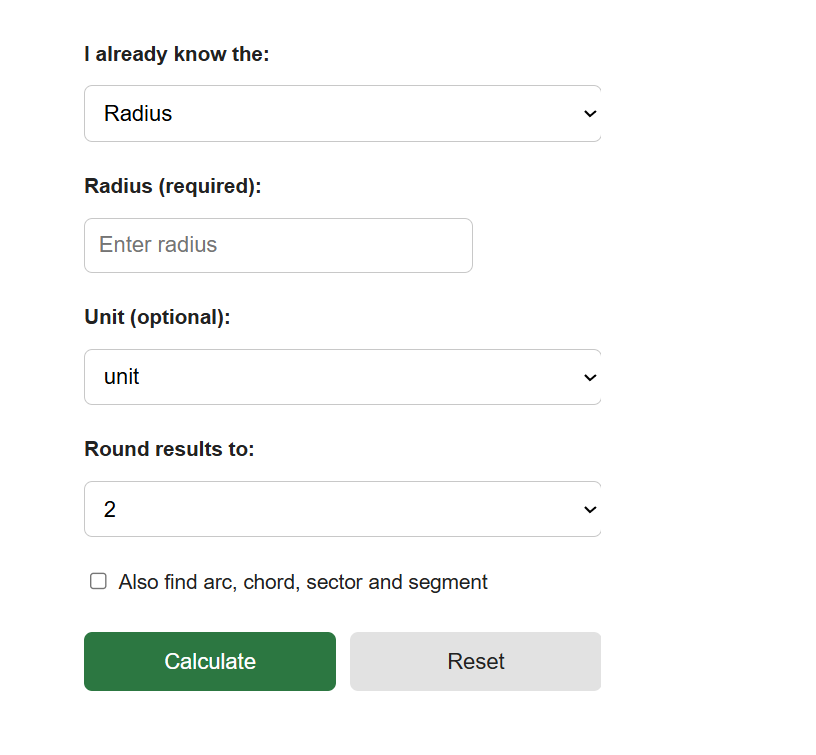
Calculate the area, circumference, radius, and diameter of a circle from any single known value, plus optional arc and sector measurements.
Circle Formula
A circle is fully described by its radius. Once you know the radius, every other measurement follows from it using these formulas:
D = 2 * r
C = 2 * pi * r
A = pi * r^2
If you start from the diameter, circumference, or area instead, the same relationships rearrange to give you the radius:
r = C / (2 * pi) r = sqrt(A / pi)
When you turn on the arc and sector option, the calculator uses the central angle to find these additional values, where the angle is measured in radians (degrees are converted for you):
Arc = r * angle Chord = 2 * r * sin(angle / 2)
Sector = 0.5 * r^2 * angle Segment = 0.5 * r^2 * (angle - sin(angle))
- r = radius, the distance from the center to the edge
- D = diameter, the distance across the circle through the center
- C = circumference, the distance around the circle
- A = area, the space enclosed by the circle
- pi = the constant 3.14159…
- angle = the central angle of an arc or sector
Pick the measurement you already have from the selector, type its value, and the calculator solves for the radius first, then fills in the diameter, circumference, and area. The radius is the link between every result, which is why a single known value is enough to find all the others. The arc and sector option is hidden until you need it, so the basic view stays focused on the four core measurements.
Common Circle Measurements
This table shows the diameter, circumference, and area for several whole-number radii. Use it as a quick check on your own results.
| Radius | Diameter | Circumference | Area |
|---|---|---|---|
| 1 | 2 | 6.28 | 3.14 |
| 2 | 4 | 12.57 | 12.57 |
| 3 | 6 | 18.85 | 28.27 |
| 5 | 10 | 31.42 | 78.54 |
| 10 | 20 | 62.83 | 314.16 |
For arcs and sectors, the central angle sets what fraction of the full circle you are measuring. A full circle is 360 degrees, so an angle divided by 360 gives that fraction of the circumference and area.
| Central Angle | Fraction of Circle |
|---|---|
| 30° | 0.083 |
| 45° | 0.125 |
| 60° | 0.167 |
| 90° | 0.250 |
| 180° | 0.500 |
| 360° | 1.000 |
Example Problems
Example 1: starting from the radius. A circle has a radius of 7. The diameter is 2 times 7, which is 14. The circumference is 2 times pi times 7, which is 43.98. The area is pi times 7 squared, which is 153.94.
Example 2: starting from the area. A circle has an area of 50. First find the radius: r equals the square root of 50 divided by pi, which is 3.99. The diameter is 7.98, and the circumference is 2 times pi times 3.99, which is 25.07.
Frequently Asked Questions
How do you find the area of a circle if you only know the circumference? Divide the circumference by 2 times pi to get the radius, then square the radius and multiply by pi. As a single step, the area equals the circumference squared divided by 4 times pi.
What is the difference between the radius and the diameter? The radius runs from the center of the circle to the edge. The diameter runs all the way across the circle through the center, so it is always twice the radius.
Can you find a circle’s size from its area alone? Yes. Divide the area by pi and take the square root to recover the radius, then use the radius to find the diameter and circumference.