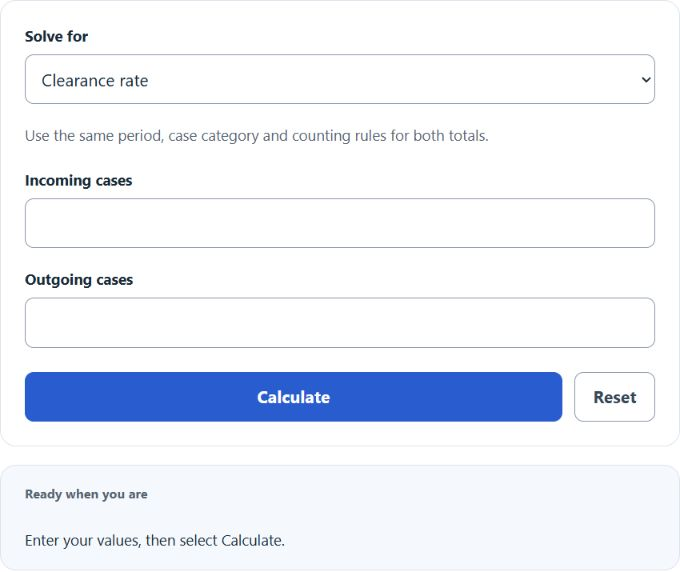
Calculate case clearance rate, incoming cases, or outgoing cases from any two values with this calculator for case processing reports and analysis.
Related Calculators
- Close Rate Calculator
- Completion Rate Calculator
- Response Rate Calculator
- Average Rate Calculator
- Rate Per 100,000 Calculator
- All Business Calculators
Case Clearance Rate Formula
The case clearance rate compares the number of outgoing cases to the number of incoming cases over the same time period. It is usually shown as a percentage.
- CCR = case clearance rate, as a percentage
- O = total number of outgoing cases
- I = total number of incoming cases
If you need to solve for outgoing cases instead, the formula is rearranged as:
If you need to solve for incoming cases instead, the formula is rearranged as:
Select the value to solve, enter the two shown quantities, and select Calculate. Use whole observed case counts, a positive incoming count and the same reporting period. Inverse answers can be fractional algebraic estimates; they do not invent whole cases. Zero incoming makes the rate undefined, and a zero rate cannot uniquely determine incoming cases.
Interpreting Case Clearance Rate Results
A case clearance rate, defined by NCSC CourTools as outgoing cases divided by incoming cases, indicates whether case processing is keeping up with new volume. It does not measure quality or time to resolution. Pending caseload also depends on transfers, reopened cases and other adjustments.
| Case Clearance Rate | Meaning | Typical Interpretation |
|---|---|---|
| Below 100% | Outgoing cases are fewer than incoming cases | Pending caseload may be increasing |
| 100% | Outgoing cases equal incoming cases | Pending count is level if there are no other case-flow adjustments |
| Above 100% | Outgoing cases are greater than incoming cases | Backlog or pending cases may be decreasing |
Common Case Clearance Inputs
| Input | What to Count | Important Note |
|---|---|---|
| Incoming cases | New cases received during the period | Use the same date range as outgoing cases |
| Outgoing cases | Cases closed, disposed, completed, or otherwise resolved | Use the same definition consistently |
| Clearance rate | Outgoing cases divided by incoming cases, multiplied by 100 | A rate above 100% is possible |
Example Calculations
Example 1: Calculate the case clearance rate
You have 800 incoming cases and 760 outgoing cases.
The case clearance rate is 95%. This means fewer cases were cleared than received during the period.
Example 2: Calculate outgoing cases
You have 1,200 incoming cases and a case clearance rate of 105%.
The total number of outgoing cases is 1,260.
FAQ
What is a good case clearance rate?
A case clearance rate of 100% means outgoing cases equal incoming cases. In many settings, this is the minimum target for keeping caseload from growing. A rate above 100% means more cases were cleared than received, which can help reduce a backlog.
Can a case clearance rate be over 100%?
Yes. A rate over 100% means the number of outgoing cases is greater than the number of incoming cases for the same period. For example, if 500 cases come in and 550 cases go out, the clearance rate is 110%.
Why do incoming and outgoing cases need to use the same time period?
The rate is only meaningful when both values cover the same period, such as one month, one quarter, or one year. If incoming cases are counted for a year but outgoing cases are counted for a month, the result will not describe actual case clearance performance.