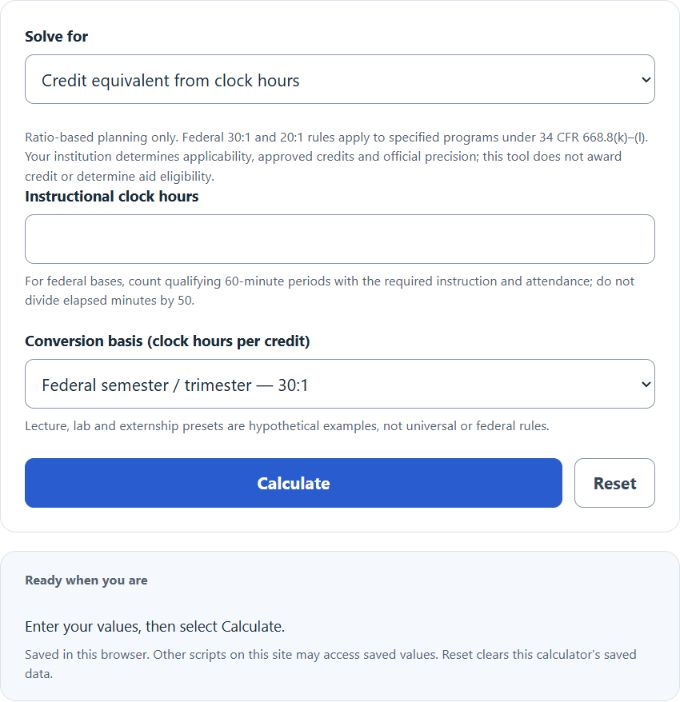
Estimate a credit equivalent, instructional clock hours, or a weekly schedule using a named federal specified-program basis, a hypothetical institutional example, or your institution’s custom ratio.
- All Unit Converters
- Credit Hours To Credit Points Calculator
- Credit Hours To Semester Hours Calculator
Clock Hours to Credit Hours Formula
There is no universal conversion. Select the applicable clock-hours-per-credit ratio R, then divide instructional clock hours H by R. The federal 30:1 semester/trimester and 20:1 quarter ratios apply only to programs subject to 34 CFR 668.8(k)–(l), with specified exceptions and additional limits. Other institutional policies may differ.
Variables:
- CH is the arithmetic credit equivalent before approved-credit caps and official precision rules.
- H is instructional clock hours under the selected definition. Qualifying federal clock hours are periods meeting 34 CFR 600.2 requirements.
- R is the selected clock-hours-per-credit ratio, such as 30 or 20 for applicable federal conversions.
- Policy limits include approved academic-credit caps and official institutional precision rules.
For a program subject to the federal semester/trimester conversion, at least 30 qualifying instructional clock hours are required per credit. Quarter conversion uses at least 20. The lecture 15:1, lab 30:1 and externship 45:1 choices are hypothetical institutional examples, not universal rules. Federal clock-hour periods are not obtained by simply dividing elapsed instructional minutes by 50.
| Clock Hours | Credit Hours |
|---|---|
| 15 | 0.50 |
| 30 | 1.00 |
| 45 | 1.50 |
| 60 | 2.00 |
| 75 | 2.50 |
| 90 | 3.00 |
| 105 | 3.50 |
| 120 | 4.00 |
| 135 | 4.50 |
| 150 | 5.00 |
| 165 | 5.50 |
| 180 | 6.00 |
| 210 | 7.00 |
| 225 | 7.50 |
| 240 | 8.00 |
| 270 | 9.00 |
| 300 | 10.00 |
| 360 | 12.00 |
| 450 | 15.00 |
| 600 | 20.00 |
| Arithmetic example only: credit equivalent = clock hours ÷ 30. Confirm program applicability, approved academic-credit caps and official precision with your institution; do not round up to increase Title IV eligibility. | |
What are Clock Hours and Credit Hours?
Under 34 CFR 600.2, qualifying classroom and supervised laboratory clock hours generally contain 50–60 instructional minutes within a 60-minute period and must satisfy applicable attendance requirements. A general academic credit hour concerns institutionally approved student work, including instruction and outside work; it is not merely a conversion of classroom minutes. The specified-program federal conversion is separately governed by 34 CFR 668.8(k)–(l). The 2026–27 Federal Student Aid Handbook explains course-by-course conversion, approved-credit caps and precision rules. This calculator does not determine credit awards, transferability or aid eligibility.
How to Calculate Clock Hours to Credit Hours?
Use these steps for an arithmetic estimate on a selected basis. Institutional and program approval remains separate.
- Determine instructional clock hours (H) using the definition and attendance requirements of the applicable policy.
- Select the applicable clock-hours-per-credit ratio (R); confirm whether a federal specified-program conversion or institutional policy applies.
- For reverse conversion use clock hours = credits × R. At a federal basis, this gives the ratio’s minimum instructional hours, not all required student work.
- Compute the arithmetic credit equivalent: CH = H ÷ R. Official conversion is course by course and may be capped by approved academic credits.
- For a schedule, divide total clock hours by instructional weeks, then scheduled days per week. Displayed decimals are approximate and do not implement official award or reporting precision.
Example Problem :
For an illustrative specified-program semester conversion, select R = 30 qualifying instructional clock hours per credit. Confirm applicability before using it for an actual program.
Total clock hours (H) = 45
The arithmetic equivalent is CH = 45 ÷ 30 = 1.5 semester credits before approved-credit caps and official precision rules. This does not mean the institution awards 1.5 credits.