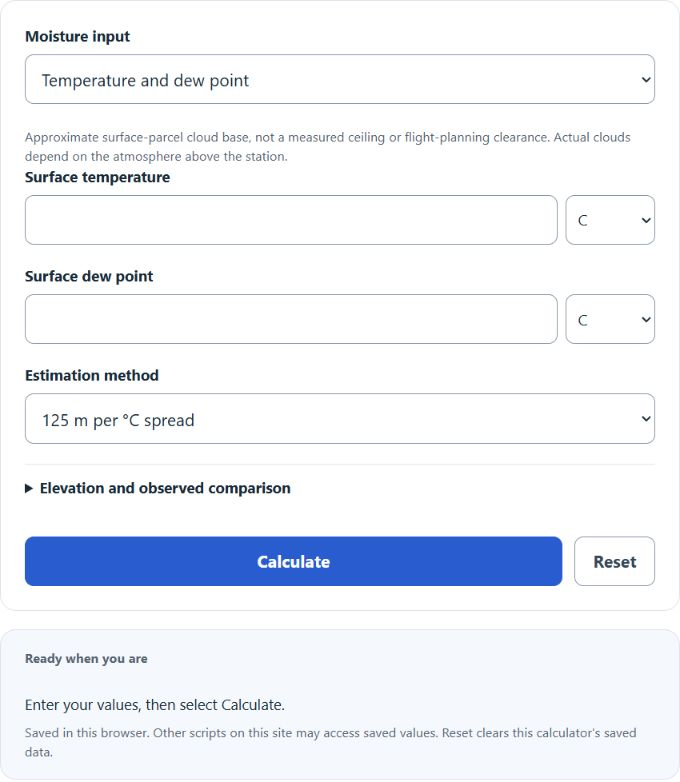
Calculate cloud base height from temperature and dew point or humidity, in °C or °F, as feet or meters above ground, with optional altitude above sea level.
- Every Day Life And Education Calculators
- Oxygen Saturation At Altitude Calculator
- Pivotal Altitude Calculator
Calculator Functions
| Function | What it does | What it requires |
|---|---|---|
| Temperature and dew point | Estimates the height of the cloud base above the ground from the spread between temperature and dew point | Requires the surface temperature, the surface dew point and an estimation method |
| Temperature and relative humidity | Works out the dew point from the humidity first, then estimates the cloud base | Requires the surface temperature, the relative humidity and an estimation method |
Temperatures can be in °C or °F. The estimation method is 125 m per °C of spread, the FAA rule of 1,000 ft per 4.4 °F, or the Bolton method. The answer is the height above ground level (AGL) in meters and feet. An optional station elevation adds the altitude above mean sea level (MSL), a terrain elevation compares the base with higher ground, and an observed cloud base shows how far off the estimate is.
Cloud Height Formulas
| H | Cloud base height above the ground (m) |
| T | Air temperature near the surface (°C) |
| Td | Dew point near the surface (°C) |
Rising air cools faster than its dew point falls, and cloud forms at the height where the two meet. That height, the lifting condensation level, is the base of cumulus cloud, and it is close to 125 m for each °C of spread [1]. The rule is accurate to about ±2% for temperatures of 0 to 30 °C and relative humidity above 50% [1].
Temperature and dew point
At 24 °C with a dew point of 16 °C the spread is 8 °C, and the estimated cloud base is 125 × 8 = 1,000 m, or 3,281 ft, above the ground. The dew point cannot be higher than the temperature. When the two are equal the answer is 0, which means the air at the surface is saturated.
FAA rule in Fahrenheit and feet
Here the temperatures are in °F and the height is in feet. Unsaturated air cools 5.4 °F per 1,000 ft as it rises while its dew point drops 1 °F, so the two close at 4.4 °F per 1,000 ft [2]. At 85 °F with a dew point of 71 °F, the spread of 14 °F gives 14 ÷ 4.4 × 1,000 = 3,182 ft [2]. The two rules agree closely: 125 m per °C is 228 ft per °F, and the FAA rule is 227 ft per °F.
Bolton method
ln(T ÷ Td) ÷ 800) + 56
TL is the temperature at which the lifted air becomes saturated, with all three temperatures in kelvin. The height is the cooling needed to reach it divided by the dry lapse rate of 9.8 °C per km. For 24 °C and 16 °C it gives 1,004 m, within half a percent of the 125 m rule.
Temperature and relative humidity
(17.625 − γ) [1]
17.625 × T ÷ (243.04 + T) [1]
RH is the relative humidity in percent and the temperatures are in °C. The constants are for saturation over water and hold to within 0.4% from −40 to 50 °C [1]. At 25 °C and 60% humidity the dew point is 16.7 °C, a spread of 8.3 °C and a cloud base of about 1,038 m. As a quick check, the dew point is about 1 °C below the temperature for every 5% that the humidity is below 100% [1], which gives 17 °C here.
Altitude above sea level
A cloud base 1,000 m above a station at 500 m elevation is at 1,500 m MSL. With a terrain elevation entered, the calculator shows whether that altitude is above or below the terrain, assuming the base is level.
How to Calculate Cloud Base from Temperature and Dew Point
Subtract the dew point from the air temperature. In °C, multiply the difference by 125 for the cloud base in meters above the ground [1]. In °F, divide the difference by 4.4 and multiply by 1,000 for feet [2]. At 75 °F with a dew point of 60 °F the spread is 15 °F, and 15 ÷ 4.4 × 1,000 = 3,409 ft. Add the elevation of the place where the readings were taken for the altitude above sea level.
Limits of This Estimate
- The estimate is for cumulus cloud formed by air rising from the surface. Layer cloud, cloud carried in by a front and cloud above an inversion have bases that surface readings do not predict.
- It is not a measured ceiling. Reported cloud bases and ceilings come from instruments and observers, and flight decisions need actual observations and briefings.
- A dew point error of 1 °C moves the answer by about 125 m (410 ft). Humidity read indoors or in direct sun gives a poor dew point.
- The Bolton method uses a fixed lapse rate of 9.8 °C per km and is given here without a published check of its accuracy. These estimates are based on the best available data and estimations.
Sources
- Lawrence, The Relationship between Relative Humidity and the Dewpoint Temperature in Moist Air, Bulletin of the American Meteorological Society, 2005: the 125 m per °C cloud base rule and its accuracy, and the dew point formula and constants
- Federal Aviation Administration, Pilot’s Handbook of Aeronautical Knowledge, Chapter 12: the 4.4 °F per 1,000 ft convergence rate and the cloud base example