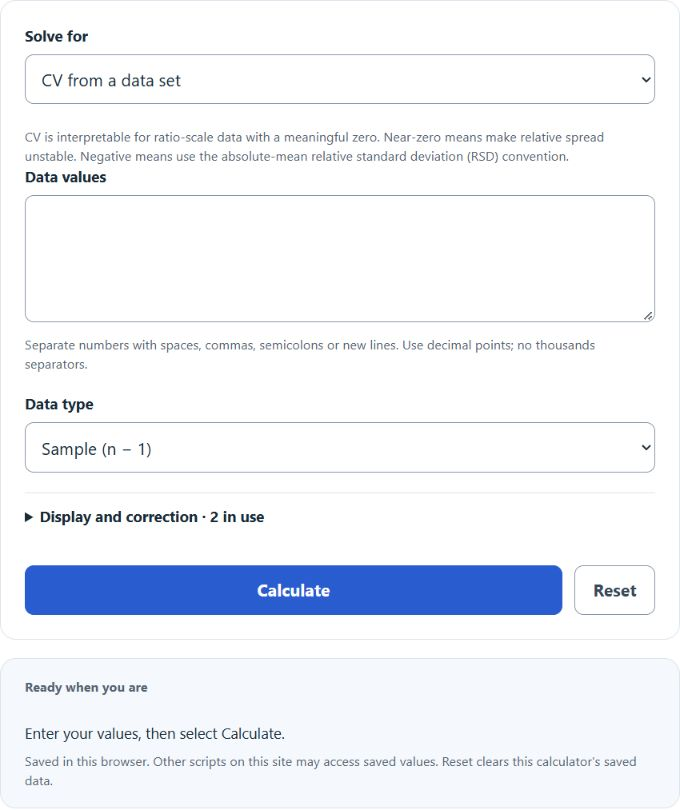
Calculate the coefficient of variation (CV) from a data set or from a known mean and standard deviation, and compare the variability of two data sets as a percentage.
Coefficient of Variation Formula
The coefficient of variation expresses the standard deviation as a percentage of the mean. It compares relative spread for meaningful-zero ratio-scale data, including equivalent unit systems; different measurement scales or near-zero means can make comparisons misleading.
CV = (s / x̄) * 100
When you work with a full population, you use the population standard deviation instead of the sample standard deviation:
CV = (σ / μ) * 100
The standard deviation itself comes from the variance. The sample version divides by n - 1 and the population version divides by n:
s = sqrt( Σ(xᵢ - x̄)² / (n - 1) )
σ = sqrt( Σ(xᵢ - μ)² / n )
For normally distributed samples, the optional first-order correction gives an approximate bias-adjusted estimate. It is not universally or exactly unbiased and is not applied to population or summary mode:
CV* ≈ CV * (1 + 1 / (4n))
Where:
- CV is the coefficient of variation, reported as a percentage.
- s is the sample standard deviation, and σ is the population standard deviation.
- x̄ is the sample mean, and μ is the population mean.
- xᵢ is each individual value in the data set.
- n is the number of values in the data set.
- CV* is the approximate normal-sample corrected coefficient of variation.
The calculator has data-set, known-summary and two-data-set comparison modes. Select sample (n - 1) or population (n) for raw data. Optional settings control decimal places and show an approximate normal-sample correction for sample data only. Negative means retain the absolute-mean RSD convention, RSD = 100 × SD / |mean|, with interpretation limits.
Interpreting the Coefficient of Variation
For positive means on a suitable ratio scale, a higher CV means greater relative spread. No universal quality cutoff applies. The table below gives numerical interpretations, not acceptable/unacceptable classifications.
| Coefficient of Variation | Numerical meaning |
|---|---|
| Below 10% | Standard deviation below 10% of the mean |
| 10% to 20% | Standard deviation from 10% to 20% of the mean |
| 20% to 30% | Standard deviation from 20% to 30% of the mean |
| Above 30% | Standard deviation above 30% of the mean |
The next table shows which formula to choose based on what your numbers represent.
| Your Data | Use | Divisor |
|---|---|---|
| A subset drawn from a larger group | Sample | n - 1 |
| Every member of the group | Population | n |
Example Problems
Example 1. You have the sample data set 12, 8, 10, 14, 8, 21. The mean is 12.167. The sample standard deviation (using n - 1) is about 4.916. The coefficient of variation is:
CV ≈ (4.915960 / 12.166667) * 100 ≈ 40.4052%
The standard deviation is about 40.4052% of the positive mean. Suitability depends on the measurement scale and context.
Example 2. A process has a known mean of 50 and a standard deviation of 7.5. You already have both numbers, so you use the mean and standard deviation mode:
CV = (7.5 / 50) * 100 = 15%
A CV of 15% means the standard deviation is 15% of the positive mean; it does not by itself establish process quality.
Frequently Asked Questions
Why use the coefficient of variation instead of the standard deviation?
The standard deviation has the units of the data. Dividing by a positive mean removes those units and gives relative spread. CV is invariant to positive unit scaling, but adding an offset, as in Celsius-to-Fahrenheit conversion, changes it. Comparisons still require a meaningful zero and suitable subject-matter context.
Should I use the sample or population formula?
Use the population formula (divide by n) only when your numbers include every member of the group you care about. If your data is a sample taken from a larger group, use the sample formula (divide by n - 1), which corrects for the tendency of small samples to underestimate spread. Choose the denominator that matches the population and sampling question.
When is the coefficient of variation not useful?
The CV is unreliable when the mean is near zero, because dividing by a tiny mean inflates the result, and it loses its meaning entirely when the mean is exactly zero. It also works best on ratio-scale data with a true zero point. For data that can be negative or that sits on an interval scale, such as temperature in Celsius, the coefficient of variation can be misleading.