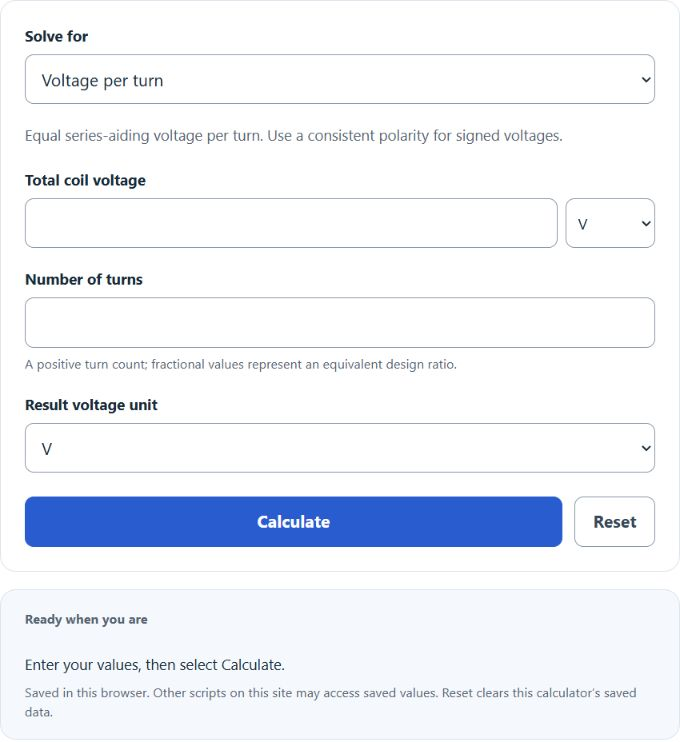
Select voltage per turn, total coil voltage or equivalent turn count, then enter the two required values. Voltage inputs and results support V, mV and kV.
- All Physics Calculators
- All Electrical Calculators
- Secondary Voltage Calculator
- Tap Voltage Calculator
- Transformer Voltage Calculator
- Coil Length Calculator
Coil Voltage Formula
The calculator uses total voltage = number of turns × voltage per turn, assuming equal series-aiding contributions. Here, “coil voltage” in CV means voltage per turn, not total terminal voltage. Use a consistent polarity for signed voltage inputs. This relationship does not independently predict induced emf, which requires the rate of change of magnetic flux, or model winding impedance and insulation limits.
- CV = coil voltage, or voltage per winding
- TV = total voltage across the coil windings
- N = number of coil windings
The calculator can solve for any one missing value when you enter the other two:
- Calculate coil voltage: divides total voltage by the number of windings.
- Calculate total voltage: multiplies the number of windings by the coil voltage.
- Calculate number of windings: divides total voltage by coil voltage.
Voltage Unit Conversions
The calculator converts voltage entries to volts before applying the formula, then converts the result back to the selected output unit.
| Unit | Symbol | Equivalent in volts |
|---|---|---|
| Millivolt | mV | 1 mV = 0.001 V |
| Volt | V | 1 V = 1 V |
| Kilovolt | kV | 1 kV = 1000 V |
Common Coil Voltage Relationships
| Total voltage | Number of windings | Coil voltage per winding |
|---|---|---|
| 12 V | 6 | 2 V |
| 24 V | 12 | 2 V |
| 120 V | 60 | 2 V |
| 240 V | 120 | 2 V |
Example Problems
Example 1: Calculate coil voltage
You have a total voltage of 120 V and 40 coil windings.
The coil voltage is 3 V per winding.
Example 2: Calculate total voltage
You have 75 windings and a coil voltage of 2.5 V per winding.
The total voltage is 187.5 V.
FAQs
What does coil voltage mean in this calculator?
Coil voltage means the voltage per winding. If the total voltage is spread evenly across the windings, you divide the total voltage by the number of windings to get the voltage for one winding.
Why do I need to enter exactly two values?
Select the quantity to solve for and enter the other two values. Turn count must be positive. Zero voltage is valid for the forward voltage calculations, but two zero voltages do not determine a unique turn count.
Can the number of windings be a decimal?
The calculator accepts decimal values, but physical coil windings are usually whole numbers. A decimal winding result can still be useful during design calculations, but the final coil design normally needs to be adjusted to a practical whole number of turns.