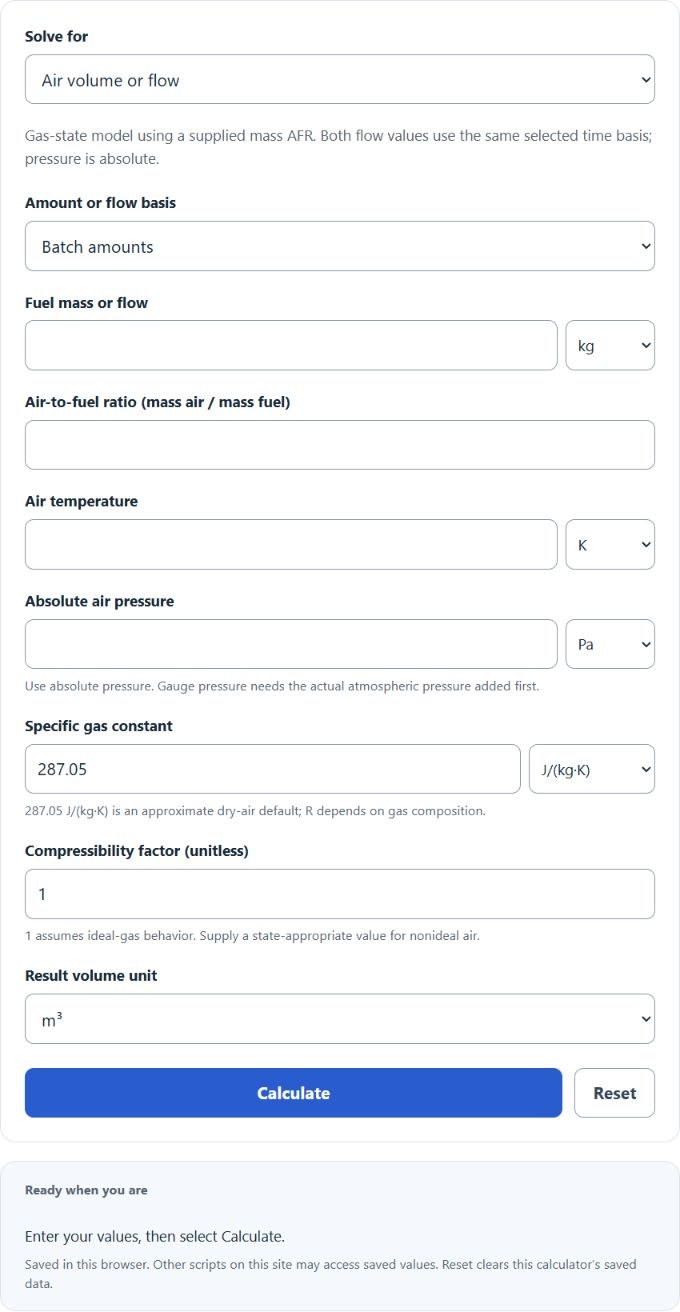
Calculate combustion air volume from fuel mass, air-to-fuel ratio, temperature, pressure, gas constant, and compressibility factor.
Related Calculators
- Adiabatic Flame Temperature Calculator
- Gas Volume Calculator
- Van Der Waals Equation Calculator
- Kg To Moles Calculator
- All Chemistry Calculators
Combustion Air Formula
The calculator converts a supplied mass-based air-to-fuel ratio into air volume at the specified gas state. It uses PV = m_air ZRT, reducing to the ideal-gas equation when Z=1; see NASA’s mass-specific equation of state and the NIST compressibility-factor definition. R and Z must suit the gas composition and state. It does not determine an appropriate AFR, size appliance air openings, ventilation, ducts or fans, or verify safe combustion.
Rearranged forms used by the selected solve mode:
- m_air = mass of combustion air
- m_fuel = fuel mass or fuel mass flow
- AFR = air-to-fuel ratio on a mass basis, such as kg air per kg fuel
- V_air = combustion air volume or volumetric flow
- Z = compressibility factor
- R = specific gas constant of air
- T = absolute combustion air temperature
- P = absolute combustion air pressure
Select one of the seven quantities to solve and enter the other six. Choose batch amounts or one common flow time basis for fuel mass flow and air volume flow. Flow inputs and outputs must share that basis; a standard or reference volume is not automatically an actual volume at the entered conditions. All SI gas-state quantities must be positive, including temperature above 0 K. The editable defaults R=287.05 J/(kg·K) and Z=1 assume approximate dry-air and ideal-gas properties; they are not measurements of your system.
Temperature is converted internally to kelvin, pressure to pascals, fuel mass to kilograms, gas constant to J/(kg·K), and air volume to cubic meters before the calculation is made.
Typical Air-to-Fuel Ratios and Input Reference Values
Pure-gas ratios below assume dry air. Gasoline and diesel ratios vary with composition and blending; use fuel-specific data. These theoretical ratios exclude excess air and do not specify an appliance’s required combustion-air supply. Pure-fuel values follow balanced reactions with a dry-air oxygen mass fraction of 0.2314 (NASA CR-145328). Fuel composition matters for automotive AFR (SAE J1829); 14.5 is a petroleum-diesel reference in ORNL’s report, p.224. Actual systems may use excess air; use the intended actual AFR, consistent with DOE combustion guidance.
| Fuel | Approximate Stoichiometric AFR by Mass (kg air/kg fuel) | Notes |
|---|---|---|
| Methane | 17.2 kg air/kg fuel | Main component of natural gas |
| Propane | 15.7 kg air/kg fuel | Common LPG fuel |
| Gasoline — nonoxygenated reference | 14.7 kg air/kg fuel | Composition-dependent reference, not a universal gasoline rating |
| Diesel — petroleum reference | 14.5 kg air/kg fuel | Approximate value, varies by composition |
| Hydrogen | 34.3 kg air/kg fuel | High AFR because hydrogen has low molecular weight |
| Quantity | Common Value | Use in the Calculator |
|---|---|---|
| Specific gas constant of air | 287.05 J/(kg·K) | Use for dry air in SI units |
| Atmospheric pressure | 101,325 Pa, 1 atm, or 14.696 psi | Enter absolute pressure, not gauge pressure |
| Room temperature | 20°C, 68°F, or 293.15 K | Temperature is converted to kelvin internally |
| Compressibility factor near ambient conditions | About 1.0 | Use 1.0 for ideal-gas air at low pressure |
Example Calculations
Example 1: Calculate combustion air volume
You burn 2 kg of methane and use an air-to-fuel ratio of 17.2 kg air/kg fuel. Air is at 20°C and 1 atm. Use R = 287.05 J/(kg·K) and Z = 1.
The modeled air volume at the stated conditions is about 28.57 m³.
Example 2: Calculate fuel mass from air volume
You have 10 m³ of combustion air at 300 K and 101,325 Pa. The air-to-fuel ratio is 14.7, R = 287.05 J/(kg·K), and Z = 1.
The corresponding fuel mass is about 0.800 kg.
FAQ
Should pressure be absolute or gauge pressure?
Use absolute pressure. If you have gauge pressure, add atmospheric pressure before entering it. For example, 0 psig at sea level is about 14.7 psia, 1 atm, or 101,325 Pa.
What value should you use for compressibility factor?
For air near atmospheric pressure and ordinary temperatures, use Z = 1. At high pressure or unusual temperature conditions, use a compressibility factor appropriate for the air state. At fixed other inputs, a higher Z increases calculated air volume and a lower Z decreases it. The calculator does not derive Z from temperature, pressure or composition.
Is the air-to-fuel ratio stoichiometric or with excess air?
Enter the actual mass-based air-to-fuel ratio you want to model. If you are calculating theoretical combustion air, use the stoichiometric AFR. If the burner, furnace, or engine uses excess air, enter a higher AFR that includes that excess air.