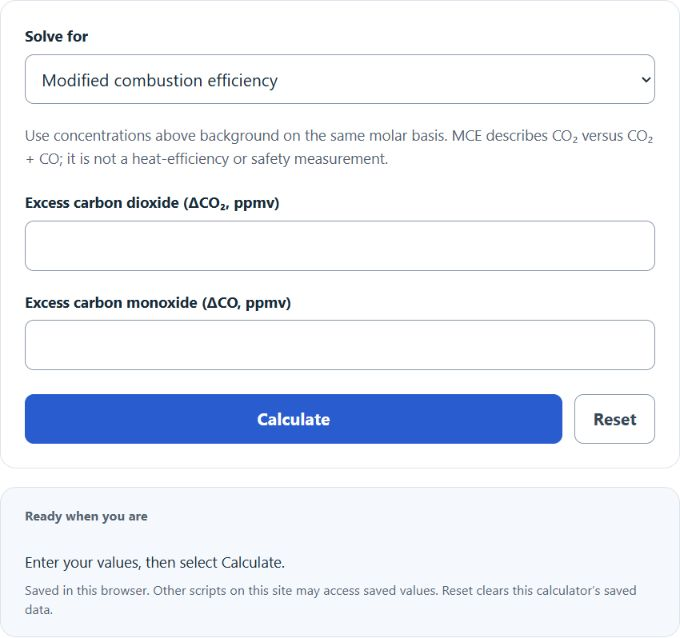
Calculate modified combustion efficiency from excess CO2 and CO, or select a concentration to solve from MCE and the other concentration in ppmv.
Note: MCE is a combustion completeness metric based on CO and CO2. It is not the same as the thermal combustion efficiency used for boilers/furnaces (which is based on useful heat output versus fuel energy input).
- All Chemistry Calculators
- All Efficiency Calculators
- Steam Turbine Efficiency Calculator
- Fan Efficiency Calculator
Modified Combustion Efficiency (MCE) Formula
The calculator uses excess carbon dioxide and excess carbon monoxide to calculate modified combustion efficiency. “Excess” means the measured concentration above the background concentration.
- MCE = modified combustion efficiency, as a percent
- ΔCO2 = excess carbon dioxide concentration, in ppmv
- ΔCO = excess carbon monoxide concentration, in ppmv
If you enter ΔCO2 and ΔCO, the calculator solves directly for MCE.
- e = MCE divided by 100
- ΔCO2 = excess carbon dioxide concentration, in ppmv
- ΔCO = excess carbon monoxide concentration, in ppmv
Select excess carbon dioxide to solve from MCE and ΔCO. For positive ΔCO, MCE may be 0% but must be below 100%. If ΔCO is zero, the inverse is impossible or nonunique.
- e = MCE divided by 100
- ΔCO = excess carbon monoxide concentration, in ppmv
- ΔCO2 = excess carbon dioxide concentration, in ppmv
Select excess carbon monoxide to solve from MCE and ΔCO2. For positive ΔCO2, MCE must be above 0% and may equal 100%, yielding zero ΔCO. If ΔCO2 is zero, the inverse is impossible or nonunique.
Illustrative MCE Bands
MCE is often used to describe how completely carbon in fuel is converted to CO2 instead of CO. Higher values indicate a larger CO₂ share of CO₂ plus CO. The bands below illustrate that ratio, not universal combustion categories; MCE alone does not establish the combustion condition. Other carbon species are omitted.
| MCE range | General interpretation | Combustion-condition limitation |
|---|---|---|
| 98% to 100% | Very high CO₂ share | Not determined by MCE alone |
| 95% to 98% | High CO₂ share | Not determined by MCE alone |
| 90% to 95% | Lower CO₂ share | Not determined by MCE alone |
| Below 90% | Greater CO share | Not determined by MCE alone |
Input Checks for MCE Calculations
| Value | Allowed input | Reason |
|---|---|---|
| ΔCO2 | 0 or greater | Excess concentration should not be negative. |
| ΔCO | 0 or greater | Excess concentration should not be negative. |
| MCE | 0% to 100% | MCE is a percentage of carbon emitted as CO2 relative to CO2 plus CO. |
| Solving for ΔCO or ΔCO2 | With positive known CO: 0% ≤ MCE < 100%. With positive known CO₂: 0% < MCE ≤ 100%. | The relevant denominator must be nonzero; a zero known concentration needs a separate impossible/nonunique check. |
Example Calculations
Example 1: Calculate MCE from ΔCO2 and ΔCO
Suppose you measured:
- ΔCO2 = 1800 ppmv
- ΔCO = 90 ppmv
The modified combustion efficiency is 95.24%.
Example 2: Calculate ΔCO from MCE and ΔCO2
Suppose you know:
- MCE = 96%
- ΔCO2 = 2400 ppmv
First convert MCE to a decimal:
Then solve for ΔCO:
The excess carbon monoxide concentration is 100 ppmv.
FAQ
What does modified combustion efficiency mean?
Modified combustion efficiency is the percentage of emitted carbon, counted as CO2 and CO, that appears as CO2. A higher MCE means more of the carbon was oxidized to CO2, which usually indicates more complete combustion. A lower MCE means a larger share of carbon was emitted as CO, which usually indicates more incomplete combustion.
Why does the formula use excess CO2 and excess CO?
The formula uses excess concentrations so background air does not distort the result. To get excess concentration, subtract the background concentration from the measured plume concentration. For example, if plume CO is 125 ppmv and background CO is 2 ppmv, then ΔCO is 123 ppmv.
Can MCE be exactly 100%?
MCE can equal 100% only when ΔCO is 0 and ΔCO2 is greater than 0. In real combustion measurements, a value near 100% may occur for very efficient combustion, but exact 100% is uncommon because some CO is usually present. When solving for ΔCO with positive ΔCO2, 100% is valid and yields zero CO. When solving for ΔCO2 with positive ΔCO, 0% is valid and yields zero CO₂. The opposite endpoints have no finite solution; zero known concentrations may make the inverse nonunique or impossible.